
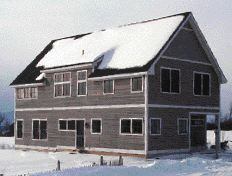
When I designed and built a house for my wife and me in the late ’90s, she gave me one instruction: “I don’t care what it looks like, I just want it to be warm.” Both of us had grown up and lived in “antique” houses infused with charm — and frigid drafts. We wanted to be comfortable in our new home.
The house would sit in a field, in a valley noted for high winds. The design was straightforward, a contemporary interpretation of a story-and-a-half farmhouse. But there were some twists: 48 windows, an open floor plan downstairs, and three bedrooms, two baths, and a central hall upstairs. Mix in a collection of family antiques to be placed against exterior walls, and the challenge of choosing a heating system robust enough to keep up with northern New England winters while occupying minimal wall space becomes apparent.
Choosing a Heating System
I also wanted a simple system, to keep maintenance costs down and because I planned to do much of the installation myself. I ruled out some systems immediately: electric baseboard, because it costs too much to operate in our climate, and hot-water baseboard, because it takes up too much space along outside walls, where we planned to place furniture. I also decided against forced hot air, which requires labor-intensive ductwork and, in my experience, is drafty and heats unevenly.
I took a close look at radiant floor heating. But my heat-loss calculations showed that I would need supplemental hot-water baseboard, so I nixed that idea. Radiant heating can also get costly because of the amount of PEX tubing required, as well as the need for mixing valves to lower the temperature of the water coming from the boiler.
High exposure.Loaded with windows and sitting in a windy valley in northern Vermont, the author’s new house had the potential to be cold and drafty. He chose hydronic panel radiators, which have provided even, comfortable heat through the first four winters. Panel radiators operate in the same range of temperatures as hot-water baseboard, but take up less wall space for a given Btu output.
A magazine ad led me to panel radiators. These compact wall-hung units promised to deliver the required Btus, could be flexibly located to work with furniture layout, and would connect to the boiler with easily installed polyethylene tubing. Panel radiators operate at the same high temperature output as hot-water baseboard, so there’s no need for additional mixing valves to lower the water temperature, as with radiant floor heating. Another benefit of panels is that they are simple to zone, by connecting two or more together in the same circuit and fitting one with a TRV, or thermostatic radiator valve — a reasonably priced nonelectric control valve. For example, if we wanted to keep the master bedroom cooler than the system operating temperature of 68°F, the bedroom’s three panel radiators could be looped together and controlled by a single TRV, which would lower the room’s temperature by restricting the amount of hot water flowing through the radiators. This in effect would create a separate zone in the bedroom.
System Components
One of the nice things about building your own home is that you can try new techniques without having to convince the client. After researching panel radiators, I was sure they were the right choice. I wasn’t really taking any risk, because they have been used successfully in Europe for years.
Panels. The radiator I selected is made by Veha, a Belgian company, and distributed in the U.S. by Windy Ridge Corp. (800/639-2021, www.veha.com). Most of the information you need to select and price the panels can be found right at the website. Panels are available in two thicknesses and many sizes to match the heating needs of various spaces. Besides the standard radiators I chose, you can get flat-panel radiators that double as towel warmers. The radiators come standard with a baked-on white enamel finish and can be professionally painted if you want other colors.
Veha isn’t the only manufacturer of panel radiators. At least three other European companies, Buderus, Myson, and Runtal, have American distributors. They all offer similar products with various individual features, and all offer towel warmers (see “Panel Radiator Manufacturers” at the end of the article).
Boiler. I chose a Buderus G115 (800/283-3787, www.buderus.net), a cast-iron boiler from a company with a reputation for high-quality workmanship. I went with the direct-vent option to avoid the expense of a chimney. I capped the exhaust vent with an aerofoil cowl to minimize the effect of head-on wind blasts. A fresh-air intake pulls in outside air rather than consuming basement air. On the advice of my plumber, I added a Stor-Ex (800/221-1522, www.dhtnet.com) indirect water heater off the boiler for domestic hot water.
What could be simpler?The heart of the heating system is the Buderus direct-vent boiler. The primary loop feeds the indirect hot water tank and the main heating manifold, which supplies hot water to secondary manifolds upstairs.
Controls. The brains of the heating system reside in a small blue box that sits on top of the boiler. The Ecomatic HS2105 (which has been superseded by the Logamatic HS2107) controller establishes a weekly heating schedule. It comes with nine factory-set heating programs that can be altered to suit personal preferences. It also automatically changes operation from winter to summer and controls domestic hot water production. Permanent memory of all program settings after power interruption guarantees that instructions do not have to be reset. A manual override switch allows temporary bypassing of the settings, while an LED panel provides information on current program settings as well as optional choices.
Controllers.The Buderus boiler control unit (top) senses outdoor temperature changes and signals the boiler accordingly. It also allows for flexible programming to fit any schedule. Heat zoning is effectively provided by equipping individual panel radiators or groups of radiators with a thermostatic radiator valve (bottom).
An outdoor sensor sends temperature readings to the controller so the boiler “anticipates” a call for heat. For example, if the outside temperature suddenly drops 20 degrees, the Ecomatic, which is programmed to expect a drop in temperature indoors as well, fires the boiler in advance to maintain a constant room temperature.
PEX tubing. Rather than use rigid copper tubing, I chose to use Kitec PEX-AL-PEX (Ipex, 800/463-9572, www.ipexinc.com), a type of PEX tubing that has a thin layer of aluminum laminated between two layers of polyethylene. The aluminum stiffens the tubing so that it retains its shape after bending (unlike standard PEX tubing, which springs back and must be clipped in place at frequent intervals). The presence of the aluminum also greatly reduces the thermal expansion and contraction of the tubing compared with standard PEX, which moves, sometimes noisily, as it heats up.
Flexible piping.Tucked away in upstairs closets, the manifolds (top left) distribute hot water to several “zones” — individual radiators or groups of radiators. The Kitec pipe cuts easily with a plastic pipe cutter (top right). The compression fittings require no special tools other than a simple reamer (above).
I purchased the manufacturer’s compression fittings (crimp fittings are also available), which simplified installation. The connectors tighten with wrenches and come in a variety of configurations to transition to threaded and sweat fittings. I also needed two manifolds, which I bought from Ipex, configured with compression fittings.
I bought three sizes of tubing: 3/4-inch for connecting the boiler output to the system’s two manifolds (one on each floor), 5/8-inch for connecting the first-floor panels to the first-floor manifold, and 1/2-inch for connecting the second-floor panels to the second-floor manifold. PEX-AL-PEX comes in 100-foot, 300-foot, and 1,000-foot rolls, so it’s easy to make “home run” connections without any intermediate couplings.
Installation
The Veha panel radiators hang from four L-shaped nylon brackets, which are lag-screwed to the wall. The location of the mounting rail on the back of the radiator varies according to the radiator’s size, so to speed layout I made a cardboard template for each of the five sizes of radiator I used. I made sure I had a stud or solid blocking for the brackets before the drywall went up.
I made similar templates to locate the supply and return line holes in the floor. (Panel radiators can be piped through the wall, but getting all the components — radiator and fittings — to line up is difficult.)
I spent two days pulling tubing (I have eight zones) and about two hours each hanging the radiators and making the connections to the PEX-AL-PEX. Setting up and piping the boiler, expansion tank, and circulators, as well as running the stainless-steel exhaust hosing, took about a week. A heating contractor spent a day hooking up the oil tank, connecting the Ecomatic controller, and firing up and testing the system.
I isolated each of the components — boiler, hot water tank, circulators — with shutoff valves so I can do maintenance as needed without draining or shutting down the entire system. I also added a low-water cutoff to shut off the boiler if there’s a leak, and a mixing valve to make sure the domestic water temperature never exceeds 120°F.
Performance
We originally set the heating cycle to the Ecomatic’s “family” setting, which pumped hot water through our system from dawn to midnight. This proved unnecessary because of our schedules, so we switched to the “single” setting, which supplies us with heat when we need it: early morning and late afternoon through the evening and throughout weekends. The change reduced our fuel bills noticeably. Nine settings are available to match various lifestyles.
I’ve been through four heating seasons now and have hardly had to fine-tune the system. Other than changing the program settings, the main adjustment has been to learn where to set the nonelectric thermostatic valves on the radiators. For example, the two smaller bedrooms are used for overnight guests, so we keep the heat shut down in those rooms until they are needed.
We like the looks of the panel radiators: They’re unobtrusive and blend in with the furnishings. The house heats evenly, with less than a 2°F variance throughout. And I have yet to hear a complaint from my wife about being cold.
Lee McGinley is a builder in Addison, Vt.
| Panel Radiator Manufacturers |
Buderus Hydronic Systems Salem, N.H. 800/283-3787 www.buderus.netMyson Colchester, Vt. 800/698-9690 www.mysoninc.comRuntal North America Ward Hill, Mass. 800/526-2621 www.runtalnorthamerica.comVeha Windy Ridge Corp. (U.S. distributor) Tamworth, N.H. 800/639-2021 |
| For More Information |
by John Siegenthaler, JLC, 5/98 Modern Hydronic Heating by John Siegenthaler Thomson Learning 800/998-7498 |


