
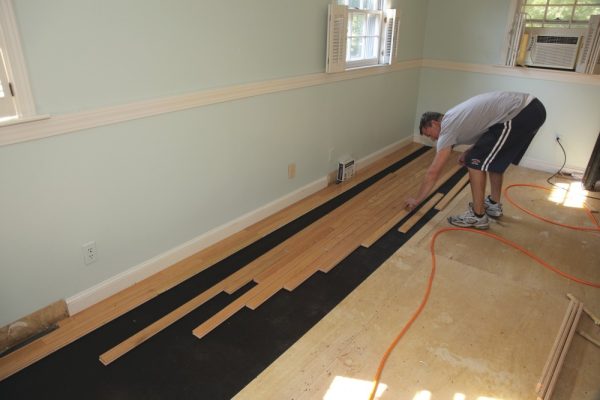
Q. Instead of tile, my clients want to install a wood-finish floor over the insulated concrete slab of a planned passive solar addition. They’ve also asked us to install tubing in the slab to give them the option of radiantly heating the space. But won’t wood flooring have a significant insulating effect that will diminish both solar heat gain and radiant heat transfer?
A. John Siegenthaler, a consulting engineer who specializes in hydronic-heating-system design in Holland Patent, N.Y., responds: For an in-floor radiant heating system, engineered-wood flooring can be a reasonable alternative to harder stone and tile, offering better dimensional stability and lower thermal resistance than solid-sawn lumber flooring. I usually specify prefinished 3/8-inch engineered-wood flooring that’s surface-glued to the heated slab, with unglued (rather than edge-glued) tongue-and-groove joints on all four edges. This kind of floor provides good heat transfer while allowing for very minor shrinkage without laterally stressing the wood. (See also: “A Radiant Panel Primer,” 3/16)
But if the space is designed to be used as a passive solar collector, keep in mind that even a relatively thin engineered-wood floor over the slab will significantly interfere with transfer of solar heat gains to the underlying concrete. A dark-colored tile, stone, or finished-concrete floor would be your best choice here.
In any case, radiant slab heating is not necessarily a good choice for a space that also experiences significant solar heat gain. If the heated floor keeps the space at a comfortable temperature at night, its thermal mass will be fully “charged” with heat when solar radiation comes through the window the following morning. The likely result will be overheating, because the floor slab simply can’t accept additional heat input while also allowing the room to remain comfortable.
Better choices for heating passive solar spaces include low-mass radiant wall or ceiling panels and steel-panel radiators, which respond quickly and won’t interfere with solar heat gain to the floor slab.


