- Q. What’s the best way to flash a skylight on a mission tile roof?
A.Craig Savage responds: Because of its fire resistance, tile is the predominant roofing here in Southern California. On these roofs we’ve done all our skylights using one of two basic methods, both of which have performed well (no callbacks yet).
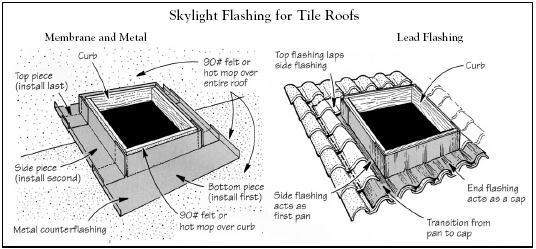
Membrane and metal. These days most local building codes call for a continuous membrane over the entire roof, with the tile over the top. We commonly use either 90-pound felt or a hot-mop, three-ply built-up roofing for this water barrier.
When we install a skylight, we start by framing in a 2×6 or 2×8 curb. The sides and ends of this curb get covered with the felt or the hot-mop tar. The felt or hot-mop then gets covered by formed metal flashing. The top, side, and bottom pieces of this flashing are shown in the illustration. Notice that water rolling down the sides and off the bottom of the metal flashing runs over the membrane and under the tile.
Lead flashing. If you don’t want to get involved with the continuous membrane on the roof, then you’ll have to opt for the expensive way to flash skylights. In this case, we install lead flashing that covers the curb and forms the first “pan” along the sides and top of the skylight. (Mission tile has both cap and pan tiles.) Near the bottom of the skylight, however, the lead has to transition from a pan to a cap, shedding water over the top of the row of tiles below the skylight. Ideally, you have a perfect, uncut cap tile starting on either side of the skylight over the lead flashing. But this method requires careful layout and a lot of time.
Craig Savage is a builder in Carpinteria, California.
Q&A: Flashing Tile Roofs
Flashing Tile Roofs
2 MIN READ