
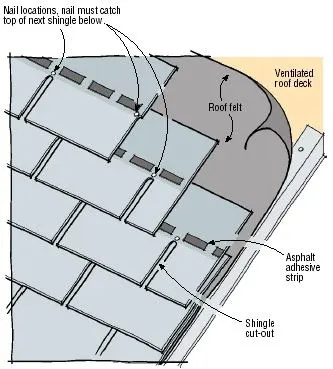
Q: Can asphalt shingles be nailed above the adhesive strip? I have seen leaking low-slope roofs with relatively new asphalt shingles, where the leaks followed the nailing pattern. In the attic, there were rows of drip holes in the cellulose insulation on the attic floor. In this case, the shingles were nailed below the line of the self-seal adhesive, according to the manufacturer’s instructions. (We use fiberglass shingles with a solid line of adhesive.) Wouldn’t it be better to nail above the adhesive, where no rain can blow up to get at the nail heads?
A: Architect and roofing consultant Harrison McCampbell responds: Asphalt shingles should always be installed according to the manufacturer’s instructions, which are usually printed on the shingle wrapper. Because the thickness, weight, and shape of shingles vary, manufacturer’s instructions vary slightly. But virtually all manufacturers agree that nails should be installed below the adhesive strip. To keep a warranty intact, follow the manufacturer’s nailing and installation instructions closely. If you deviate, whether you think it is a better installation or not, be prepared to roll with the directive from the manufacturer if there is a leak or performance question.
If you nail too low, nail heads can be exposed, with the potential for water entry. If you nail within the adhesive strip, the nail head cuts down on the amount of asphalt surface available to hold the shingle down.
If you nail too high (above the adhesive strip), the nails may miss the top of the next shingle underneath. Most people don’t realize that each nail holds down two shingles at once. If the nail is not at least 1/4 to 1/2 inch below the top of the shingle below, it may tear through. Proper nailing is especially important with the new ” dimensional” (thicker and heavier) shingles, which, if not nailed properly, have a tendency to slide.
In the case of the dripping nails, it is possible that the drips were caused by condensation, not roof leaks. If a roof is cold or snow-covered and the air in the attic is relatively warm and humid, condensation can form on the underside of the roof sheathing and drip from projecting nail points.
If the low-slope roof is actually leaking, the installation may have been incorrect. All shingle roofs should include a layer of unperforated organic (not fiberglass-based) felt underlayment. Shingles should not be installed on slopes of less than 4 in 12, unless specific issues have been addressed. This is both a code requirement and a requirement of most shingle manufacturers.


