
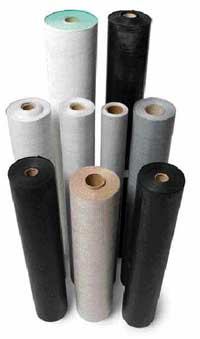
Not that long ago, plastic housewraps like Tyvek and Typar replaced organic felt paper as the standard siding underlayment. Now there’s a new generation of synthetic roofing underlayments poised to displace felt paper up on the roof. To find out whether their advantages justify their higher prices, I recently gathered together as many of these roofing membranes as I could find.
Along with roofing contractor Martin Elle, who’s a strong advocate of 30-pound felt-paper underlayment, I designed a simple field test to compare roofing underlayments from an installer’s point of view and get an idea of how they perform.
Why Not Stick With Felt Paper?
The primary job of any roofing underlayment is to keep the roof deck dry before the final roofing is installed. Underlayments also provide a secondary weather barrier in the event of wind-driven rain or damage to the roofing, and they improve fire resistance.
Clearly marketed as replacements for 15- and 30-pound roofing felt, synthetic underlayments have proven to be far tougher and more durable than organic felt when exposed to wind and sun, and they’re a lot lighter. Some of them, like Tri-Flex 30, have been around for many years, but most are relative newcomers to the United States, if not to Europe and Canada. Distribution is improving, but — based on my experience simply tracking them down for this survey — some underlayments may be hard to locate in your area.
Material. These underlayments are composed primarily of polypropylene (PP) and polyethylene (PE), synthetic polymers used to make everything from Tupperware to long underwear. Some manufacturers start with a layer of spunbonded PP, a nonwoven fabric, while others use a woven PP or PE fabric and then add extra coatings or laminations for better traction, UV and abrasion resistance, and other characteristics.
Because most types of PE have a much lower melting point than PP, underlayments made with PE fabrics or coatings tend to be more temperature-sensitive than their all-PP counterparts. When choosing an underlayment, it’s important to consider shrinkage and expansion, particularly in hot climates, since this cycling can stress and elongate fastener holes.
FelTex
• FelTex, a woven polypropylene fabric with a waterproof backing, comes in black or gray. Our rolls measured 4 feet by 250 feet, but smaller, 100-foot rolls are also available. Code compliance, manufacturer information, and lap lines are printed on the fabric; fastener locations are not.
While FelTex has a skid-resistant coating, I suspect that the weave of the fabric itself contributes most to traction. When I run my hand over the surface, it feels smoother along the length of the roll than across it, which feels quite rough. Also, the product feels hard underfoot, with no give to it. Although I used a section of FelTex diagonally above a valley and had no trouble walking on it, it’s definitely designed to be installed horizontally. Perhaps more important, we found that the shiny, woven surface of FelTex won’t take a chalk line at all. We noticed minor wicking at the laps on the mockup, with more where the FelTex lapped over the smooth peel-and-stick membrane. No weathering was apparent on the mockup. The FelTex never wrinkled on the mockup or on my roof.
Some manufacturers make products in lighter colors to help reduce surface temperatures during installation in hot climates, which should also help reduce cycling. And at least one manufacturer claims that because dark colors tend to show ice better and warm up faster, black underlayments are a good choice for colder climates.
Cost. Synthetic underlayments are more expensive than 30-pound felt, but not prohibitively so. Depending on variables like transportation costs and volume, prices range nationwide from $10 to $14 per square, with one exception (see chart). A few extra dollars may be worth it for an underlayment that won’t rot or tear like felt paper.
* Warranties are typically limited to materials only; check with manufacturer for terms and conditions.
Don’t Use Staples
It’s tempting to treat these new roof wraps like housewrap. I made this mistake at first, using 3/8-inch stainless steel staples in my T-50 stapler to hold my first roll of RoofTopGuard II down on a small house of my own that I was remodeling. Contrary to the manufacturer’s instructions, I also lapped the roof wrap over — instead of under — the eaves metal.
On the same project, I ended up short of material and finished off a small dormer on the front of the house with some leftover 30-pound felt.
After a couple of months of Pacific Northwest winter rain and wind, the felt disintegrated and blew off the dormer, while the roof wrap remained intact. I replaced the felt with Tri-Flex 30 and FelTex, and relied on these two roof wraps to protect the dormer roof deck for the rest of the winter. By May, when we finished roofing the house, all three underlayments were still in good shape.
Still, I learned that these manufacturers aren’t kidding when they say not to use staples as fasteners. This isn’t necessarily because the staples will tear through the roof wrap or pull loose from the decking; it’s because water — a lot of it — can get through the staple holes via capillary suction, commonly known as wicking.
The problem starts when a little water gets inside the holes and comes into contact with the slick underside of the roof wrap and decking. Adhesive intermolecular forces between the water and the two smooth surfaces create a gravity-defying film that draws more water in through the holes as it spreads outward. This happens with felt, too, but not to the same extent.
I discovered how serious the wicking can be when I pulled back several sections of roof wrap in search of the source of some water leakage. Blobs of butyl caulking (compatible with RoofTopGuard II) smeared on the staples solved the problem, but I was glad I’d left a large tarpaulin spread out inside the attic during tear-off, because it prevented leaks into the living space below. Instead of staples, you should use plastic or tin caps to hold these underlayments down.
Wicking at other locations. This house also had a pair of low-pitched shed-roof dormers, which I had covered with peel-and-stick membranes. I ran the membranes up the 8/12 slope of the main roof, then lapped the RoofTopGuard II over them. Wicking was a problem here, too, which I solved by caulking the lap with butyl caulking, leaving a few weep holes for drainage.
Polyprotector UDL
• Polyprotector UDL is a polyolefin-based, multilaminate underlayment sold in 39 3/8-inch-wide rolls (the shortest in our survey), each of which provides 948 square feet of net coverage. The distinctive light-adobe-colored woven top layer is printed with lap lines and fastener locations; it provides good traction, and shows and holds a chalk line well. On the underside, a fuzzy white spunbonded poly layer gives the roof wrap a grip on the roughness of the decking and just a little cushion, making this underlayment very comfortable to walk on. Polyprotector UDL is supposed to hold up for 180 days when left exposed, but it didn’t in our mockup. Our sample curled at the laps in the first few weeks, exposing the fuzzy underside, which is not UV-resistant. The fuzz held water and carried it up the underside of the roof wrap a bit, and eventually the fuzz at the laps disintegrated in the sun.
RoofShield
• RoofShield consists of a spunbonded layer of polypropylene coated on both sides with additional layers of PP. It comes in a number of colors and roll sizes. We used a bright green roll measuring 59 inches wide that provided about 800 square feet of coverage. The top surface is coarse, with a waffled pattern, making the material easy to walk on in wet or dry weather. The fuzzy white spun-poly layer on the underside grabs the decking and prevents wicking. Preformed corners for dormers and skylights are available, as are seam tape and adhesive. With a perm rating of 86.7, this underlayment is definitely vapor-permeable, and it shows and holds a chalk line well. Installed on a 12/12 roof in a high-traffic area, our sample showed virtually no wear, and the roofers reported no trouble walking on it. And while the maker recommends leaving this underlayment exposed for no more than four months, that number seems conservative: Our mockup looked like it would never wear out, even after seven months of exposure. This is a premium product, which is reflected by its premium price.
RoofTopGuard II
• Manufactured in Finland by Rosenlew RKW, this five-layer polyethylene/polypropylene fabric has a slick underside and a fuzzy, spunbonded polypropylene topside for better foot traction. The fabric is imprinted with top and bottom lap lines and fastener locations. We found that this roof wrap shrinks a bit when exposed to the sun, so it will wrinkle in the cool of the day; if it is installed in cool weather, it should be left loose in the valleys. It can be pulled tight without distorting, and it will hold a chalk line. If there is a weakness in this product, it lies in the fuzzy traction surface. While it tends to keep water from wicking at the laps by breaking the capillary action, it also can scuff, especially in high-traffic areas. The scuffs form woolly rollers, and when you step on them, down you go. This tendency to scuff increases with weathering, of course, but I noticed it even during installation. By the time I finished the shingles, I was really fed up with the scuffing.
Wicking also occurred where I had lapped the roof wrap over the metal drip edge at the eaves. Again, out came the caulking gun. Most roof-wrap installation instructions require that you extend the lower edge of the first course at least the thickness of the decking beyond the edge of the decking at the eaves. You then install the eaves metal over the roof wrap, bending the latter down to form a protective cover for the edge of the decking.
Unlike felt, roof wraps won’t crack when you fold them, and they won’t rot, so the roof wrap will probably outlast your eaves metal, especially if you’re using galvanized steel. Only with Tri-Flex 30 do you install the drip edge under the roof wrap.
There are a few other twists to working with these underlayments. First of all, put away your hook-bladed roofing knife: It won’t cut these roof wraps properly, and using it can even be dangerous. Instead, use a utility knife. If you keep a sharp blade in the knife, the roof wrap will cut effortlessly, just like housewrap. In fact, you have to be careful not to cut a piece you’ve already installed; the cuts can be so clean they’re invisible.
You’ll also need to give up roofing cement and other asphalt-based products; they aren’t compatible with these synthetics. Use a compatible caulk specified by the manufacturer, and follow the instructions for lapping.
Sharkskin
• There are two Sharkskin underlayments: Comp and Ultra. Unfortunately, we discovered them only after completing this study, so we were unable to test them in the field. Sharkskin Comp, directed at the asphalt-shingle roofing market, comes in 48-inch-by-250-foot 30-pound rolls. This light-gray underlayment is made with 100 percent polypropylene, which the manufacturer claims will neither expand nor contract with changes in temperature. The company also says the product can tolerate six months of UV exposure. Like the other underlayments, it installs with plastic or metal cap nails. It’s imprinted with 5 5/8-inch layout lines, which should help increase shingling speed. Intended for use under tile, metal, and slate roofs, Sharkskin Ultra is thicker, heavier, and more expensive; a 4-foot-by-250-foot roll weighs 45 pounds and allegedly delivers 12 months of UV resistance. Unlike the other underlayments in our survey, Sharkskin Ultra can be installed with 3/8-inch roofing nails, which means the fasteners won’t telegraph through a metal panel or get in the way of a batten strip. Both versions of Sharkskin have a patented nonslip surface, which the maker claims provides better traction than the surface of other underlayments. We hope to verify this in a future field test.
Vapor Permeability
With one exception, these synthetic underlayments aren’t vapor-permeable and should be used only on roofs with ventilated attic spaces. Nor should they be substituted for housewrap on exterior walls. The exception is VaproShield’s RoofShield, which is designed as a breathable waterproof membrane. (Actually, it’s the same product as the company’s WallShield.)
The other underlayments are classified as vapor retarders, with a perm rating of less than 1.0. (For reference, 15-pound organic felt paper has a minimum perm rating of around 5, though this number can rise in high-humidity conditions.)
Titanium-UDL
• A coated, woven polyolefin fabric manufactured in Canada, Titanium-UDL comes in black, white, and gray. Rolls are available in 3- and 4-foot widths and feature a 1/4-inch grid texture on the top surface for better traction on steep roofs. While we found that the textured surface worked well on the 5/12-slope roof we installed it on, we would have liked to have tested it on a steeper slope in wetter conditions. We found that this roof wrap will take a chalk line, but it can be rubbed off, leaving only a trace on the grid texture. The texture seems to prevent any serious wicking from occurring — although there was some wicking on our mockups where the roof wrap lapped the slick peel-and-stick membrane. InterWrap offers a companion peel-and-stick underlayment — Titanium-PSU — for low-pitched areas, which apparently has the same surface texture. We didn’t test it, but I suspect it would help reduce wicking. We found that Titanium-UDL lays flat and stays flat, and that it easily holds up to at least six months of UV exposure. Its plywood mockup still looks as good as the day we built it.
Tri-Flex 30
• Manufactured and marketed by Flexia Corp. in Canada for nearly 25 years, Tri-Flex 30 was purchased by W.R. Grace in 2004. Since then, it’s been sold in the U.S. under the Grace name. At 41 1/2 inches by 300 feet, each Tri-Flex 30 roll contains 1,037 square feet and provides a full 10 squares of coverage. Code compliance and lap lines are printed on the material’s face. The product comes in black, gray, and — for use in hot climates — a reflective white. The spunbonded polypropylene fabric is coated on both sides with layers of UV-stabilized polypropylene. A “tackifier” coating on the topside enhances traction and the underlayment’s ability to hold a chalk line. However, the snapped line may not remain entirely accurate: We found that this roof wrap tends to belly and distort if it’s pulled too tight, and it seems to expand and contract a little — like felt — so that it doesn’t always lie flat. While the surface coating started to show wear in the heavy-traffic areas of our mocked-up ridge, the panel showed no weathering at all. Wicking was not a problem.
Code Approvals and Warranties
All of these underlayments are approved for use under most applicable building codes, but a prudent builder will still want to verify that a specific product and use (for example, a severe-climate application) complies with local code. Shingle warranties and fire ratings are unaffected by their use, according to the shingle manufacturers we contacted.
Testing the Roof Wraps
To test the membranes under controlled conditions, we built a series of mockups using 4-foot-by-8-foot plywood sheets nailed to 2×3 “rafters.”
After fastening roof-wrap samples in place, we tipped the plywood mockups on end, so their bottom edges were held off the ground by the 2x3s, and leaned them up against a wall facing the sun.
We also formed a simulated ridge by nailing some plywood strips together and applying sections of all the roof wraps to them; we placed this structure on a walkway to Martin’s shop. He and his workers could walk over it as they went to and from the shop, which would allow us to check the underlayments’ traction and durability.
Typar RoofWrap 30
• If the sizes and specs for Typar RoofWrap 30 and Grace Tri-Flex 30 seem similar, it’s no coincidence. These two roof wraps are manufactured in the same Canadian facility, using the same type of spunbonded polypropylene fabric for the core. We found the working characteristics of RoofWrap 30 and Tri-Flex 30 to be virtually identical, although both Grace and Reemay assured us that there are proprietary differences between the two products. Of all the underlayments, Tri-Flex 30 and RoofWrap 30 look, behave, and feel more like felt than any of the others do. Finally, we sent samples of each roof wrap to job sites where Martin’s roofing company was working. The intention was to install these swatches on the part of the roof that would receive the most traffic during the roof installation. It may seem that this was the most important part of our experiment, but in actuality it was the least consistent. The conditions for each roof — especially the pitch — varied, as did weather conditions.
Moreover, since Martin rarely leaves underlayments exposed on the roof for more than two weeks, they weren’t exposed to the elements for very long.
After seven months of exposure to the weather and hundreds of trips across the mock ridge, we evaluated our test mockups. The results of the ridge traffic test were impressive: While there was some wear on all of the roof wraps, they remained watertight despite more foot traffic than they would ever actually receive on a job site.
As for the panels, even after seven months of exposure, none showed significant degradation.
In some cases, our roofers noted that it’s easier to walk on these roof wraps when they’re wet than when they’re dry — though that may be attributable to Portland’s air pollution, which seems to put oil in the air.
As one of Martin’s roofers put it, “These things aren’t harder than felt paper to walk on — they’re just different. You just have to learn how to do it.”
John Nicol is an architectural designer and remodeler in Portland, Ore.


