
Q. I’m reroofing an older ranch house that has continuous soffit vent panels and gable-end attic vents but no ridge vents. I’m wondering if I should add a continuous ridge vent; it would be fairly easy to do while the roof is stripped. Is it okay to combine soffit-to-ridge roof ventilation with gable-end vents?
A. Mike Keogh, a specialist in energy conservation and ventilation from Campbellford, Ont., responds: Upgrading existing ventilation when reroofing is a smart move — an opportunity that is missed all too frequently. But should you add a ridge vent to a roof with gable vents? No way — that’s a prescription for disaster. Gable vents will alter the air flow around the ridge vent and, especially when wind is parallel to the ridge (at right angles to the gable), can actually reverse air flow through the ridge vent, pulling rain or snow into the attic.
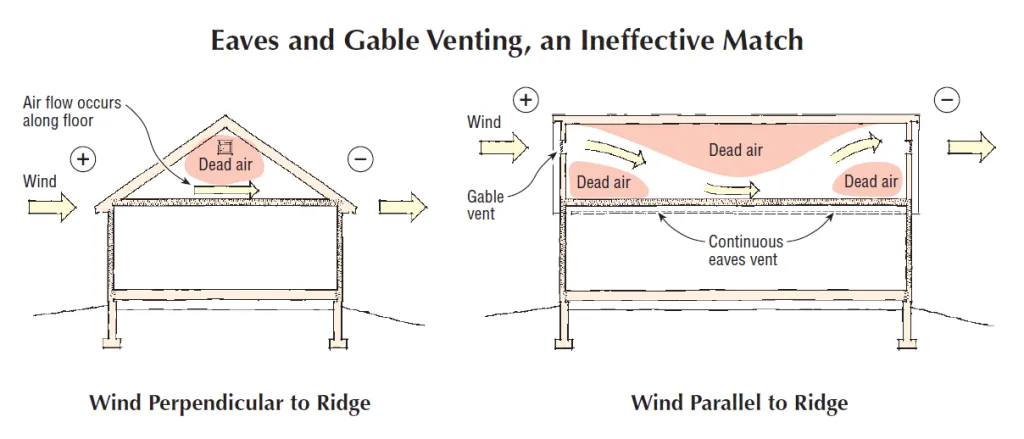
Unfortunately, however, even when they’re matched with continuous eaves venting, gable vents are not very effective because most of the air flow is along the floor of the attic. This leaves much of the attic volume unvented (see illustration below), with pockets of dead air that can store summer heat and radiate it into the living space below.
Click to enlarge image below.
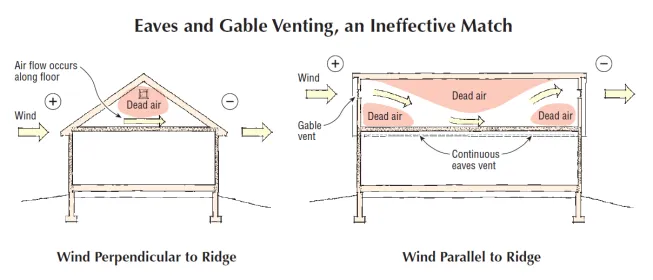
On a house with eaves and gable vents but no ridge vents, wind perpendicular to the ridge tends to create air flow along the floor of the attic but leave hot dead air in the roof peak (above left). When the wind is perpendicular to the gable, the cooler outside air enters the gable vent and drops to the floor of the attic before rising to exit at the other end, again leaving zones of dead air (above right).
The most efficient option is ridge venting combined with continuous soffit vents. If in this case, you choose to add ridge vents, you must either remove the gable vents or seal them up from inside the attic. Sealing and leaving them may look better from outside, to avoid creating a blank gable. There are also some attractive, strictly decorative gable vents available.


