Has it ever occurred to you that dropping your prices to stay in business could put you out of business? Many contractors tell me they’ve had to drop their prices to remain competitive in today’s market. They just know they’re losing jobs because the “other guy” is cheaper.
And yet there always has been and always will be someone out there who’s cheaper — in good times and bad. Think back to the good old days, when the leads were flowing in and there were lots of jobs. Because there were so many customers, you probably weren’t as aware of — or concerned about — the ones you were losing due to your prices. But that doesn’t mean they weren’t there. And now, with the market tighter and fewer customers available, you feel the hit every time you lose a job. Many contractors are so afraid they’ll lose a job because of price, they’re changing the way they communicate with customers. But they’re doing themselves more harm than good.
There are two aspects to pricing: the numbers and the psychology. We’ll talk about the psychology first. You set your prices according to assumptions you make about clients and what they’re looking for. But are your assumptions correct?
What Do Customers Want?
This summer, I gained an interesting perspective on this issue by going through the selling process as a customer. Thanks to a house filled with 60-year-old galvanized pipes that had failed, I needed a quick, unplanned kitchen remodel. It was certainly pleasant to have every contractor and sub I contacted immediately return my call and promise to work within my tight schedule. But I was struck by the fact that almost everyone I spoke to mentioned he would give me the “best price” — even though I myself never mentioned price. I’m not saying I didn’t care about money, but I was far more concerned about quality. Yet all these contractors assumed that I’d hire them only if they were the cheapest.
Five years ago, many contractors’ marketing strategies were based on quality, integrity, and value. But today’s marketing plans seem to be based solely on price. And that approach can backfire, for a couple of reasons. First, it can antagonize customers like me, who are looking for an emphasis on quality. And second, it can have a devastating effect on a contractor’s ability to stay in business. Why? Because any drop in price needs to be accompanied by an increase in volume or the business simply won’t survive.
Are You Buying Jobs?
The concept isn’t that complicated: When your margins decrease on jobs, you have fewer dollars to add to the pot, to cover overhead, and to pay yourself. Many contractors are reducing their prices to such an extent they’re essentially “buying jobs” — paying to go to work for the client. They still have to perform the work, still have the same headaches, still are liable for the outcome — but they end up with less money in the bank than they started with.
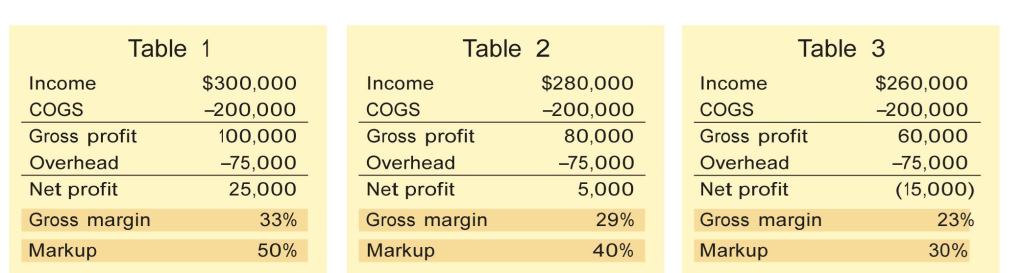
Here’s one way it could happen. Say that a typical P&L (profit and loss statement, also called an income statement) for your company a few years ago looked like Table 1 below. Your revenue for the year was $300,000, and your net profit was $25,000. Your total costs of $275,000 were separated into two categories: The COGS (cost of goods sold) of $200,000 is the total direct expense required to produce your jobs; the remaining $75,000 represents your overhead — those costs that cannot be specifically attributed to jobs and wouldn’t typically change if your sales volume fluctuates. You sold your jobs with a 50 percent markup (gross profit of $100,000 divided by COGS of $200,000) and a gross margin of 33 percent (gross profit of $100,000 divided by total sales of $300,000).
Then, after steady years of revenue, the economy enters the biggest recession of your lifetime. You continue to estimate with the same 50 percent markup but find that you’re not getting any work. So you decide you need to reduce your markup just to stay in business. Perhaps you drop your markup to 40 percent. If you continue to do the same type of work, your COGS may stay at $200,000, but your net profit will drop to $5,000. You could stay in business with those numbers, but not for long.
What happens if you next decide to drop your markup even further, to 30 percent? If you don’t reduce your overhead, you’ll start losing money. You will be paying, out of your own pocket, to work for your clients.
Do the Math
Understanding gross margin is critical: It’s the money left over, after paying job expenses (materials, subs, labor), with which you pay the fixed expenses that come with running a business — rent, telephone, insurance, and so on. When you’re thinking about reducing your markup — and therefore your margin — it’s important to understand how markup relates to the total sales volume.
First, determine the gross profit you need to achieve to cover your overhead and net profit. In the example at the top of this page, it costs $75,000 just to keep the doors open. Next, determine the total dollar volume of jobs (total sales) you need to sell to cover these costs. If you can achieve a 33 percent gross margin, then in this example you need to sell a total of $225,000. But if you were to lower your price for those same jobs, their cost wouldn’t change — only the total sales would. So, if you price your jobs with an expected 30 percent gross margin, you’ll need to sell $250,000 worth of work ($75,000 · .30 = $250,000). Notice how, as the price gets lower, the total required sales number increases. If you lower your margin to 20 percent, you’ll need to sell $375,000 worth of work — $150,000 more than the level needed at a 33 percent margin.
As you reduce your markup, you may be able to sell more work, but your margin will fall. And as your margin falls, your volume will need to increase just to cover your costs, so that you can stay in business.
What To Do?
I challenge you to put together a similar spreadsheet based on your company’s actual numbers. Then consider what sales volume you can realistically achieve in the short term. You may need to restructure your overhead. Carefully rethink what costs you need to stay in business. Do you really need a receptionist? Can you clean your own offices? Perhaps you can negotiate with your landlord for reduced rent. Analyze your cellphone usage and see if you can get a better plan. For each dollar you reduce in overhead, you will reduce the gross profit required to stay in business. And this will reduce the total sales you need to stay profitable — or at least break even.
Another approach is to take definitive steps to increase your margin. You may think that the only way to do this is to increase your sales price. But another, better way — especially in this market — is to reduce slippage, to produce jobs with the most efficient use of resources. Improving productivity, sticking to a schedule, and using material effectively will go a long way to lowering your job costs. And if you can produce a job for less, you can lower your price without lowering your margin.
You might also reconsider the size of the jobs you take on. Bear in mind how much longer the sales process is for big jobs compared with small ones. While large jobs may be attractive because they promise to keep your crews busy for the long term, you may be missing out on opportunities to land smaller jobs.
Quality, Not Price
Ultimately, the economy will recover. In the meantime, running around buying jobs with no profit just forces you to sell more jobs. You may stay busy, but you also may soon be out of business. Do what it takes to streamline production and lower your overhead — and above all, stop chasing volume and sell jobs based on quality, integrity, and value.
Leslie Shiner provides business advice to builders throughout the country. She is a frequent speaker at JLC Live.