Several years ago, our small remodeling company was in the process of planning for growth. One of our goals was to “brand” our company locally. To do this, we needed exposure. After looking at our total projected costs and the potential for quality exposure to our target market, we decided to sign up for our first local home show. For an initial outlay of less than $1,000 (see Figure 1), we could put our company face to face with over 8,000 potential buyers. That works out to just under 12¢ per “impression,” to use a marketing term.
| Cost Breakdown | |
8’x 8′ booth space at the show Copying for handouts Used display Color photo enlargements and mounting Pens and magnets for giveaways Miscellaneous supplies Total | $595 $50 $75 $100 $100 $20 _____ $940 |
Figure 1.The booth was staffed by two salaried people — the owner and the author — whose salaries were part of company overhead and thus not included as a marketing cost.
In a single weekend, a home show can put you in front of more homeowners and home buyers than you could possibly see in a month of home visits. And many are buyers who are ready and able to buy what you’re selling. But it takes more than a card table and a photo album to make this marketing method work. What follows are a few hard-won tips to help you make the most of one of the most efficient and effective marketing opportunities available to you.
Pick a Target
Know what you want to get out of your home show experience. Even if you’re primarily interested in marketing your growing company, “marketing” isn’t a precise enough expectation. Are you simply planning to introduce your company to the public? Or to introduce a new product or service? Are you trying to line up work for a particular time period? Or to expand your database of names for a mailing list? These are all legitimate goals. But focus on just one or two of these objectives, keep your message simple and direct, and you’ll have a much better chance of success. In our case, we wanted face-to-face exposure, and we wanted to generate good-quality leads.
Once committed to our goal, we started planning our display and the information it would feature. A home show can overload attending homeowners with the quantity and variety of information. We wanted to make sure that the material we presented in our booth was simple, direct, and appealing. We decided to use lots of photographs of completed work, accompanied by written testimonials from satisfied clients.
The idea is to be mindful of the exact information you want to present. For example, if you want to highlight a new service or product that you’re offering, such as fiber cement siding or vinyl replacement windows, then photos and brochures supporting those items should dominate your display. You may include information about other work you do, but try not to cover too much ground. Remember, this is a chance to introduce your company, not to tell your life story. Nonessential information risks overwhelming or confusing prospective clients.
Choosing the Show
It’s important to choose the show that’s best for your purpose. If the organizers at your local exposition hall don’t already keep your business apprised of upcoming events and opportunities, call and request their events calendar. Your local builder or remodelers’ association is another likely source for home show alerts. In our area, there are two main home shows each year, each with its own characteristics. For the first few years we exhibited, we did only one show a year. We chose the smaller of the two, one that hit our area in late February or early March each year. We reasoned that a smaller show would prove less overwhelming for potential clients and present fewer of our competitors. Not only the venue, but also the time of year was important to us. Here in the cold Northeast, people begin to feel cabin fever around February and look for an excuse to get out of the house and start planning for spring. After all, they’ve been stuck inside for months, noticing all the things they want to fix or change.
As we gained experience, we learned to consider more information about a show before choosing it. Some pertinent questions to ask are:
* How long has the sponsoring group been producing home shows?
* How many people have attended in the past?
* How many people are expected to attend this year? (For a small show, I look for attendance figures of 8,000 to 12,000.)
* Do the sponsors have a list of past exhibitors I can call for references?
* How, specifically, will they promote the show? (You don’t want to incur additional advertising expenses on top of your booth fee. The promoter should provide ample, multimedia promotion of the event.)
* What’s the price of admission, and are any complimentary tickets available to exhibitors to distribute to select prospects?
The answers you get to these, and any other questions you think of, will help you choose a show that promises the best return on your investment.
Planning the Display
Our first year, we weren’t as prepared as we might have been. From that experience, we learned that we had to compete for attention. They don’t call them home “shows” for nothing — this is show business: You’re the star, and your booth is the stage and set. And like any good set, your booth should capture and hold the attention of your audience. Above all, it must be attractive, sturdy, and well lit. Creative touches may be a plus, but make certain it meets those three primary criteria.
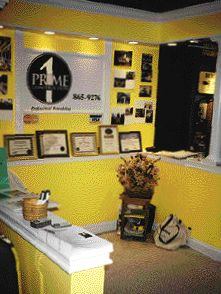
Prefab booths can work fine, but they tend to be pricey, easily costing thousands of dollars. Our first booth was a prefab, pre-owned trade show display that we bought at a university salvage warehouse for about $100. It consisted of fabric-covered fiberboard panels that stood on a standard folding table. We attached attractive photos of completed work to the panels and stocked the table with handouts. This is the simplest, and least expensive, booth format. Because of the positive response we received following our first couple of shows, we decided to invest in our own, custom-designed booth and had one of our lead carpenters build it, complete with crown molding, decorative columns, and recessed lighting (Figure 2). We made a point of telling every visitor that the booth had been built by our own field staff. It cost over $2,000 in labor and materials, but it makes a great impression.
Figure 2.A staff-built, custom show booth can speak volumes about the quality of your service. The layout should be open and welcoming to browsers. Booth props help keep prospects engaged when you’re too busy to immediately greet them. Customer testimonials and photo galleries, packaged in open three-ring binders, provide an effective introduction.
Another lesson we learned the first year was how to arrange our booth. In fact, we learned that how the booth is laid out is more critical than where it happens to be located on the show floor. Home building and remodeling are personal services, and the booth should be warm and welcoming to reflect your awareness of that. If you put a table across the front of the booth, you make it difficult for potential customers to come in and browse the photos and other materials. You want them to get to know you and your work, and that’s not likely to happen across a table barrier.
Props and supplies. Every set needs props. Props tell your story, even when you can’t speak directly to a prospect. We like to use white, three-ring presentation binders that hold copies of returned customer satisfaction surveys, reference letters, and testimonials. We use a separate binder as a “project gallery” (which sounds more exciting than “photo album”). All of the binder contents are housed in sheet protectors to endure a two- or three-day show.
Refrigerator magnets, bearing our company logo and phone number, make great giveaways. They’re one of the longest-lasting, and therefore one of the most cost-effective, marketing tools we’ve found.
For supplies, we bring the ever useful duct tape, marking pens, business cards, bottled water (but no food), a screwdriver, and spare light bulbs. These items keep minor glitches from becoming major problems.
Staffing
If you go to the expense of setting up a home show booth, it’s critical to keep it staffed at all times. In fact, some show organizers require that. For a one- or two-person operation, staffing can be a challenge, but be creative. Invite a spouse or friend to help you. At one show, we even invited a loyal client to help in the booth, and she loved it (potential clients were impressed as well). If yours is a larger organization, have some of your field staff join you in the booth for short stints. Don’t abandon them there to go it alone; rather, stay with them and make it fun. Model your best professional behavior. It’s a great way for field personnel to meet the public and to see what it takes for you to generate leads and build rapport.
We’ve always been amazed when the doors open and the public floods in. We’ve had people three or four deep at (and in) our booth, for nearly the duration of a show. Don’t worry if your booth gets that busy. Just acknowledge new visitors with eye contact or a welcoming comment and get to each visitor in turn. You can also broaden your conversation from just one party to several and include new arrivals in your presentation. Remember that crowds attract crowds — you’re there to be seen!
Take Advantage of the Opportunities
To meet our goal of generating good leads, we’ve made a concerted effort to “capture” names. But we learned the hard way that there’s a right way and a wrong way to go about it. Initially, we paid more attention to the quantity of names than the quality, and that wound up costing us in lost time, as we chased bum leads for weeks at a time. You don’t just want names, you want qualified leads. For this reason, I’m not a big fan of contests or drawings. I’ve seen home show booths where the vendors might be selling windows, but they’re holding a drawing for a toaster. Visitors fill out entry cards and drop them in a box. But how many of those people are interested in windows and how many just want a chance at a free toaster? Those window guys will never know. I prefer to conduct a prequalification interview right on the spot. If a visitor seems like a good prospect, I’ll offer a free consultation and ask for name, address, and phone number. It’s also a good idea to schedule an appointment before the prospect leaves the booth. This helps keep the workload manageable while raising the job closing rate.
Follow-up. One of the most important aspects of exhibiting at a home show is the post-show follow-up. Make sure that every new prospect on your list gets a phone call or a letter within a few days of the show. Prompt and courteous follow-up marks you as a true professional. I make phone calls to set up appointments with the hottest leads. Other leads get a short letter. Our follow-up letter thanks the prospect for visiting us at the home show and also mentions that the show generated a lot of interest in our services: “Our summer is booking quickly, but we do have some time slots still available. Call us to see if your project might fit into our schedule.” If we are busy, the people who get those letters won’t hear from us again for several months. But if they call us soon after receiving that letter, they’ve just become a hotter lead.
Add notes and observations to your home show file during and immediately following the show. Include information on attendance numbers, number of leads generated, ideas for additional props and supplies, etc. After all, once you’ve successfully completed one home show, you’ll want to do more. Here’s why: In our first home show (before we had our act together), we generated 65 solid leads and nearly $200,000 in profitable work. That’s a good return on investment in anybody’s book.
Tom Peterson, CGR, is a professional estimator and project manager in Burlington, Vt.