
By Joseph Fusco with Dave Holbrook
Cutting my first complex roof slowed me to a crawl. Things got especially hairy where two slopes of unequal pitch met in a hip or valley. Although I gradually sorted out the trigonometry that enabled me to move through all the steps and cuts, I’ll admit that mastering the calculator keystrokes wasn’t a piece of cake. Sometimes on site it’s more practical to take a simpler approach. In this article, I’ll show how you can lay out and cut a split-pitch, or irregular, hip rafter using a framing square, a tape measure, a bevel gauge, and a series of triangles you can draw on a scrap of plywood.
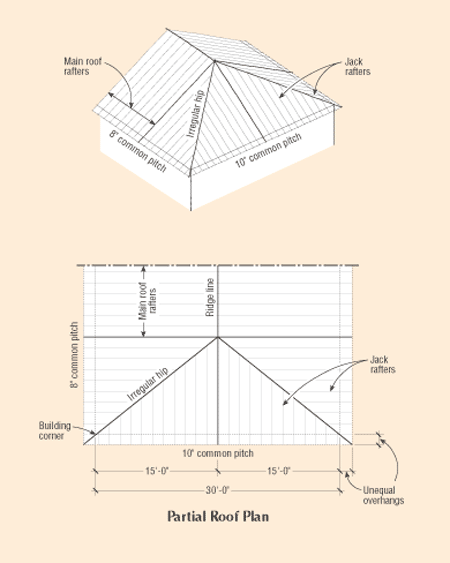
As an example, I’ll use a roof where the main 8/12 pitch ends with a 10/12 hip. Because the converging pitches are unequal, the hip doesn’t bisect the plan view at 45 degrees, as it would in a regular hip roof. In a regular 8/12 hip roof, you would use 8/17 to step off the hip rafter; 17 is the unit run of the hip per 12 inches of run of the common rafters. With a split-pitch roof, that won’t work — as a unit run, 17 applies only to a 45-degree hip.
Because the 8/12 pitch in my example is the main roof and establishes the ridge height, I’ll do the hip layout in terms of that side of the roof. This will mean finding a new ratio that expresses the 10/12 pitch in terms of an 8-inch rise.
In all the drawings, layout will be done at the centerline of the framing member; you would need to deduct for the thickness of the stock before you cut.
Find the Hip Angle in Plan
The hip doesn’t hit the wall at 45 degrees, but finding the angle is easy. Using the framing square, draw a right triangle with a 10-inch and an 8-inch side. Close the right angle with the hypotenuse and you’ve got the angle of the hip in plan, plus the two cheek-cut angles (triangle A).
The irregular hip plan angle is a straightforward representation of the relationship between the two roof pitches, in this case 8 and 10 inches, drawn as two sides of a right triangle. The 8-in-12 slope is the “main,” or controlling, pitch on this roof; the 10-pitch is subordinate. The resulting angles can be copied with a bevel square and used to set a circular saw for the hip cheek cuts.
Hip Unit Run
To determine the hip unit run (the hip run per 12 inches of common run), extend the 10-inch baseline of triangle A to 12 inches. Draw a new line perpendicular to the endpoint of the base extension. Extend the adjacent hypotenuse to meet it: The 12-inch baseline is the unit run for the common, 8-pitch rafter; its opposite side represents the 10-pitch unit run as a ratio of the controlling 8-inch pitch.
Hip Unit Length
The next step is to find the unit length for the hip. Draw an 8-inch line — the controlling unit rise — perpendicular to the hip unit run line and return it to the 12-inch baseline endpoint (triangle B). The length of this new hypotenuse is the hip unit length. All unit dimensions will be multiplied by the run (1/2 span) of the main pitch to determine total run and total length of the hip and each common rafter.
10-Pitch Unit Length
To determine the unit length for the subordinate 10-pitch king common rafter, draw the 8-inch main unit rise perpendicular to one end of the 10-pitch unit run line, and draw a hypotenuse back to the opposite point (triangle C). Measure the hypotenuse to find the unit length for the 10-pitch rafter. Because the 8-pitch determines the ridge height, the 10-pitch is seen as a ratio of the 8-inch pitch — the wireframe roof key illustrates how these unit triangles relate to the controlling rise unit.


