
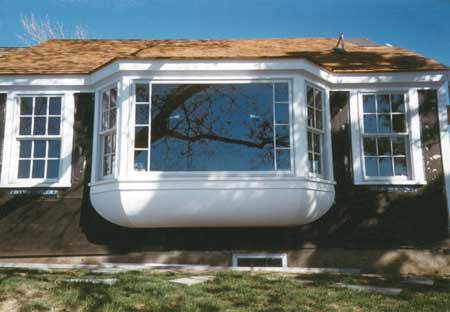
The original plan for this bay window called for a walk-in installation over cantilevered floor joists. But when local zoning restrictions prevented builder Scott Babcock from creating the additional floor space, he had to come up with a different approach. Spurred on by the client’s request for “something interesting,” the inventive builder drew inspiration from the boats moored just off the edge of the lawn outside the window.
The epoxy-bonded curved plywood apron beneath this waterfront bay window was designed to mirror the forms of the boat hulls moored just beyond the lawn.
Babcock created the hull-shaped apron by laminating a double layer of 3/8-inch bendable plywood sheathing to a series of plywood ribs with an epoxy resin often used by boat builders. The ribs were located to sister against a series of five custom steel brackets, padded with 2×4 cleats, that supported the window. To provide a way to screw the completed apron to the brackets from within, a series of temporary access holes were cut into the sheathing with a recip saw.
The bendable plywood skin of the “hull” draws its support from curved plywood ribs. Tarpaper templates were used to plot the vertical joints between the straight central section and the tapered ends.
Welded angle-iron brackets attached to the framing provide structural support for the bay window. Access holes were later cut into the sheathing between brackets to permit screwing the nonstructural apron to the brackets from within.
When the insulation contractor arrived to install icynene in the walls, he also completely filled the shell via the access holes. The outside of the hull was waterproofed with more epoxy resin and primed, then top-coated with latex paint. The result draws enthusiastic appreciation from boaters and landlubbers alike.


