
The American Sanitary Plumbing Museum in Worcester, Mass., will never be listed among the world’s great museums, but to people who are interested in pipes and fixtures, there’s no place like it. The collection got its start when Charles Manoog, the founder of a wholesale plumbing supply company, retired in 1979 and handed the business over to his son, Russ. At about the same time, someone gave the older Manoog a 300-year-old section of wooden water main that had been dug up during excavation work at Boston’s Faneuil Hall.
That chance event, coupled with a lifelong passion for plumbing and a newfound abundance of free time, set Manoog to collecting plumbing fixtures and tools of all kinds, including bathtubs, water heaters, and an eye-opening variety of toilets. (One visitor favorite is a 19th-century earth closet — a Rube Goldberg-like indoor device that housed an elaborate mechanism designed to sift a thin layer of soil over waste by way of a flush.) The collection moved into its own 3,000-square-foot building in 1988, a year before Charles Manoog’s death.
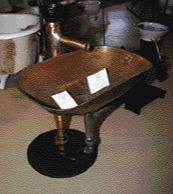
Everything old is new again. Could this 19th-century copper pump and sink become the model for next year’s high-end designer fixture?
“We didn’t have PEX when I was a boy, Sonny.” These ingenious offset couplings allowed a plumber to sneak one run of threaded pipe past another with minimal fuss. They’re no longer made, so today’s plumbers have to approximate the same solution with an awkward series of street elbows or elbows and close nipples.
This nightmarish-looking series of lead drain lines leading to a single cylindrical drum trap was once standard equipment. Today’s plumbers still encounter this sort of thing in old houses, often to their sorrow: The offset lines running to and from the drum trap won’t allow a plumber’s snake to pass through, as a more modern P- or S-trap will. A too forceful attempt to clear the drain may cause the snake to punch right through the soft lead wall of the trap. Damn!
There’s no direct connection between the nonprofit foundation that funds the museum and the still-thriving family business, although the two share a parking lot. But the indirect connection is strong: When Russ Manoog retired in 2000 and passed the company along to his own son, he took on the job of museum trustee. Russ’s wife, Bettejane — known to all as B.J. — is the museum’s administrative director and chief tour guide.
According to B.J., about 400 visitors pass through the museum annually. Lawyers sometimes use the museum’s document collection to research cases, and industrial designers looking for ideas make sketches of old fixtures and hardware. Classes of young apprentices from area training programs visit regularly, and Manoog often hears older retired plumbers exclaim at the sight of a forgotten piece of the past.
The American Sanitary Plumbing Museum is located at 39 Piedmont St. in Worcester, Mass. Hours are from 10 a.m. to 2 p.m. on Tuesdays and Thursdays; admission is free. For directions and information, call 508/754-9453.


