
I’ve been building stairs full-time for the last 16 years in high-end homes in the Boston and New York City areas. Most of these stairways are complex, with curves and spirals. But when it comes to straightforward stairs, I’ve developed a technique that can easily be followed by any decent site carpenter, even without access to a millwork shop. In this article, I’ll walk you through the way I would go about trimming out a fairly simple, but elegant, staircase made entirely out of stock parts — something you might put in a high-end spec house, for example.
Obviously, before trimming a staircase, you’ve got to design and build the structural undercarriage. I use several framing details that lead right into my trim-out technique (see Figure 1, “Rough Framing for Stairs”). If I’m not building the undercarriage, I try to get the framers to incorporate the key features of my system.
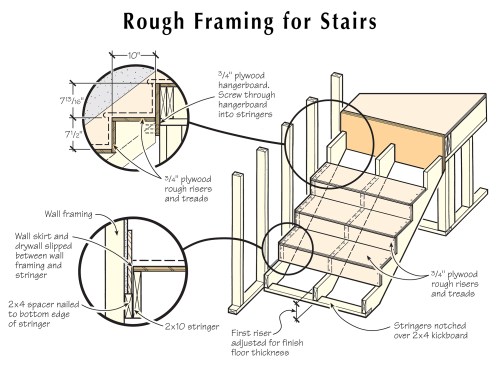
Figure 1: The author spaces the stair undercarriage out from the wall framing with a 2×4 along the lower edge of the inside stringer to leave room for the drywall and the wall skirt. To strengthen the entire carriage system, he installs 3/4-inch plywood sub-treads and sub-risers — glued and screwed.
Newels Are Key
The first step in trimming out a stairway is to set the newel posts. In this article, I’ll be discussing turned newel posts with a block at the top — where the handrails are cut to fit between the starting and landing newels (post-to-post). Because the newels bear the strain that goes on the rail, they need to be locked in tight. I put the newel posts in first and fit all the other trim to them.
Locating newel posts is a straightforward procedure that works off the centerline of the handrail and balustrade.
Bottom newel. I like to place the bottom newel on the second step, just above the starter step. If you put the newel on the front of the bottom tread, you end up with a very narrow stair. It looks like a cattle chute and doesn’t feel very welcoming. Also, when the newel is placed slightly up on the stairs, it’s much easier to put your hand out and step on the first tread from the side, so you actually turn as you begin going up. The curved bullnose tread and starter step that I often use make this common sideways approach comfortable.
To locate the bottom newel front to back, I set it where it will catch the front overhang of the second tread, plus a slight reveal. To find the side-to-side location, I work off the centerline of the handrail (Figure 2, “Laying Out the Bottom Newel”). The rail centerline is determined by the width of the balusters and by an arbitrary decision as to where the balusters are placed. I think that balusters always look better when their edges line up with the skirt board below. I also prefer the first baluster on each tread to sit right on the corner so that its front edge lines up with the riser below. The balusters seem to grow more naturally out of the stairs that way.
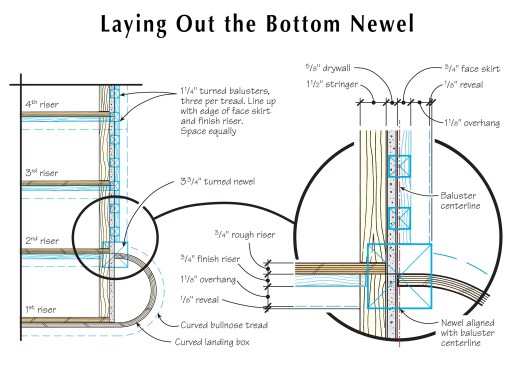
Figure 2: If the baluster edges line up with the face skirt edge, the centerline of a handrail is going to be half of one baluster in from the face of a face skirt. The treads are typically cut to overhang 11/8 inches. The minimum width of newels equals half of the baluster width plus the tread overhang plus an optional reveal — times two. Because many readily available newel posts are not wide enough to notch solidly into position, the author always specs wider newel post styles.
Where nosing meets newel. Traditionally, the tread nosing dies into the newel posts. For this to work out, the newel posts must be wide enough to catch the nosing. To calculate the minimum newel width, add half the baluster width to the tread overhang, plus the reveal where the tread dies into the newel — then double it. For a 1-1/4-inch baluster (minimum standard size), a 1-1/8-inch overhang, and a 1/8-inch reveal, you need at least a 3-3/4-inch newel. That’s bigger than most readily available commercial newel posts, which may be 3 inches square or even smaller.
If you use a wider 1-3/4-inch baluster, you’re going to need at least a 4-1/4-inch newel post. Any other solution will cause design problems. You’ll have to make a little return on the nosing where it extends past the newel post, or worse, put the centerline of the handrail in so far that you create a weak newel attachment.
Cutting newels to length. When laying out a newel post, I first determine the best side and lightly mark it with an “F” for “face.” Next, I cut the newels to length at a dimension determined by the handrail height and how far the newels extend below the subtread. (For more on this, see “Laying Out Newel Cuts.”) I put the landing rails at a height of 36 inches above the finish floor, and the rake rail at 32 inches above the tread noses.
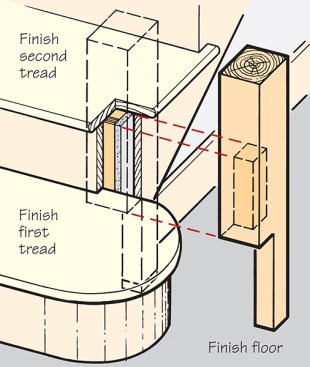
Editor’s note: See “Laying Out Newel Cuts” for more information on how Jed deals with bottom and landing newel posts.
Notching the bottom newel. After a newel is cut to length, it’s time to figure out how it will be notched. The bottom newel needs a pocket notch that lets the tread of the first step slide underneath while the newel face continues down over the drywall. Newel posts are expensive, so the cuts for pocket notches have to be figured carefully. Work your layout from the centerline of the handrail and from the face of the subriser. Remember, the notch dimensions are determined by the dimensions of the baluster, drywall, face skirt, and reveal. When marking the notch cut, make sure that it accurately accounts for the riser height as well as the thickness of the stair tread and finish flooring. I still scratch my head over these things, even after building stairs for years. Drawing the whole scenario out on the post and looking at it while holding the post in position is essential to avoid costly mistakes.
Landing newel. The landing newel is longer than the bottom newel because it catches the landing rail at 36 inches above the finish floor and then runs below the tread far enough to catch the face skirt and scotia molding. All that said, a typical landing newel would be cut about 55 inches down from the top of the newel block. The newel will appear to extend down below the landing and will need to be finished with a dropped finial. To lay out the pocket notch, I follow the same rules as for the bottom newel, except that I allow 37 inches above the finish floor.
Before making these notch cuts, check the carriage and walls for plumb. You may have to rough-cut the pocket notches, then scribe the newels plumb to the plaster before making the final cuts.
Cutting pocket notches. To cut the notches, use a circular saw set to the proper depth. Before cutting, clamp the newel to a bench, because accuracy is essential on the cuts where the newel meets a tread or drywall. Finish the notch cuts little by little with a good, sharp chisel. I use cheap, all-steel chisels, so I can hit them hard (Figure 3). The steel in them is not bad, but you’ll need to take the time to keep them sharp.
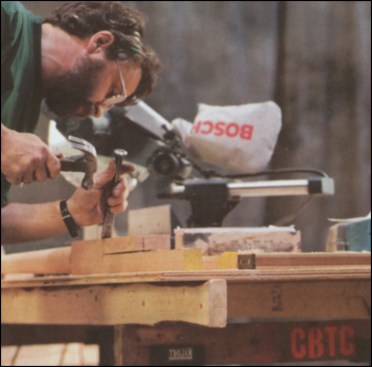
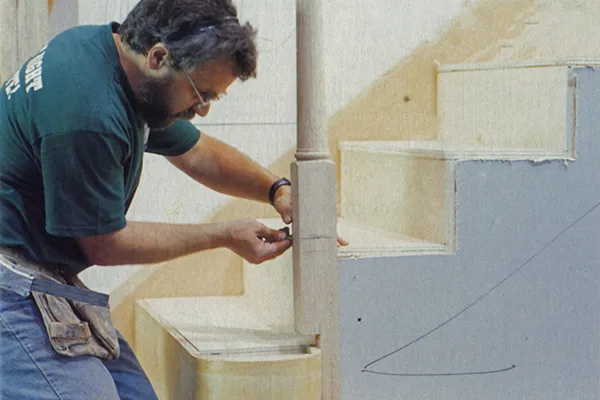
Figure 3: The author completes the newel pocket notches with a sharp chisel.
After the pocket notch is complete, drill for the screws. I use a 1/2-inch counterbore and come back later to fill with 1/2-inch bungs that match the grain of the wood. I line up the grain of the bungs, and pare them off smooth. If I’m making the bungs in my shop, I’ll use a piece of scrap wood from the newel to cut them. That’s especially important with mahogany, because the color varies quite a bit, and you can match the grain better if you use a bung cut from the same piece.
I use a level to plumb the newels, then I fasten them into the framing with 3-1/2- or 4-inch lag screws. I don’t glue the newel to the framing because the lag screws are strong enough. However, I always glue all the other abutting trim, such as the risers and skirts, onto the newel so the joints stay tight over time.


