
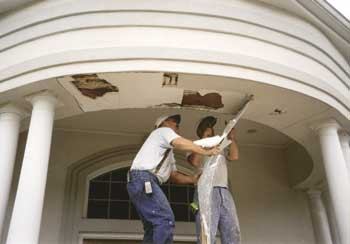
by Harrison McCampbell, AIA
Improperly detailed EIFS joints allowed water to soak into the structure of this portico, with ugly and expensive results. |
As an architect and frequent consultant on waterproofing and building envelope failures, I see a lot of EIFS problems involving water leakage and resulting structural damage. Given the number of lawsuits involving these sorts of problems in homes built over the past decade, you’d think that builders would have learned the importance of water-shedding details. But as I see almost every day, surprisingly few of them have. Although that provides me with a measure of job security, it’s also frustrating because a little attention to a few key details can eliminate a huge amount of trouble down the road.
Caulk and Backer Rod
The key to a trouble-free EIFS application is the maintenance of a 1/2- to 3/4-inch gap wherever EIFS meets a non-EIFS material, such as roofing, trim, or doors and windows. The correct gap makes it possible to finish the exposed edges of the expanded polystyrene — which should be backwrapped with reinforcing mesh before the EPS is secured to the sheathing — with a waterproofing application of base coat when the rest of the finish goes on. Finally, the gap is filled with soft plastic backer rod and a bead of compatible caulk. Good caulk, bad caulk. If it’s going to last, the caulking has to be done right. The surface has to be clean and dry, the caulk space must be correctly filled with backer rod, and the caulk joint itself must be properly tooled (see Figure 1).
Figure 1. Wherever EIFS meets another material, backer rod must first be installed in the joint. This keeps the caulk from adhering to the back of the joint and allows it to stretch with building movements. A correctly tooled caulk bead has an hourglass shape that is about twice as wide as it is thick. |
The backer rod serves two functions: First, it prevents the caulk bead from adhering to the back of the joint, allowing the caulk to flex in response to thermal expansion and contraction and other building movements. If the backer rod is omitted, the caulk will adhere to the back of the joint as well as the sides, limiting its ability to stretch and guaranteeing premature failure. Second, it controls the thickness of the finished application of caulk, which should ideally be about half as thick as it is wide. More often than not, though, the caulk and backer rod are never applied at all. (I’m always told, “They’re in the truck.”) That was the case in the repair job photographed here, where the polystyrene board was simply butted against the trim and other surfaces (Figure 2).
Figure 2. Moisture-soaked EIFS was butted directly against the gable-end trim in this photo. Water seeped through the resulting crack and penetrated the gypsum sheathing, which had turned to gray mud in some areas. Note the impression of the reinforcing mesh on the sheathing. |
When you butt EIFS up against another material, the edge of the EPS board is now exposed to water absorption, since there is not enough space to apply the base coat. The caulking, if used at all, has less than 1/16 inch of EIFS surface to adhere to in order to seal against water entry. I have even heard EIFS contractors try to defend themselves in a failed application by pointing out that they had diligently backwrapped the edges of the EPS board with mesh, as required. But unless the mesh-wrapped edges are also embedded in basecoat, this does no good at all (Figure 3).
Figure 3. The EIFS applicator backwrapped the edges of the polystyrene with mesh, as specified — an empty exercise, because the tight spacing made it impossible to apply EIFS to the edges of the sheets. |
More from Journal of Light Construction
-
Practical Energy Upgrades
12 MIN READ
-
Monopour Lessons Learned
11 MIN READ
-
