
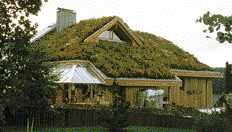
The idea of grass-topped rafters isn’t new, as any Swiss miss can tell you. But the technology’s been updated in recent years to serve specific purposes, like controlling runoff. In hard-paved cities with little or no absorbent ground cover, municipal sewer systems can be overwhelmed by excess flow following a hard rain. A green roof absorbs 50 to 75 percent of the rainfall that strikes it, significantly diminishing the amount of water that reaches the gutter.
Roof pitches of up to 12/12 can be green, although the system’s complexity and cost may increase accordingly. Outside Stuttgart, Germany, a contemporary-style house with a verdant roof updates the archetypal thatched cottage (top). A private rooftop garden — also near Stuttgart — puts to rest any argument that a flat roof is an ugly roof (above). And in the Seattle area, another lift of growth medium hits the deck (right).
That’s not the only big-city problem that green roofs can alleviate. Urban centers tend to be hotter than surrounding areas, partly because of the cumulative acreage of black asphalt rooftops that soak up solar heat and radiate it outward into the air and downward into the buildings. A green roof maintains a lower surface temperature, reducing a structure’s heat gain by as much as 50 percent.
Other benefits — not necessarily proven — include a 30-year typical roof-membrane life; quieter interiors; and reclaimed outdoor living space.
In the U.S., commercial projects claim the lion’s share of green-roof installations, but Europeans have embraced the technology on a broader scale. In Germany, for example, 7 percent of all new flat roofs, both commercial and residential, are said to be green, with a total of 140 million square feet covered to date.
Heads up — we may be looking at a growth industry.


