
Q. My customer wants to have her combination steam room–shower tiled with a nonglazed floor and wall tile she has already purchased. Is the tile suitable for this type of application? I would use Hardie’s Tile Backer for a substrate and the appropriate thinset mortar.
A.Michael Byrne, a JLC contributing editor, responds: Your question would be simple to answer if I could refer only to the tile, but given your uncertainty about such a basic issue, I wonder what your thinking is on the other important aspects of the installation? For instance, what do you consider an “appropriate” thinset? And how will you be using the Hardiebacker?
This is one of the most difficult of all tile installations to properly specify and install. First, I would stay away from using any unglazed tile in this area except for the floor, where slip resistance is desired. Unglazed tiles in a steam room may cause maintenance problems because salts tend to build up in such areas; salts are more easily cleaned off glazed tiles and may prove difficult to remove from the surface of unglazed tiles.
Have you checked with the backerboard manufacturer to see if its product can be used in a steam room environment? Some backerboards may not be suitable for such use.
You say nothing about how the floor of the shower will be built. Certainly, you should not expect to use backerboard there, since the floor must be sloped to the drain. Also, cement backerboards are known to wick moisture: Therefore, the junction between the wall and the floor setting bed will require a waterproofing detail that may differ from one brand of backerboard to the next.
On steam units, I always recommend a surface-applied waterproofing membrane (liquid or sheet). Membranes located behind the backerboard will allow steam vapor to enter the wall cavity.
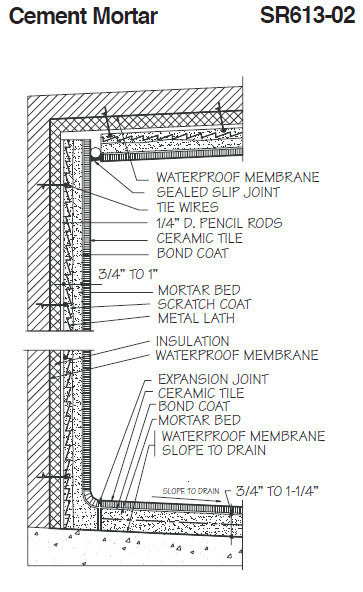
I suggest that you obtain a copy of the TCA Handbook (864/646-8453, www.tileusa.com) for details on steam showers and other ceramic tile installations. In the meantime, see the illustration below.
Requirements:
- steam rooms require a waterproofing membrane on all surfaces to prevent moisture from penetrating adjoining spaces.
- some membranes will require insulation on walls and ceilings to protect them from excessive heat.
- slope ceilings (2” per ft. minimum) to avoid condensation from dripping onto occupants (sometimes sloped to center to minimize rundown on walls).
Material and Tile Installation:
- attach four equally spaced tie wires to the supporting members and through the insulation. Attach 1/4” D steel pencil rods vertically over the insulation. Attach metal lath to pencil rods on both walls and ceilings.
- install open slip joints in all corners between walls and ceilings and to divide areas that exceed 16’-0” in length.
- floors—follow Method F121.
- walls and ceilings–follow Method W221.
NOTE: Waterproof membrane is shown in two different installation locations on wall. Specify one or the other.
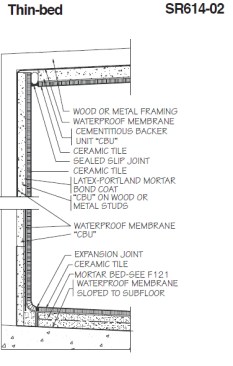
Requirements:
- steam rooms require a waterproofing membrane on all surfaces to prevent moisture from penetrating adjoining spaces.
- slope ceiling (2” per ft. minimum) to avoid condensation from dripping onto occupants (sometimes sloped to center to minimize rundown on walls).
- waterproof membrane must be capable of withstanding heat exposure.
.Material and Tile Installation:
- tile—A137.1 and certified by manufacturer for wet environment.
- cementitious backer units—ANSI A108.11 and A118.9.
- bull; reference and follow membrane manufacturer’s installation directions for placement of membrane.
- install open slip joints in all corners between walls and ceilings.
- floors—follow Method F121 or F122
- walls and ceilings—follow Method W244 or B415.
NOTE: Any penetration of the membrane should be sealed with appropriate sealant before installing tile.
Courtesy of the Tile Council of America, Inc., © 2002


