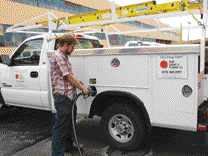
Many contractors prefer diesel trucks. Gary Gerber is no exception — his service truck has a diesel engine. But Gerber never takes his truck to the gas station. It runs on biodiesel fuel made from used cooking oil.
The only thing special about this truck is that it uses biodiesel fuel produced and stored in the company shop.
This is not as strange as it sounds. Early models of the diesel engine — which was invented in the 1890s — ran on vegetable-oil fuel. Most modern diesel engines will run on biodiesel without being modified, but since biodiesel can eat through certain kinds of rubber, engines built before 1995 may need new fuel-line parts.
For Gerber, biodiesel is just another way to avoid using fossil fuels. He is the founder of Sun Light & Power, a Berkeley, Calif., company that designs and installs alternative energy systems like photovoltaic power and solar water heaters.
At first, Gerber purchased biodiesel from a supplier who delivered it to a storage tank in his shop. Recently, however, he began making his own. Acquiring the raw materials is easy. In the past, local restaurants paid a rendering company to haul used oil away. Now, Gerber takes it away for free. Well, almost free. They have to give him lunch.
Converting used vegetable oil into biodiesel is a fairly simple process: The oil is mixed with catalysts and heated in a tank (left). The finished product (right) is amber brown and chemically similar to No. 2 heating oil.
When the oil arrives at the shop, warehouse manager Karl Tupper processes it for use as fuel. Processing is necessary because plain oil is viscous and contains compounds that will gum up an engine. Converting the oil into biodiesel is a relatively simple process, thanks in no small part to Tupper’s graduate degree in chemistry.
Tupper filters out the food debris, adds lye and methanol to act as catalysts, and then pumps the mixture through a heated tank. This cracks the oil molecules into shorter chains, producing biodiesel plus a residue of glycerin. The glycerin is drained off, and after further purification the biodiesel is ready for use as fuel.
Other than the energy that went into the lye and ethanol, no fossil fuels are expended to process the oil. Heat for the reaction is generated by burning biodiesel from previous batches, and the electricity that runs the pumps comes from a photovoltaic power system. Glycerin is the only waste product, and some of it goes to a local mechanic who is trying it out as an engine degreaser.
Commercially produced biodiesel is available at a small number of gas stations around the country. Since Berkeley has a mild climate, Gerber can run his truck on pure biodiesel. But the substance gels up in very cold weather, so in other parts of the country it’s blended with conventional diesel fuel or other additives.