
- Q. I recently learned that building codes in my state now require that newly installed water heaters be set at 140°F. But up until now, with concerns about energy conservation and scalding safety, 120°F was the normal setting. Why the change?
A.Dave Yates, a plumbing contractor in York, Pa., responds: This initiative actually got its start in Canada, when the Canadian Institute of Plumbing and Heating (CIPH) began requiring 140°F minimum temperatures in storage-tank water heaters to suppress bacteria numbers. This measure is aimed in particular at Legionella pneumophila sero-group 1, the bad boys that cause legionellosis, or legionnaires’ disease, a pneumonialike respiratory disease.
Estimates of the number of deaths from potable hot- water system bacterial infections range widely, but 10,000 per year is the middle ground. Roughly 25 percent of all potable water heaters have measurable levels of Legionella pneumophila SG1, which thrive in water temperatures between 95°F and 115°F.
These bacteria begin to die off only when the temperature rises above 131°F — but because of stratification (where cooler water sinks to the bottom), 140°F is the minimum recommended setting for a storage-tank water heater.
You can’t contract the disease by drinking or bathing in infected water; you have to breathe in the bacteria, which is carried by fine water droplets.
Of course, once you raise water temperatures high enough to kill bacteria, scald protection becomes increasingly important. CIPH now requires an ASSE-certified thermostatic mixing valve at the water heater’s outlet, or ASSE-certified 1016 scald-guard faucets or valves installed at each point of use.
A single ASSE 1017 point-of-source mixing valve costs less than multiple valves, but either approach will add to the cost of plumbing a house.
Unfortunately, code changes come slowly in this country, and until now our code bodies have largely ignored this issue. One reason is that a change like this requiring an additional layer of antiscald protection marginally increases construction costs, so it’s been opposed by many builders’ groups.
Nevertheless, the code changes you’ve already seen in your state are just the beginning of what will soon become a national standard.
Proper Water-Heater Temperature
2 MIN READ
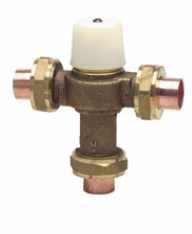
A mixing valve installed at the water heater reduces domestic hot-water supply temperatures. The outlet temperature of the ASSE 1017 point-of-source mixing valve shown here is adjustable from 80°F to 120°F.


