The first estimate my company ever produced was for a basement remodel. I spent an hour driving back and forth to the prospective client’s house, two hours talking to her, and then several more hours doing a detailed estimate. That evening I went back so that we could review the projected cost and — I assumed — sign a contract. You can guess how this story ends: I didn’t get the job.
I must be a slow learner, because for the next several years I continued wasting time on similar dead-end sales calls. It simply didn’t occur to me that I needed to be selective about which clients and jobs I spent time trying to get.
Tracking Leads
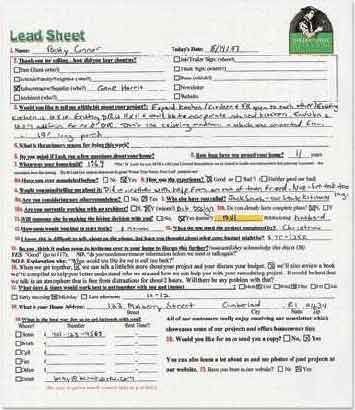
Then I attended a seminar by a contractor who explained how he uses a lead sheet to track leads — where they come from, how many turn into prospects, how many become projects, and how profitable those projects turn out to be. Armed with this information, he makes better decisions about which leads to pursue.
A lead sheet is a preprinted form for recording information about potential clients. It’s more than just a place to write things down — it’s a list of questions that the person who answers the phone needs to ask callers.
Our first lead sheet had space for just the basics: the clients’ names and project location, how they found out about us, and what kind of work they wanted done. Gradually we started using this information to weed out people who, for whatever reason, seemed unlikely to become our clients. Perhaps they lived too far away, or had an unrealistic budget or a schedule we couldn’t meet. This allowed us to spend more time with people who fit the profile of our best clients and most rewarding projects.
I’m not talking about a trivial amount of time; we’ve determined that it takes about 45 minutes to turn a raw lead (anyone who calls our office) into a qualified lead (someone with whom we’ve gone through the lead sheet). It takes another five hours to turn a qualified lead into a prospect (someone we’ve met and would like to work with). This does not include the time it would take to do an estimate, work out a deal, and sign a contract.
Digging Deeper
Our lead sheet is a work-in-progress. We added sections to the second version reminding us to ask the homeowners for a more detailed description of the house, whether they had building plans and financing, and when they wanted to start.
Our current version goes even further, supplementing those questions with ones about the homeowners’ past experiences with remodeling: Have they remodeled before, and if so, how did it go? We also ask if there will be someone else making the hiring decision with the caller — usually a spouse or significant other. Whoever it is, we need to know his (or her) name, his relationship to the caller, and whether he will be present at our first meeting. We don’t want to find ourselves thinking we have a deal and then discover that someone we never met has to sign off on it.
Guiding the conversation. We think of our lead sheet as a script we can use to guide our conversation with potential clients. For example, we start by asking if it’s okay to ask some questions about their house. Getting their permission is a way to get them to buy into our process.
We no longer collect detailed contact information up front. Instead, we wait until the end of the call, when potential customers have confirmed that they would like to meet with us. By then we’ve established a rapport and the questions seem less like prying; some people are taken aback if you begin a conversation by asking for personal information.
Interpreting the answers. The answers we get can tell us a great deal. For instance, if the potential customers have owned the house for a long time, they may have enough equity to get a loan to pay for the work. But if they just moved in and want to do an expensive project, you’ve got to wonder if they can really afford it.
The reasons they give for wanting to do the work may indicate how serious they are about the job. If they tell you “Mother is moving in with us” or “The sliders all leak,” they most likely really need to have the work done. Or if they come to you with detailed plans and specs, or have already secured financing, they’re probably serious about the project.
It’s important to find out where the potential client heard about you. If someone says he heard about us from a friend or family member who’s worked with us, he’s probably already qualified. But if the person found us through a Google search, chances are slim that this will work out well for either of us.
Is There Any Competition?
Let’s face it: We all want to know if we’re competing against other contractors, and if we are, who. But you may be afraid to ask. I was, too — until I realized what a difference it made for us to know.
When we first started asking the question “Are you considering any other remodelers?” I was sure there was no way we’d get a straight answer. But I discovered that most leads are so surprised by this question they’ll answer it honestly. If they admit they’re talking to other contractors, we follow up with another query: “Who else have you called?” Some won’t answer, but others will.
If the potential clients are talking to three or four remodelers, we take this as a sign that they are looking for a low price and do not view one contractor as being any different from the next. Sometimes the lead will mention that the other remodelers have been lax about returning phone calls or priced the job without any drawings.
I used to consider this an opportunity to make the sale by explaining the difference between hiring a professional who offers a high level of service and hiring someone with nothing to offer except a rock-bottom price. What I’ve learned from our lead-sheet data, however, is that it’s a waste of time to try to convert these leads into clients. Once we hear they’re talking to several other contractors, we keep the rest of the call short, though we encourage them to call us back if things don’t work out with the other remodelers.
What’s the Budget?
There’s no consensus among remodelers about the right time to ask clients about their budget. Some say you shouldn’t talk about something so personal without first establishing a relationship. I can see their point, but I refuse to go to the home of otherwise “qualified” leads only to discover that they have a completely unrealistic idea of what things cost and that they are unwilling to adjust their plans or budget.
We ask potential clients what their budget is in as “soft” a manner as possible. If the number is completely out of line with what they want to do, we save ourselves the wasted hours of a trip to their home for a meeting.
No Scoring System
We all love to rate things in quantifiable ways — restaurants, movies, concerts, you name it. At one time I tried to rate leads by assigning a numerical score to each answer on the lead sheet. For example, leads would get low scores if they had an unrealistic budget or the project was too far away. They’d get high scores for having plans and the ability to get funding. We found, however, that numerical scores didn’t help us; people are just too unpredictable. Although the lead-sheet data is useful, we still have to exercise judgment when deciding which leads to pursue.
Extra Benefits
Besides helping us qualify leads efficiently, the lead sheet process presents a professional image when prospects call. It saves us about 80 hours per year by focusing our attention on leads that are likely to develop into good projects. And because we know so much about those leads — thanks to the lead sheet — we are able to spend our marketing dollars where they’ll have the most impact on our bottom line.
Joe Cracco, CGR, owns Modern Yankee Builders Inc., a remodeling company in Cumberland, R.I.