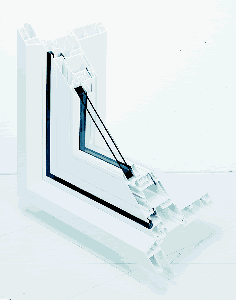
Allowing for thermal expansion is the biggest concern when installing vinyl windows
In the past five years, the number of residential vinyl windows sold in the U.S. has doubled. Once confined to the replacement window market, today about a third of all windows used in new homes are vinyl. In fact, most observers predict that vinyl windows will overtake wood windows in new residential construction sometime in the next few years. To explain this steady growth, vinyl window makers point to advantages vinyl windows have over their aluminum and clad wood counterparts. None of the three window types require painting, but most vinyl windows have better thermal performance than aluminum windows and don’t swell with changes in humidity like wood windows. The biggest advantage, however, is lower price, especially when compared with wood windows. Some vinyl window critics charge, however, that the strong price competition between vinyl window manufacturers has led to lower quality. Skeptics point to several shortcomings, including:
- vinyl’s high rate of thermal expansion and contraction, which is especially troublesome with wide windows
- the tendency in the past for some vinyl sash and frames to become brittle after being exposed to strong sunlight
- the fact that vinyl windows are available in a limited number of colors
In this article, we’ll give you the information you need to make a sound decision when purchasing vinyl windows. We’ll also look at installation procedures that will ensure trouble-free performance.
Quality Issues for Vinyl Windows
Vinyl window production follows three steps: resin production, vinyl extrusion, and window fabrication. At all three steps of the process, decisions are made that can affect the quality of the window.
AAMA Certification Vinyl extruders and window manufacturers have responded to quality concerns by participating in the certification program developed by the American Architectural Manufacturers Association (AAMA). In 1985, the AAMA standard for steel and aluminum windows was expanded to include vinyl windows. The most recent version of the standard, AAMA/NWWDA 101/I.S.2-97, was approved in 1997, and has separate requirements for aluminum, wood, and vinyl windows. The section for vinyl windows, Section 303, stipulates that vinyl profiles must meet certain requirements for impact resistance, dimensional stability, heat resistance, weight tolerance, color fastness, and weathering. The weathering tests are performed at three U.S. locations chosen to represent extremes of climate (Florida and Arizona) and air pollution levels (Kentucky). For the weathering tests, vinyl profiles (not whole windows) are exposed at a 45-degree angle, facing south, for up to two years. When purchasing vinyl windows, it is worth looking for the AAMA certification label, since certified windows are more likely to be of consistent quality than uncertified windows. Most, but not all, vinyl extruders and window manufacturers participate in the AAMA certification program. Of the top 15 U.S. manufacturers of vinyl windows, 14 are AAMA-certified. The exception is Croft Metals in Mississippi. The new International Residential Code, which may eventually be adopted by various states and local jurisdictions, requires that all windows comply with the AAMA standard. |
Chemistry vs. cost. Resin producers make polyvinyl chloride (PVC) in the form of pellets or powder. The vinyl formulations used for window parts usually include heat stabilizers, as well as pigments like titanium dioxide, which protects vinyl from ultraviolet light. Manufacturers vary the percentage of these expensive ingredients in an effort to strike a balance between durability and price. When asked whether a builder should worry about the quality of the vinyl used to manufacture windows, Kevin Jones, vice president of Dallas Laboratory, which reviews test reports as part of the AAMA window certification program, answered, “Some compounds are better than others. Some plants might produce inconsistent vinyl. In the weathering tests, we have seen some white vinyl that has gone brown, and some light browns that have gone chalky.” Jones explained that such color changes can indicate embrittlement, which weakens the structure of the vinyl. “Embrittlement is more of an issue in hot climates,” says Jones. “It is caused by UV degradation. The sunlight actually breaks down the polymers.” According to Jones, manufacturers understand the chemistry behind making weather-resistant vinyl. “The problem is really based on cost,” says Jones. “If you use the best of the materials, it will be high-priced, and it will be hard to compete selling windows.” Since the quality of vinyl cannot be determined by appearance, the window buyer’s main assurance of quality is the reputation of the window manufacturer. One way to ensure that a window meets industry standards is to look for AAMA-certified windows (see “AAMA Certification”). Structural characteristics. In the second step of vinyl window production, manufacturers called extruders use the vinyl resin to produce “profiles,” or “lineals” – extrusions made up of webs and voids for structural rigidity and stability (see Figure 1, below). To improve the rigidity of extrusions used in wider windows (or in windows sold in high-wind regions), some manufacturers insert steel or aluminum reinforcement into the hollow vinyl profiles. In general, this results in a window that is stronger but somewhat less thermally efficient.
Figure 1. The webs and voids in vinyl extrusions are designed to give stiffness to the window using a minimum of material. Some manufacturers fill the hollows and voids with foam insulation, although the effect on window U-value is slight. |
Some manufacturers will fill the voids in vinyl profiles with foam insulation. Although this improves thermal performance, the benefits from the foam may be so slight that the added cost is not justified. Metal-reinforced profiles, which are already more expensive, are generally not foam-filled. Sturdier windows can be built, but in the U.S., price competition is at the heart of the issue. “European windows are built stronger than American windows,” says Bill Gorman, an engineer at Milgard Windows. “The problem is cost. Americans won’t pay the price necessary to build a European-quality window. In Europe, you see 1/8-inch wall thickness [for vinyl extrusions], which is .125 inch. Here in the U.S., the wall thickness varies from .060 inch to .090 inch.”