
by Martin Holladay Although most builders can confidently specify plumbing or roofing materials, many feel out of their depth when it comes to answering customers’ questions about broadband Internet access or home automation. Perhaps you’re still sitting on the sidelines, wondering whether today’s communication cables and hardware will become obsolete, the way Betamax lost out to VHS. Customer demand for structured wiring varies widely, depending mostly on geography. In some areas of the country — including San Jose, Calif., and northern Virginia — builders have been forced by insistent customers to get up to speed on communications wiring. But in rural areas away from high-tech hot spots, demand for structured wiring is still weak. “Builders won’t spend a nickel until they know that their customers want it,” says Bill Black, vice president for wire and cable at the Copper Development Association.
What’s Structured Wiring?
Communications wiring is often referred to as low-voltage wiring or structured wiring. Structured wiring includes the cables, outlets, and distribution boxes, as well as the process of installing them.
Structured wiring can accommodate many overlapping systems, including telephones, Internet access, home computer networks, cable or satellite TV, audio equipment, home-security equipment, and home-automation functions (such as hvac control, lighting control, and smart appliances). Structured wiring generally includes two, and sometimes three, types of cable:
- Unshielded twisted pair (UTP or TP) wiring, which is basically upgraded phone wire. UTP is used for phone systems, Internet access, computer networks, and home-automation systems. The most common type of UTP is called Category 5 or Cat 5 cable. (Cat 5E is an enhanced version of Cat 5.) Cat 5 cable contains 8 conductors in 4 bundled pairs. Cat 5 wiring requires an 8-pin RJ-45 jack, rather than the usual 4-pin RJ-11 jack used for most telephones.
- (coax or CX), which is a heavier, better-shielded version of RG 59, the common TV cable used in most homes. Coaxial cable is used not only for television signals, but also for cable modems providing broadband Internet access.
- Fiber-optic lines, which are often called simply “fiber.” Although fiber-optic lines are commonly used for long-distance communications cables, at present they have virtually no uses in homes. Nevertheless, some structured-wiring installers include two fiber-optic lines in their residential installations, because the fibers can be marketed as an enhanced feature, at little cost to the installer.
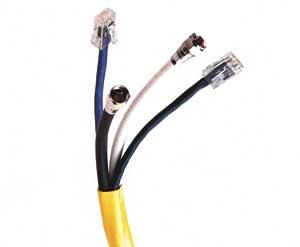
Most residential structured wiring installations include two Cat 5 cables and two RG 6 coaxial cables. |
Bundled cable, which is available from several manufacturers, is a sheathed cable that usually includes two Cat 5E cables and two RG 6 coax cables. Some types of bundled cable also include two fiber-optic strands. Standards. Fortunately, structured-wiring installers have achieved a consensus on what a new home requires. The existing standard for residential communications wiring is ANSI/TIA/EIA-570-A, published in September 1999. This standard offers two grades of service; most installers recommend that new homes be equipped with Grade 2 service, which requires installing two Cat 5 cables and two RG 6 coax cables to most rooms. Standard 570-A requires wiring to conform to a star topology (meaning that each outlet is served by home-run cables running back to a centrally located distribution panel). This standard replaces an earlier standard, 570, which permitted daisy-chaining cables.
Industry Hurdles
From the perspective of companies promoting structured wiring, most Americans, including builders as well as homeowners, are ill informed about communications wiring. This lack of knowledge, they feel, is a major barrier to growth. Component manufacturers are trying to reassure bewildered customers by forming marketing alliances. In February, 2001, Smart Corp., a home-automation products manufacturer in Las Cruces, N.M., announced an alliance with appliance manufacturer General Electric and software giant Microsoft. Similarly, Home Director, a manufacturer of home-automation products, recently announced a partnership with Sears Connected Home, the home-automation division of Sears Roebuck. The marketers forming these alliances hope that uncertain homeowners and builders will be more likely to purchase systems from a company with a well-known brand name. Another hurdle for the industry is public indifference to home-automation features. A sizable fraction of the population is content to control their lights with toggle switches and their furnaces with old-fashioned thermostats, and doubt the need for their home appliances to be connected to the Internet. But even skeptics admit that though their refrigerators don’t need to be online, their teenagers do. “What’s driving this thing is the demand for faster Internet,” says Bill Black. What about existing homes? High-tech proponents predict that within the next five or ten years, structured wiring will become standard in new homes, just as indoor plumbing did in the early years of the twentieth century. When it comes to rewiring existing homes, however, predictions vary. “Only a small percentage of homes in the marketplace have fanatics who want to rewire their homes,” says Richard Dunfee, training program manager at BICSI, a Tampa, Fla.-based trade association for manufacturers and installers of communications wiring. Many manufacturers are developing systems to permit computer networking and broadband Internet access without installing any new wires. Under development are wireless systems using radio-frequency (RF) communication, powerline systems that transmit signals or data over existing AC wires, and systems designed to cram increasing amounts of data through existing 4-conductor phone lines. Consensus standards do not yet exist for these emerging “no new wires” systems. But even if wireless technologies eventually capture the existing-home market, the advantages of wired systems — better privacy and higher data-transmission rates — will almost certainly tip the balance in favor of structured wiring for new homes.
One supplier of structured-wiring systems, Home Director, calls its distribution panel a network connection center. All of a home’s Cat 5 cables and RG 6 coaxial cables are wired back to the panel in a home-run configuration, simplifying troubleshooting and future modifications. |
Climbing on Board
Before you decide to jump onto the broadband bandwagon, be sure to do your homework. Cat 5 wiring or bundled cable must be installed with care (see “High-Tech Home Wiring,” 5/00). The wires won’t be able to carry the data they were designed to transmit if they are installed with tight bends or too close to 120-volt AC wires, or if twisted pairs of wires are excessively untwisted when terminated in a box. The wires can also be easily damaged if they are pulled too hard or dented by staples. Careless rough-in is just one pitfall for the unwary. The main reason that most builders prefer to leave structured wiring to an experienced subcontractor is to ensure that someone else handles any problems during the warranty period. Who’s installing? Lately, everybody and his brother has been getting into the low-voltage wiring act. Contractors offering to install structured wiring include:
- members of CEDIA, a trade association that trains and certifies structured-wiring installers;
- electricians, some of whom have received training in low-voltage wiring;
- security-system installers, including Brinks Home Security (800/334-9750; www.brinkshomesecurity.com);
- cable television companies, including Cox Communications (404/843-5000; www.cox.com);
- installers employed by electronic retail chains, including Radio Shack and Best Buy;
- phone installers;
- manufacturer-certified installers selling packaged systems like Home Director (800/426-7144; www.homedirector.com) and OnQ (800/321-2343; www.onqtech.com).
Although most new homes do not include structured wiring, the percentage that do is growing rapidly. As a result, there is an acute shortage of qualified structured-wiring installers. Costs. The cost to install structured wiring in a new 2,500 square-foot home ranges from about $750 to $3,500, depending on what equipment is included. Cat 5 cable costs about 8 to 14 cents a foot, while bundled cable (which includes two Cat 5E and two RG 6 coaxial cables) costs about 50 to 85 cents a foot. Learning more. Three good sources of information on structured wiring are: CEPro magazine (508/358-3400; www.cepro.com); the Custom Electronic Design and Installation Association, or CEDIA (800/669-5329; www.cedia.org); and the Home Automation and Networking Association, or HANA (202/712-9050; www.hanaonline.org).


