Most project schedules in residential remodeling are built by one person and handed to everyone else. Typically, the project manager, salesperson, or the owner spends an hour or two building a schedule that reflects the promises they have made to the client. This schedule gets passed along to the lead carpenter who may take it seriously or may never look at it twice. The schedule might get tacked to a wall or it might end up on the floor of the van. In either case, the most likely outcome is that before demo is complete the schedule no longer reflects reality, and everyone quietly agrees to stop pretending it does.
After struggling with this for years from both the field and the office, I now view this as a system failure not a people failure. The schedule isn’t wrong because one person built it badly. It’s wrong because one person built all of it. Project duration, phase sequencing, and day-by-day task order require three different kinds of knowledge, owned by three different people. When one person tries to carry all of it, the parts they are farthest from are the parts that fail.
At TDS Design Build we close more than 90% of our projects on the schedules that were set during contract negotiations—two to three months before work began. We’re not able to do this because we’re unusually good at predicting the future. We’re able to do it because we’ve built a scheduling system where each layer of the schedule is owned by the person closest to that layer of the work.
Each layer of the schedule is owned by the person whose knowledge matches that layer’s required precision.
Schedule Layers
I’ve written previously in JLC about Volume Per Week (VPW) and its role in setting project duration based on historical data. In a nutshell, VPW is the average revenue your company produces per week on projects of a given type and size. On a $180,000 remodel with a VPW of $18,000, the expected hammer-swinging duration is 10 weeks. VPW gives you the container for the project. Structuring what goes inside the container—the phases, the trade partner sequencing, the day-by-day task order—is where most scheduling systems break down. That’s because they treat all the variables the same.
Think about it in terms of what you actually know at each stage of preconstruction. When I’m setting overall project duration three months before we break ground, I have the contract price, the project type, and a set of drawings. I have no reliable knowledge of how the lead carpenter will sequence the day-to-day work of demo and framing against the mechanical rough-in work—because that depends on trade partner availability, which is unknown. Asking me to build that level of detail at that moment is asking me to invent it, which all but guarantees missed deadlines.
The inverse is also true. On the day the lead carpenter walks onto the site, they have detailed knowledge of what needs to happen today, tomorrow, and next week. What they don’t have, and shouldn’t need To figure out from scratch, is the overall project duration and the financial consequence of missing it. That ship sailed on the day the project was sold.
The same principle—what I call “the cone of uncertainty” and describe in “A Budget Represents What You Know” on my Substack (and elsewhere)—affects the budget. A budget built before design is complete carries more uncertainty than one built after. Not because the earlier budget is worse, but because less is known. You match the precision of your estimate to the precision of your information. Scheduling works the same way.
At TDS, we’ve built our scheduling system around this principle. Each layer of the schedule is owned by the person whose knowledge matches that layer’s required precision. There are four layers, four owners, and a clear sequence for when each layer gets built.
The Four Layers
Layer 1: Overall Duration (Owned by the Operations Manager)
The first question any schedule has to answer is the simplest: How long will this take? At TDS, that question belongs to me, and I answer it with VPW.
Once the project has a contract price, I use our historical VPW data, tracked across 60-plus completed projects, grouped by type and revenue range, to set the hammer-swinging duration.
For a $180,000 kitchen and bath remodel with a VPW of $18,000, the duration is 10 weeks. That number anchors everything that follows. It also feeds directly into our pricing: As I’ve written before, duration and gross profit are inseparable, and a project that runs two weeks long without a corresponding change order has already given up a meaningful slice of its gross profit.
Leadership-level ownership of this layer isn’t just about having the historical data. It’s about having the financial context to understand what the duration means. A lead carpenter who sets overall duration without understanding the gross profit consequence of an overrun is being asked to make a financial decision they are not equipped to make.
Layer 2: Phase Duration (Owned by the Build Coordinator)
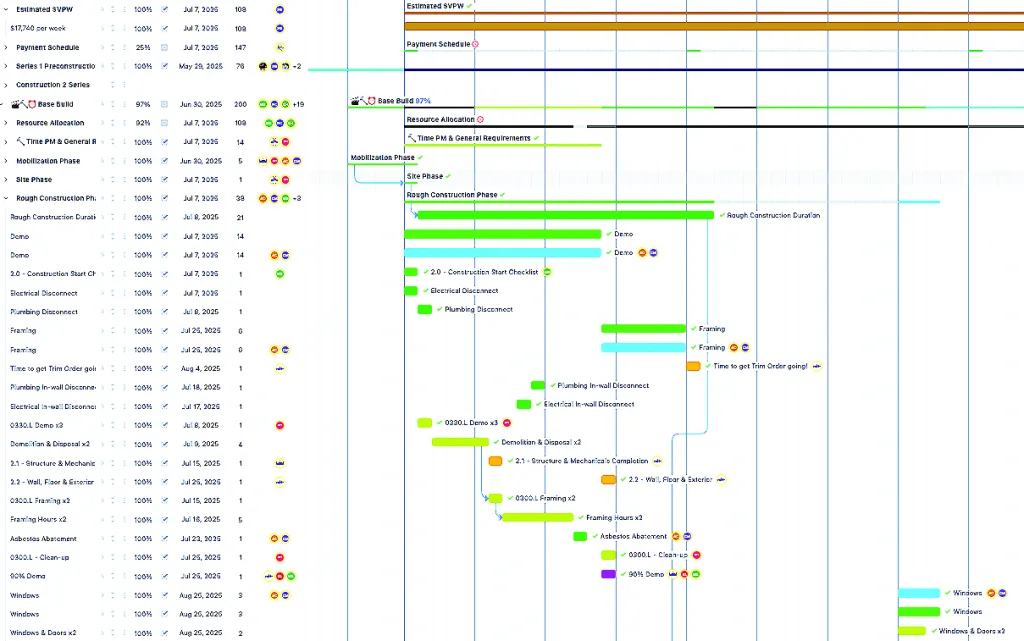
Once overall duration is set, our build coordinator, Phil, uses the Phase Cost Summary from our estimating spreadsheet to break the single duration bar into phases. The Phase Cost Summary allocates cost codes across the project’s construction phases—Mobilization, Site, Rough Construction, Rough Mechanicals, Exterior Finishes, Interior Finish, and Completion—and applies our VPW data to calculate the expected duration of each phase. Phil will introduce buffers based on his perception of how the construction phases may run in parallel.
Phil owns this layer because he lives in the intersection of procurement, cost data, and schedule structure. He knows what a Rough Mechanicals phase costs on projects like this one, and he knows how that cost translates to weeks of production given our trade partner capacity. I don’t carry that level of phase-specific detail in my head, and the lead carpenter shouldn’t have to build it from the drawings alone.
The output of this layer is a high-level Gantt chart in JobTread: one bar per phase, sized to the expected duration, arranged in the sequence the project will run. It’s not a finished schedule. It’s the skeleton on which the next two layers will hang.
Layer 3: Self-Perform vs. Trade Partners (Owned by the Project Manager)
The project manager, Kevin, takes Phil’s phase framework and refines it into a second layer of detail: which work TDS is self-performing and which work belongs to trade partners. This distinction matters enormously for scheduling because the two types of work have fundamentally different scheduling constraints.
Self-perform work—our demo, framing, and interior finish carpentry —is scheduled around our own crew’s capacity, which Kevin manages directly. Trade partner work—mechanical rough-ins, drywall, tile—is scheduled around the trade partners’ availability, lead times, and sequencing requirements, which Kevin has developed through the preconstruction buyout process. Kevin further refines Phil’s buffers and introduces additional buffers within the phases.
By the time Kevin hands the schedule to the lead carpenter, the project has a phase structure and a clear map of who is responsible for each scope of work. What’s still missing is the day-to-day detail of how the self-perform work unfolds onsite. That’s the one piece Kevin can’t build with confidence, because he won’t be on the site.
Layer 4: Boots on the Ground (Owned by the Lead Carpenter)
The lead carpenter builds the final layer: a day-by-day task sequence for the self-perform work, fitted inside the phase containers Kevin established. This is the schedule the crew runs.
Two things are true about this layer that make lead-carpenter ownership essential. First, the lead carpenter has site knowledge that no one else has—they’ve walked the job, they know the access constraints, they’ve talked to the trade partners about sequencing preferences. Second, the lead carpenter is the person who will be held accountable if the day-to-day work doesn’t stay on track. Accountability requires ownership. A lead carpenter executing someone else’s day-to-day schedule is a lead carpenter who can always blame the schedule. A lead carpenter who built the day-to-day schedule has full accountability for their outcomes.
A schedule problem caught in preconstruction costs a conversation. The same problem caught in week seven costs margin.
Impact on Finances
The scheduling system isn’t just an operational convenience. It’s a financial instrument, and understanding why requires one more metric.
In my previous JLC articles on GP/Day, I wrote that every project needs to be evaluated not just by gross profit percentage, but by how much gross profit it delivers per day of duration. A $180,000 kitchen at 30% gross profit generates roughly $770 in gross profit per day across its 10-week run. That number isn’t arbitrary. It’s the daily contribution the project must make to keep the company’s financial engine running.
When a project runs long, that number tells you exactly what the overrun costs. Two unplanned weeks on that $180,000 project—10 additional working days at $770 per day—is roughly $7,700 in gross profit that was never in the budget to lose. No change order was written. No client conversation was had. The money simply didn’t arrive because the project didn’t finish when it was supposed to (which also tied up resources that should have been used on
another project).
This is why the accountability stack matters beyond the organizational logic. When the lead carpenter owns the day-by-day layer, a slipping task sequence is visible to the person who can act on it immediately. When the project manager owns the trade partner layer, a subcontractor scheduling conflict surfaces during buyout, not during rough mechanicals. When the build coordinator owns the phase layer, a phase that’s budgeted too thin shows up in preconstruction, not five weeks from completion.
The system pushes problems upstream, toward cheaper solutions. A schedule problem caught in preconstruction costs a conversation. The same problem caught in week seven costs margin.
Where This Comes From
My team and I did not invent the principles behind this system. The idea that scheduling precision should be matched to the knowledge of the person building it has roots in Takt Planning and Pull Planning techniques used by large commercial contractors—methods that have been slow to migrate into residential remodeling, partly because they require a team structure sophisticated enough to distribute the ownership.
That’s the prerequisite most residential companies skip. The system only works if the roles are real. A build coordinator who doesn’t live inside the cost data can’t own the phase layer. A project manager who hasn’t done the preconstruction buyout can’t own the trade partner layer. A lead carpenter who hasn’t walked the site and been onboarded to the project can’t own the day-by-day layer. The scheduling system reflects your team’s actual depth. It is not a substitute for it.
What we’ve found is that when the roles are right, the schedule takes care of itself. Each person builds the layer they can see clearly, and the layers connect. Inevitably, when something breaks, it breaks visibly and early enough to respond to—rather than silently and in a costly manner.
That’s the difference between a schedule that ends up on the floor of the van and one that closes 90% of your projects on time.