U.S. lumber interests won an early round this month in their battle to restrict lumber imports from Canada: “The U.S. International Trade Commission says it has found there was a reasonable indication that softwood lumber products from Canada materially injured American producers,” reported the CBC (see: “U.S. International Trade Commission says Canadian softwood lumber caused harm,” by The Canadian Press). “The preliminary finding could force U.S. importers of Canadian lumber to pay cash deposits to cover preliminary countervailing duties in early March, followed in mid-May with deposits for any anti-dumping duties, unless the deadlines are extended,” the paper reported. The ruling opens the door for a long, drawn-out legal proceeding, but Canadian Minister of Foreign Affairs Chrystia Freeland (Wikipedia) is holding out hope for a negotiated solution. Read More:
- “Canada-U.S. trade not broken so no need for Trump to fix it: Freeland,” by Mike Blanchfield (news1130.com)
- “Freeland is hanging on to the Canada-U.S. trade file,” by Matthew Usherwood (iPOLITICS)
- “Tough days ahead for Canada-U.S. trade on softwood lumber predicts trade lawyer,” by The Canadian Press (Daily Commercial News)
- “Trump has aimed his NAFTA criticism at Mexico. But Canada is now worried,” by Alan Freeman (Washington Post)
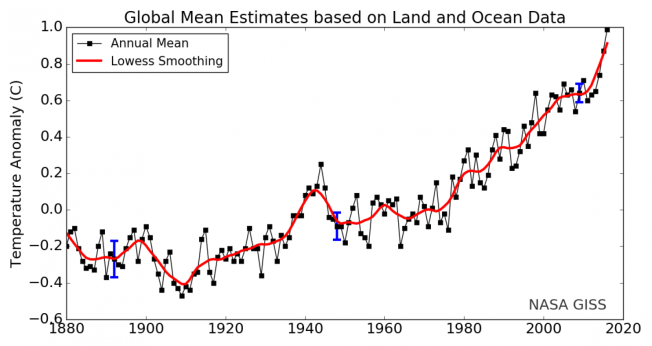
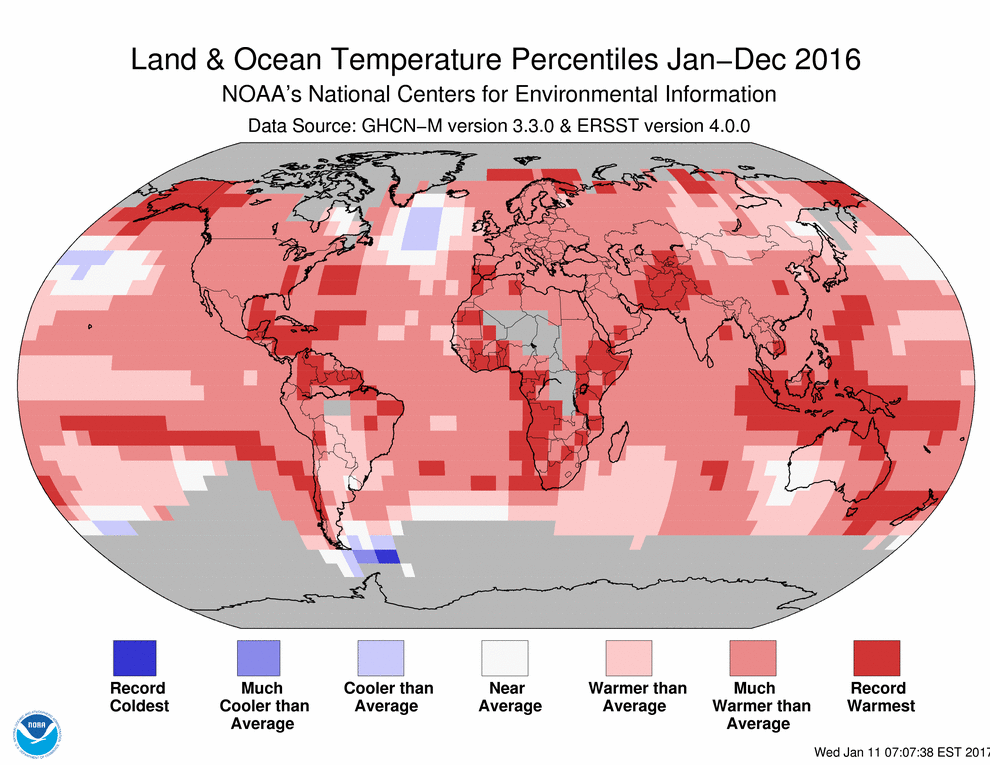
2016 was the warmest year on record for planet Earth, researchers reported in January. The New York Times had this report (see: “Earth Sets a Temperature Record for the Third Straight Year,” by Justin Gillis). “NASA’s calculations suggested that the planet had warmed by well over a half-degree Fahrenheit from 2013 to 2016,” the paper reported. “That is a huge change for the surface of an entire planet to undergo in just three years, and it appears to be the largest temperature increase over a three-year period in the NASA record, which begins in 1880.” The Washington Post wrote, “Extreme high temperatures were seen from India — where the city of Phalodi recorded temperatures of 51 degrees Celsius (123.8 Fahrenheit) in May, a new national record — to Iran, where a temperature of 53 degrees Celsius (127.4 F) was recorded in Delhoran on July 22 (see: “U.S. scientists officially declare 2016 the hottest year on record. That makes three in a row,” by Chris Mooney). “For the contiguous United States, 2016 was merely the second-warmest year on record, but for Alaska, it was the warmest yet recorded, underscoring once again the sharpness of Arctic warmth, in particular.” Read More:
- “Global sea ice is at lowest level ever recorded,” by Michael Le Page (New Scientist)
- “Confirmed: 2016 the Warmest Year in History of Global Recordkeeping,” by Jeff Masters and Bob Henson (Weather Underground)
Rick Perry, the former Governor of Texas who famously forgot the Energy Department when listing agencies he planned to abolish in a debate during his 2012 Presidential bid, is now President Donald Trump’s nominee to head the department. Perry now regrets calling for the department’s abolition, he told Senators last week. The Washington Post had this report (see: “Rick Perry expresses ‘regret’ for pledging to abolish Energy Department,” by Steven Mufson and Sean Sullivan). The New York Times reports that even after accepting Trump’s offer to lead the department, Perry was misinformed about the agency’s function (see: “‘Learning Curve’ as Rick Perry Pursues a Job He Initially Misunderstood,” by Coral Davenport and David Sangerjan). “Mr. Perry gladly accepted, believing he was taking on a role as a global ambassador for the American oil and gas industry that he had long championed in his home state,” the Times reported. “In the days after, Mr. Perry, the former Texas governor, discovered that he would be no such thing — that in fact, if confirmed by the Senate, he would become the steward of a vast national security complex he knew almost nothing about, caring for the most fearsome weapons on the planet, the United States’ nuclear arsenal.”
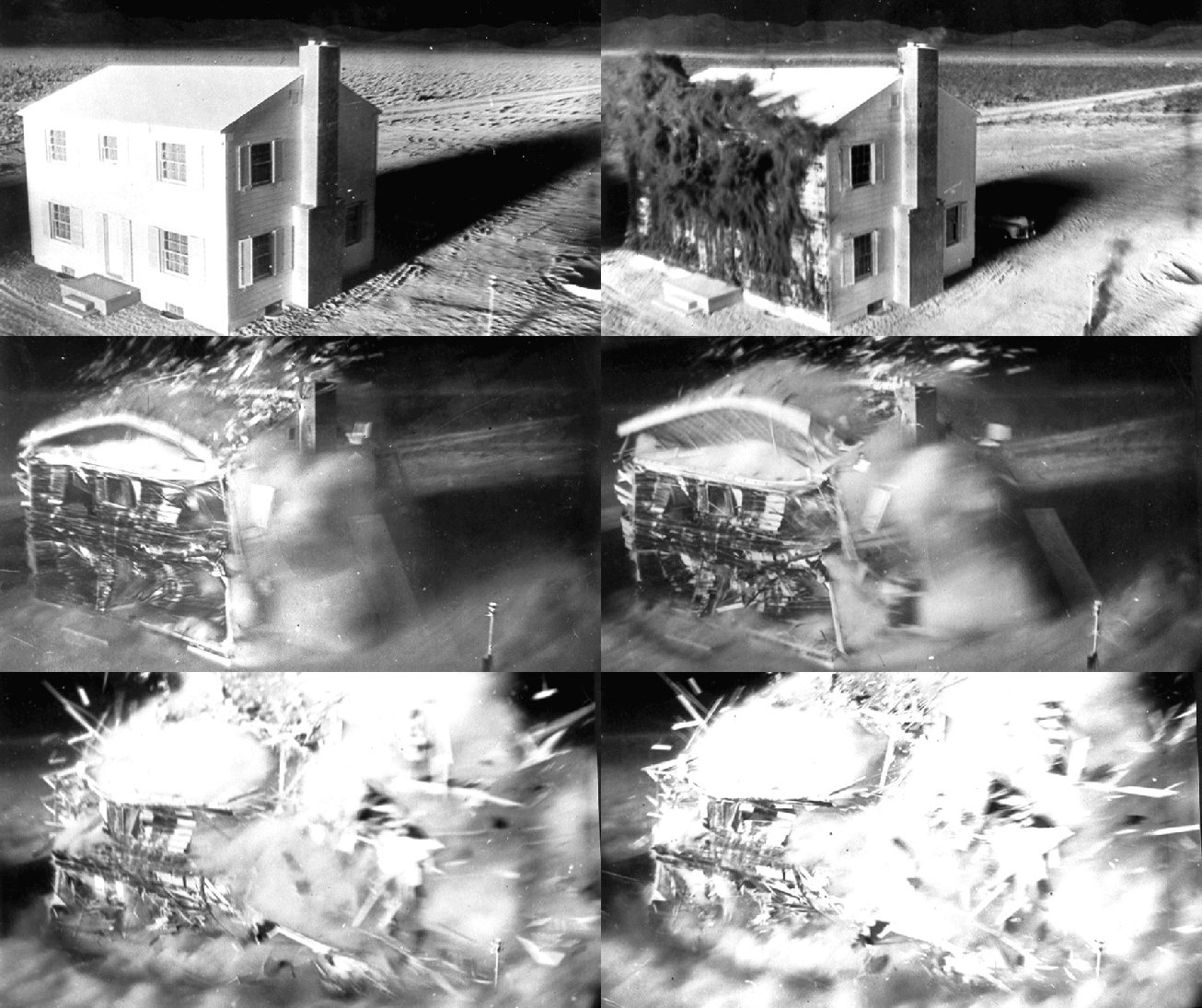
A nuclear device destroys a test house in March 17, 1953, at Yucca Flat at the Nevada Proving Ground. (Photo by Department of Defense)
“The Energy Department — specifically the National Nuclear Security Administration (NNSA) — is responsible for ensuring the integrity and safety of the nation’s nuclear weapons, advancing nuclear nonproliferation and promoting international nuclear safety,” explains an Energy Department website. But the department is also important in the homebuilding industry: the agency’s Building Energy Codes Program’s Building Technologies Office (BTO) “supports the development and implementation of residential and commercial building energy codes by engaging with government and industry stakeholders, and by providing technical assistance for code development, adoption, and compliance,” the agency says. DOE-created software packages, COMcheck and REScheck, automate the process of verifying compliance with the International Energy Conservation Code.
DOE’s future role in energy conservation may be up in the air. But the Washington Post noted that Perry, while certainly a cheerleader for Big Oil, has also done his bit for Mighty Wind: “During Perry’s tenure, Texas became the nation’s leading wind energy state,” the paper reported. “In 2000, Texas wind energy production was 200 megawatts. By the end of 2015, the state had nearly 18,000 megawatts of installed capacity, driven by more than $32 billion of private investment in wind farms. Perry’s decision to support expansion of the Texas electric transmission lines spurred almost $7 billion in areas such as western Texas.” Read more:
- “Texas Sets New All-Time Wind Energy Record,” by Robert Fares (Scientific American)
- “When we Tested Nuclear Bombs” (Atlantic Big Picture Blog)
STATE BY STATE
South Carolina. You know your real estate market is hot when parking spaces cost more than cars do. The Post and Courier has this report: “A single parking space in downtown Charleston is being sold for $74,000 — but that’s not even the most expensive one,” by Caitlin Byrd.
Washington. Speaking of expensive real estate: Seattle is seeing rising prices in a tight market, reports the Seattle Times (see: “Why are home prices so high? Seattle has 2nd-lowest rate of homes for sale in U.S.,” by Mike Rosenberg). Seattle ranks second in the nation on Realtor.com’s ranking of cities with a scarcity of for-sale listings (see: “Sold Out: These 10 U.S. Cities Have the Biggest Housing Shortages,” by Yuqing Pan).
Louisiana. With FEMA-led flood recovery efforts slow, private charities are trying to fill the void, reports the Advocate (see: “Baton Rouge nonprofits in the thick of flood recovery while survivors wait on FEMA,” by Andrea Gallo).
North Carolina. Officials in the Outer Banks town of Currituck have blocked the completion of a controversial mega-home intended for hosting large events, reports the Elizabeth City Daily Advance (see: “Currituck blocks finishing of massive home on beach,” by William F. West).