
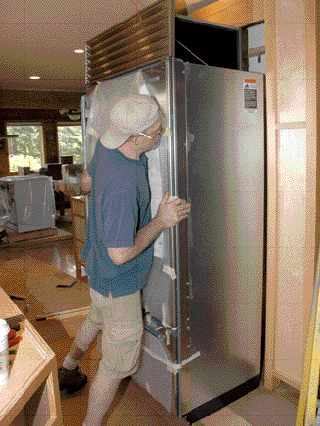
Early in my career, I worked exclusively as a custom
cabinetmaker; I didn't concern myself with appliances other
than to make sure that the openings for them were the right
size. It wasn't until I became a remodeler and found myself
responsible for the entire project that I learned how to plan
properly for appliances. Not only do the units themselves have
to fit, but the mechanicals have to be located so that
connections can be made without reworking rough-ins or
butchering cabinets.
Specifications
The importance of appliance specifications cannot be
overemphasized. Our company policy requires that all appliance
decisions be made before the cabinetry is designed and the
actual work is begun. Even small differences between models can
cause problems if you don't pay attention.
Simply knowing the size of the openings and what utilities to
bring in isn't enough, either: You must read and become
familiar with all of the installation requirements. If you
don't follow the instructions, the manufacturer will not honor
the warranty.
Also, don't assume the instructions are complete or accurate.
Several years back, the motherboard on an oven I'd installed
burned out because the instructions failed to mention venting
the cabinet. At first, the manufacturer blamed me and said I'd
have to pay for the replacement. But I'd saved the instructions
and was able to show that they didn't mention venting. In the
end, the company admitted its mistake, replaced the oven, and
paid for me to modify the cabinet according to the new
specifications.
Now when something in the instructions seems off-kilter, I call
the manufacturer's technical-support number and check.
Ranges
There are two main types of slide-in ranges: freestanding and
built-in. Both sit on the floor. Freestanding units project
slightly above (1/8 to 1/4 inch) the countertop and have a
raised back that butts to a wall; since countertop edges are
partially visible, they need to be finished. Built-in ranges,
by contrast, have trim pieces that seal the gaps between the
countertop and appliance. They come with or without raised
backs, making them suitable for island applications.
Size of opening. Face frames usually hang 1/8 inch or more
beyond the sides of the cabinet boxes (see Figure 1), so if the
specifications call for a 30-inch opening I install face-frame
cabinets 30 inches apart edge-of-frame to edge-of-frame. With a
1/8-inch overhang, the sides of the boxes will be 30 1/4 inches
apart; the extra space makes installing the appliance easier
and keeps it off the sides of the boxes.
Figure 1. When installing face-frame
cabinets on both sides of an appliance bay, the author measures
from scribe to scribe to create the specified opening; the
extra quarter inch leaves more room for the appliance itself to
fit (left). Frameless cabinets (right), with their tight
reveals, are less forgiving.
Frameless cabinets have no overhang, so when I install them I
hold each side about 1/16 inch back from the opening; this
gives me a 30 1/8-inch space between boxes. I make sure the
person fabricating the counters knows to run them 1/16 inch
beyond the sides of the boxes so that the counter opening is 30
inches wide.
Figure 2. The rough-in for a dual-fuel
range includes a 220-volt outlet, a gas connection with
shutoff, and — farther up the wall — a clip to
prevent tipping.
Some ranges are required to be a specific distance from
adjacent drawer fronts and doors so that heat doesn't char or
melt the cabinet fronts. Accommodating these clearances is easy
if you know about them in advance, but if you don't, you may
have to shift the cabinet layout in the field and install
filler pieces.
Gas and electric hookups. Ranges can be all-electric, all-gas,
or dual-fuel (gas burners with an electric oven). Electric and
dual-fuel models usually require a dedicated 220-volt circuit
(40 or 50 amps) in the wall near the floor (Figure 2). Don't
assume you can reuse the existing three-wire circuit; many
jurisdictions don't allow you to ground through the neutral, so
you will have to run a new four-wire circuit.
All-gas units require 110-volt electrical service for the
electronics and ignition. The gas shutoff valve is typically
located next to the wall just above the floor. The exact
position varies according to the manufacturer's requirements
and the location of joists.
Most houses have a 1-inch gas-supply line, and that's usually
enough. But multiple appliances and long runs may strain gas
flow, so when remodeling a house with many gas appliances I
always ask the mechanical contractor to inspect the system and
verify that there will be adequate flow.
Cooktops
There are two types of cooktops: drop-ins and range tops. With
a drop-in, the counter is continuous and there's no break in
the face of the cabinets. A range top slides into an opening
that interrupts the edge of the counter and the cabinetry face.
Since range tops vary in height, custom cabinets may be
required (Figure 3).
Figure 3. In the best-looking
installations, a range top — which gets mounted on a
custom-height cabinet — is flanked by drawers that match
its height.
The gas shutoff and electrical connections are usually in the
cabinet below the unit. The one exception is when a gas cooktop
is installed over an undercounter oven, in which case the gas
shutoff must be in an adjacent cabinet; if there's room, the
electrical connection can be behind the oven. Don't assume that
any cooktop can be installed over any oven: Some appliances are
not compatible, generally because the necessary clearances
can't be maintained.
The instructions for a drop-in cooktop specify the size of the
opening in the counter and the clearance (or air space) needed
for cooling. Most drop-ins overlay the edges of the opening and
screw or clamp to the underside of the counter.
One issue often overlooked in cabinet layout is how the space
below the cooktop will be used. To maximize storage, I always
try to position the mechanicals along the far back wall of the
cabinet. The current trend is to put a lot of drawers in base
cabinets, which works fine under cooktops and range-top units
as long as allowances are made for utilities and the required
clearance from combustibles. Ideally there should be a 4-inch
space for utilities behind the drawers in cabinets that contain
cooktops (Figure 4).
Figure 4. To allow room for the electrical
connection, the drawer in this cooktop cabinet (above left)
stops short of the back. An electrician removes it and installs
the cooktop (above right), then makes the connection with
armored cable (bottom).
Putting the gas shutoff behind drawers is also acceptable. The
requirement is that the shutoff be accessible; since drawers
are removable, the area behind them qualifies. Service people
can follow the supply line to find the valve.

Built-in Ovens
Wall ovens can be difficult to install because they're heavy
and have to be maneuvered into tight openings. The tolerances
are exacting — even more so than for other appliances. If
the opening is just a little too small or slightly out of
square, the oven won't fit. And if it's too big, the trim won't
cover the gap.
Like all appliances, ovens require dedicated circuits. The
electrician roughs in a wire that is later routed into the
cabinet (Figure 5). The oven comes with a flex conduit with
conductors ready to be hard-wired to a junction box in the back
of the cabinet just before installation.
Figure 5. An electrician makes the
220-volt connection to a built-in convection-microwave oven
(left). The electrical box will be mounted in the back of the
cabinet, which will also contain a conventional built-in oven,
shown here (right) being lifted into place.
Undercounter ovens are installed the same way as wall ovens;
the only difference is that they go under a counter. A gas oven
should be connected to a dedicated 110-volt circuit and to a
gas valve in an adjacent cabinet.
Microwaves
There are two kinds of built-in microwaves: models that can be
installed only in cabinets, and models that can sit on the
counter or be field modified for installation in a cabinet.
Field modifying a microwave means installing an optional vent
that redirects the exhaust from the back (where it's typically
located on countertop units) to the front, and adding trim to
cover the gap between the appliance and the cabinet.
For either kind of microwave, you have to provide a
specific-sized opening and electrical power in a specific
location. Typically, the opening is much larger than the
appliance, so there's room to attach venting. The hardest part
of this installation is lifting the unit into place (Figure
6).
Figure 6. The author lifts a microwave
into a cabinet (left), which for venting purposes will remain
open from below. The microwave is held in place from above and
will be plugged into a 110-volt outlet (right).
Microwaves draw a lot of amperage and — like any
appliance — require dedicated 110-volt circuits. A large
built-in unit must be hard-wired; a small one has a power cord
that plugs into an outlet you provide.
The most common wall-mounted application is an over-the-range
microwave/ventilation unit. These appliances hang from brackets
screwed to studs in the wall. Once in place, the ventilation
fan should be connected to a metal duct that runs to the
exterior. It's important to use the correct-size duct and not
to exceed the maximum run or number of fittings allowed by the
manufacturer.
Ventilation
Updraft ventilation systems are typically mounted on the wall
or — for island installations — hung from the
ceiling. Wall-mounted updrafts are the simplest to install:
They're secured to the wall or to adjacent cabinets and then
connected to the duct and a dedicated 110-volt circuit.
Island units are a little more complex. The duct must come out
of the ceiling exactly where the hood will be; blocking must be
installed in advance so there's something to hang it from. Most
units are designed to fit standard flat ceilings, so if a
ceiling is sloped or especially high, a duct cover may have to
be custom fabricated (Figure 7).
Figure 7. Since this vent hood wasn't tall
enough to reach the ceiling, the author extended it with metal
angles and a vertical run of duct (left) that will be hidden
behind a custom-fabricated cover. The hood plugs into an outlet
in the ceiling above (right).
The motor can be attached to the unit itself (the most common
and least expensive approach) or installed remotely on the roof
or sidewall. One advantage of a remote installation is that it
keeps the motor noise out of the kitchen.
Downdraft models. Although not quite as popular as it
was once, downdraft ventilation is still a good choice for
island-mounted cooktops when the presence of an overhead hood
would be objectionable (Figure 8).
Figure 8. This downdraft vent (left) ducts
through the bottom of the cabinet and connects to a remote fan
and motor on the outside wall (right).
Some ranges come with the downdraft unit built into the
chassis. Cooktops, however, require a separate downdraft
element. Components must be compatible; I've found it's best to
work with an appliance dealer who can specify what will
work.
Among the details you need to know to plan the installation are
the size of the opening in the counter, the size of the
cabinet, and the path the duct will take. The cooktop and
ventilating unit have to share the same opening, so it must be
sized accordingly. Most downdraft/cooktop combinations are
designed to fit inside a standard 24-inch cabinet. If possible,
I specify a slightly larger cabinet, to provide more room for
the appliance and ductwork. The downdraft unit will be smaller,
lighter, and easier to install if the motor is mounted
remotely.
Ductwork. Running the ductwork is usually the hardest part of
the installation. Because the pipe run is a straight shot up
from the hood, it's easiest to vent through the roof. If the
space above is finished, though, you have to go through the
sidewall. Every manufacturer specifies the duct size, maximum
duct run, and number of elbows allowed. Exhaust fans are
designed to work with rigid metal pipe, so don't use flexible
duct. It's critical to do accurate layout at the rough-in
stage; once installed, metal pipe is hard to move.
Ideally you will be able to avoid floor and ceiling joists. If
not, consult a structural engineer about making changes to the
frame. On one recent remodel we had to cut ceiling joists and
make other modifications to help the 10-inch duct avoid
existing plumbing (Figure 9).
Figure 9. It's easiest to run an exhaust
duct through unfinished attic space (left). Ceiling runs are
harder (right); to avoid lights and plumbing, this 10-inch duct
had to jog between bays and through a joist —
necessitating an engineered design that involved doubled
3/4-inch subflooring above, and several sistered
members.
If the duct passes through unheated space, such as an attic or
crawlspace, it should be insulated to prevent condensation.
Most ventilation systems come with built-in dampers; to prevent
critters from getting in, a damper should also be installed
where the duct exits the building.
Dishwashers
With dishwashers, the important distinction is whether they are
of American or European design. American-made units require
24-inch openings; European models require 23 5/8 inches. If you
plan for an American model but install a European one, you'll
end up with an ugly 3/8-inch gap. I once had to move a cabinet
after the granite countertop had been installed just to rectify
the 3/8-inch discrepancy.
Double-drawer units stand on the floor, same as traditional
dishwashers. Single-drawer models sit on top of short cabinets,
much as range tops do.
Dishwashers require a dedicated 110-volt electrical circuit,
plus a hot-water supply and waste line. If the unit is
hardwired, a wire is run into the opening at rough-in and the
connection is made from the front at floor level after the unit
is installed. Many dishwashers now come with an attached plug,
so they can be plugged into standard outlets. It's best to wire
the outlet into an adjacent cabinet; that way, the appliance
can be easily disconnected for future service.
I've installed only a couple of dishwashers that weren't
located next to the sink cabinet. In both situations, we still
used the plumbing at the sink location. Plumbing rough-in is
fairly basic: Fresh water is supplied via an extra hot-water
stub-out. An angle stop is installed on trim with a flexible
water line running to the dishwasher through a hole in the side
of the cabinet. A flexible waste line runs through the same
hole and ties into the sink's P-trap or a dedicated waste
line.
Air-gap device. In our area the code requires that dishwashers
have an air gap in the waste line to prevent wastewater from
being siphoned inside. The standard way to achieve this is by
installing an air-gap device in the counter. However, many of
my clients absolutely despise having an extra hole in the
counter, so in their kitchens we install an air-gap fitting
called a Johnson Tee (Johnson Industries, 800/548-6895) during
rough-in. The product includes a 1/2-inch copper pipe that runs
from the sink cabinet location and connects to its own waste
pipe in the exterior wall (Figure 10). When the dishwasher is
installed, the drain hose is connected to this copper
pipe.


Figure 10. When customers don't want a dishwasher air-gap
device on top of the sink counter, the author installs a
Johnson Tee, an air-gap fitting approved by the Uniform
Plumbing Code that allows a 1/2-inch copper drain line to
connect directly to the ABS standpipe (left). The dishwasher
drain connects to the copper drain line (below).
I consider the Johnson Tee a great alternative to a
counter-mounted air gap, but some plumbers refuse to install it
because they claim the waste line is easily clogged. My
experience has been that if homeowners scrape their plates
before loading the dishwasher, clogging will not be a
problem.
Refrigerators
Standard refrigerators require nothing more than a dedicated
electrical circuit, a space against a wall, and perhaps a water
line for an icemaker. The placement of the electrical outlet is
not critical; I usually put it about 4 feet off the
floor.
There are two main ways to run the line for an icemaker. The
first is to use an in-wall shutoff valve that the water line
connects to. The second is to run soft copper pipe from the
sink cabinet to the refrigerator location — a method I
prefer because the water can be shut off without moving the
appliance. I also recommend putting a water filter in the line
that runs to the icemaker.
Built-in refrigerators have become very popular in high-end
kitchens. Their low profile allows them to be integrated into
standard 24-inch-deep cabinetry; the maker provides a specific
size opening and specific locations for the utilities.
With a Sub-Zero — one of the most common built-in
refrigerators we install — the water connection is made
in the center of the opening near the front of the unit. I
strongly recommend putting a water shutoff in the sink cabinet
so the appliance doesn't have to be moved if there's a leak (a
standard 36-inch-wide Sub-Zero weighs about 600 pounds). The
compressor is at the top of the unit, so the 110-volt outlet
needs to be at a spot high on the wall. Anti-tip blocking may
be required at the top of the opening (Figure 11).
Figure 11. The author installs an anti-tip
bracket for a Sub-Zero refrigerator (left). A soft copper water
line (right) is run to the front of the opening, where it will
connect to the icemaker.
Built-in refrigerators are installed after all the adjacent
cabinetry is in place. First, the flexible water line is bent
down and slid underneath the appliance. Next the unit is rolled
into the opening (finished floors should be protected). Once
the refrigerator is pushed all the way back, it must be
leveled. With the upper grille removed, the power cord can be
plugged in; then the appliance can be powered up and the upper
grille replaced. Finally, the water supply is attached from the
front of the appliance and the toekick cover is
installed.
Miscellaneous Appliances
There are plenty of other appliances you might be asked to
install, including trash compactors, warming drawers, wine
coolers, and espresso machines. In most respects these
appliances are similar to the more common ones described above:
All require electricity, and some also require water. The
bottom line is that you need to know in advance which models
will be used, and then do your rough-ins and cabinetry
installations in accordance with the appliance manufacturers'
specs.
David Getts owns David Getts Designer
Builder, a remodeling company in Seattle.

