
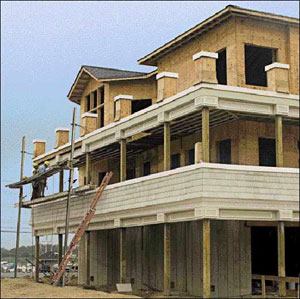
Deck durability begins with the house design. In hurricane zones, multistory decks over porches or integrated into the foundation footprint have a better chance of withstanding a major storm, while attached decks (inset) are more vulnerable to being ripped apart by storm waves and hurricane-force winds.
Decks and porches on beach homes take the brunt of any storm. Add to that the homeowners’ desire for low-maintenance finishes that stand the test of time even in a salt environment, and it’s clear that builders have to be especially fussy about their deck materials choices and installation methods.
We asked three East Coast builders who work on waterfront homes what materials and techniques they recommend for exterior decks. All agreed durability is the goal, but they each take a slightly different path to get there.
Fir Preferred
Peter Kroll of Cape Painting and Carpentry in North Falmouth, Mass., has been building and renovating homes on Cape Cod for 25 years. Many of these decks lie a few feet from the water. His customers tend to stick with him, many from the beginning of construction, and most of them are neighbors. “We live here, so we need to get things right,” he says. In this marketplace, Kroll also has to walk a line between durability and aesthetics. His customers want materials that offer low maintenance but that also look good on an expensive home. In this tradition-bound New England market, that usually means natural wood, not plastic.
Despite the moisture-resistance of composite decking, you won’t see it on any of Kroll’s projects. “There are too many things that can stain it: hamburger juice, suntan oil — even daily foot traffic can leave stains,” Kroll notes. “And once it’s stained, the stain is almost impossible to remove.”
Most of his deck surfaces are either ipe (Brazilian walnut) or vertical-grain fir. Although ipe stands up well to traffic and turns an appealing silver gray over time, Kroll prefers fir (Figure 1). “It has a tight grain and comes in a better mix of lengths,” he explains. He insists that a fir deck will last 20 years, and he notes that the quality of the material he’s getting these days remains good. Kroll doesn’t oil these decks. “I think it’s a waste of money. If you put a color on the wood, you’re stuck with that color and you have to reapply it every year.”
FIGURE 1. On outdoor decks, Peter Kroll of North Falmouth, Mass., prefers vertical-grain fir for its tight grain and the ready availability of mixed lengths. He doesn’t oil the wood; instead, he allows it to weather naturally. This reduces the maintenance for clients, as any outdoor finish would have to be reapplied every couple of years in a coastal environment.
Rule 2: Never notch railing posts. The National Design Specification for Wood Construction, on which the model building codes are based, prohibits notching in the middle third of a post and limits notch depth to one-sixth the depth of the member in the outer thirds and one-fourth the depth at the very ends. This amounts to a notch of only 1/2 inch in a 4×4 and 7/8 inch in a 6×6 — hardly worth the effort. And even this notching weakens the post by as much as 40%. If posts are notched, the cut should be coated with a preservative, such as copper naphthenate, which is yet another reason for avoiding notches altogether. Bean’s notchless railing details (Figure B) provide a lasting alternative. — Clayton DeKorne FIGURE B. Rather than notching railing posts, the Southern Pine Council recommends sandwiching the posts between a double rim joist and through-bolting the connection as shown. On railings running perpendicular to the joists, space posts so that they can be securely bolted to the ends of the joist. |
Fasteners. Kroll points out that the durability of an exterior deck includes the fasteners used to build it. Builders take a chance with galvanized fasteners, he says. His crews recently replaced a set of beach steps where the galvanized fasteners had rusted completely through. “They don’t last,” he states.
Instead, Kroll relies on stainless steel nails for fastening deck boards. But he’s found there’s really no alternative to galvanized framing nails. He never uses nail guns on exterior decks, either. It’s tough to get anything but an electrogalvanized nail from local suppliers. Kroll maintains these quickly corrode in a salt environment.
Hardware. Ordinary galvanized hardware is problematic as well. Ordinary joist hangers, in particular, quickly corrode outside in a salt environment. This problem has been exacerbated in recent years with the use of ACQ-treated lumber and other copper-based wood treatments. While a “triple zinc” product will hold up longer under coastal exposure conditions, Kroll has begun reinforcing the connection with stainless steel L brackets. He prefers to get other framing hardware from a marine-supply store. In Kroll’s experience, marine-grade hardware lasts longer in a coastal environment.
Durable Deck ConstructionWhile a coastal deck may feel sturdy when first built, you can be sure the wind, sun, and rain will go to work immediately, pushing and eating away at the fasteners and baking the wood fibers. It doesn’t take long under these conditions for structural weaknesses at railing posts and ledger boards to emerge. To ensure a strong deck, follow these basic guidelines: Rule 1: Never use nails as the attachment to the house. Instead, use lags or through-bolt connections (preferably in conjunction with framing hardware) for all structural connections joining deck to house, girder to column, post to deck, and rail to post. Even with the right hardware, however, water seeping into these connections will increase the chances for failure over time, cautions Steve Bean of the Southern Pine Council (SPC). The ledger itself is usually treated lumber, explains Bean, but most wall sheathing is not treated and rots relatively quickly. On an elevated deck, builders must go to extra lengths to protect the joint be-tween the ledger and sheathing (Figure A). For first-story decks, however, it’s better to avoid a ledger board altogether and build a freestanding deck that is not attached to the house. Bean recommends using a second support beam and posts next to the house instead of a ledger board. FIGURE A. An elevated deck must be rigorously attached to the building and painstakingly lashed to keep water from seeping between the ledger and the wall sheathing. |
Truck Tough
Anthony “Smokey” Saduk, project manager of Haffelfinger and Standeven Construction, builds beach homes in the Cape May County area of New Jersey. He stopped using cedar about five years ago because it was getting too soft. Although he likes ipe, he tends to use a more mahogany because it’s less costly. He likes the way it looks, and he doesn’t mind having to treat it each year. “Any wood will have to be treated,” he insists. He uses Cabot’s Australian Timber Oil (Figure 2), which he says “is super durable; it doesn’t flake, peel, or yellow.”
FIGURE 2. Cabot’s Australian Timber Oil will maintain a deep tone that contrasts well with white PVC trim (left). However, in a coastal environment, this finish will need to be maintained. If left unfinished, mahogany and ipe will gradually weather to a silver tone but maintain their integrity (below). In 12 years of using unfinished ipe, Eric Borden says he’s never seen it appreciably deteriorate. “I suspect it will last much, much longer than it has already,” he states.
Saduk is also ambivalent about composites. He tried composite decking when it first hit the market, but backed off on using the stuff after it had some problems with mold. Today, he will use it at the customer’s request, and he has used TimberTech composite decking with no mold problems. However, he never uses composites around oak trees, which he says put a black stain on the deck that’s difficult to get out. And while he also mentions problems with staining from grease and oils, he hasn’t heard complaints about it from customers.
Fasteners. Saduk doesn’t use regular stainless steel screws or nails on composite decking: screws tend to leave a mushroom at the surface that has to be removed, and the material moves so much that he’s afraid nails would tear out. He has had good luck with TrapEase deck screws (www.fastenmaster.com), which have a coarse thread at the bottom and a machine thread at the top, and will pull the boards tight to the framing with minimal mushrooming. But most of the time when fastening composite decking, Saduk prefers a hidden fastener system. He has used Deckmaster, Eb-Ty, and Tiger Claw systems.
Deckmaster (www.deckmaster.com) uses a metal bracket that’s fastened to the top edge of the joists before the decking is installed. The installers then lay the deck boards in place and drive screws through the bracket up into the underside of the boards. Saduk likes this fastening system but finds it labor intensive. The deck also has to be high enough off the ground for someone to get underneath it.
Eb-Ty (www.ebty.com) consists of a polypropylene biscuit installed between each deck board at every joist. The installer uses a biscuit joiner to make a kerf in the edge of the deck board, slips the biscuit into the kerf, and screws it into the top of the joist. The installer must also lay a bead of construction adhesive under each board. Saduk finds Eb-Ty to be about as labor intensive as Deckmaster, but he prefers it because his crew can do all the installation from above. And he says that big decks can be completed quickly: “We set up a table with jigs and someone on the jig table pre-slots all the boards.”
Tiger Claw (www.deckfastener.com) relies on 3-inch-long stainless steel fasteners that, like Eb-Ty, are driven into the edges of the boards and screwed down into the joists. But, unlike Eb-Ty, there’s no need to cut slots: prongs on the sides of the fasteners are simply hammered into the edge of the deck board. This sounds easier than it really is, according to Saduk. “The fasteners are made for composites, but composite decking is so hard that we end up beating ourselves to death. It’s really a pain; I won’t use this fastener again.”
Roof decks. Many of Saduk’s homes include rooftop decks above living spaces. He used to cover these with fiberglass, but says that after a few years the fiberglass would crack and delaminate, and its color would start to fade. About three years ago he heard about a spray-applied surface that’s made by Vortex from a blend of polyurethane and polyurea (www.vortexsprayliner.com). It was developed as a sprayed-on liner for truck beds but has a good track record on pool decks. It creates what Smokey describes as “a 1/4-inch-thick solid rubberized shell,” which he now uses it for all of his rooftop decks.
Saduk sprays the Vortex surface over an AdvanTech oriented strand board sheathing, because he finds that AdvanTech doesn’t swell as much as conventional OSB or plywood. Before applying the spray, he fills nail holes with auto-body filler, sands them flat, and then preps the surface with a Vortex-supplied sealant. Saduk sprays the surface before the siding goes on, extending it a foot up the wall and structural posts, so it will act as a flashing (Figure 3). The finished surface is coated with a UV inhibitor. He also uses the spray-on liner to mold door pans.
FIGURE 3. Along the East Coast, deck and porch surfaces over living space are usually treated with a fiberglass or polyurethane topping. Typically, the seams of a plywood subdeck get treated with fiberglass tape and Bondo epoxy before the topping is applied (top). Smokey Saduk has had problems with fiberglass toppings cracking and delaminating, so he prefers a spray-on liner over an AdvanTech OSB surface (above). This topping was originally developed as a truck liner, but it also has a good track record on pool decks.
So far, Saduk has been impressed with the material’s durability. “If you whack it with a hammer, you will dent the underlying wood but won’t tear the surface. And if you step on a roofing nail, the nail head won’t go through the material.” It’s even too tough to cut with a standard utility-knife blade. “The only way to cut it is with a roofing-hook blade.”
One drawback to using the material is that the sheathing has to be perfectly dry: you can’t install it if there’s high humidity, or if it has rained recently. And according to Saduk, it doesn’t adhere well to stainless steel flashings, but scuffing them up with a palm or disk sander solves the problem. (Stainless steel nails don’t pose a problem because they are set and then filled with auto-body filler.)
Storm Zone
Eric Borden of ESB Contracting in Toms River, N.J., has been building vacation homes around the Mantoloking, N.J., area since 1986. He builds on a narrow barrier island that ranges in width from three blocks to 1/2 mile. Most of his homes are traditional Shingle-style with natural wood exteriors, including cedar roofs and siding. Most have white trim and all have some type of exterior decking.
Design and structure. Borden says that the biggest challenge with decks isn’t durability but rather local zoning codes. “Zoning codes include raised-level decks in a home’s square footage. That means a 2,000-square-foot house with a 500-square-foot raised deck is considered a 2,500-square-foot house.” To avoid this penalty, he builds a lot of grade-level decks. “If the deck is on grade level, we can build a bigger house.”
Local zoning also gives grade-level decks preference over patios, according to Borden, because decks don’t count toward the impervious lot coverage, as pavers or concrete would. The purpose of the restrictions is to reduce storm-water runoff into bays and rivers. Surrounding a house with too much paving would defeat that purpose, while a deck with open spaces between the boards provides a way for water to drain into the ground around the house.
He says that the code requirements concerning wind uplift are straightforward. He simply has to take steps to securely anchor the deck structure, such as embedding galvanized straps in concrete piers and wrapping them over the deck beams.
However, when a major storm hits, the beach environment can create problems for conventional footings. “Everything we’re building on is beach sand, and if it gets waterlogged it acts more like water than sand,” he says. Because of this, some houses — and some raised decks — have to be built on piles driven deep into the sand. (Supporting the corners on piles and putting concrete piers between them is often sufficient.) Borden says that pile depth requirements for the deck are based on FEMA regulations, and are the same as for the main house. “In one house the elevation was 12 feet above sea level, so we had to drive the pilings 25 feet deep,” he recalls.
Railings. As for finish materials, Borden says that he picks the most durable ones he can, but he makes sure his customers know that any material will weather. “We build close to the dunes, so when a storm hits it’s like putting the house into a sand blaster. I don’t care what you build, there’s going to be maintenance.”
For more durable exteriors, Borden will use composite materials instead of wood if they perform better and don’t look like plastic. For instance, he makes deck and porch railings from Fypon (www.fypon.com), a high-density, closed-cell urethane railing system that includes a baluster with a structural pipe going down the middle (Figure 4). The railing and baluster pieces are glued together, then installed on the posts. While Fypon isn’t cheap, it’s easy to install and requires little or no maintenance over time. “With a wood railing, I guarantee it will eventually rot unless you’re constantly maintaining the paint,” he predicts. And he says that homeowners never guess that the material isn’t wood. “If I custom-turn a cedar baluster and paint it and then put it next to a Fypon railing, they can’t tell the difference.”
FIGURE 4.Hefty Fypon balusters cost Eric Borden around $50 each, while the top and bottom rails each run about $23 per linear foot. The alternative for Borden is custom-milled redwood or western red cedar balusters at $35 apiece and handrail at about $16 per linear foot. However, substantial savings with Fypon comes in the installation. Borden estimates the labor of installing wood is easily 30% more to assemble and finish, and the wood will have to be maintained frequently as well.
Borden says that common installation problems are the same as with wood, including installers that cut rails too short or drill balusters in the wrong places. “Sitting and reading the instructions is the best 20 minutes you will spend,” he advises.
Decking. When it comes to decking, Borden and his customers are still partial to wood, although he finds today’s choices less than ideal. “I don’t like the cedar they’re selling these days, even in the higher grades. It’s not as weather resistant as it used to be.” He also has been displeased with mahogany. He says that the species of mahogany he gets varies by delivery, so he can’t predict how it will perform over time. And he dislikes the fact that mahogany needs to be stained and restained each year in order to maintain its appearance.
One thing Borden likes about ipe, which he has been using for 12 years, is that he gets the same product from all the major distributors. “With ipe I know that the quality will be consistent. This is important, because we maintain a lot of the houses we build. We’ve had quite a few decks in place for years and we haven’t had to do any repairs.” While some builders have complained about shrinkage with ipe, Borden doesn’t find it to be a problem. He has seen customers get disappointed if they don’t understand how the wood will weather, so he makes sure to tell them what to expect. “I show them some weathered samples so they know how it will look in two years if they don’t finish it,” he says.
As for composites, aesthetics can also be a problem for Borden’s customers. “In our high-end $6-million vacation-home market, people feel like composites are not quite as high end.” As with any material, he says that helping customers understand how it weathers can reduce callbacks. “If you educate the client about how the deck will look in a year, you won’t get complaints about its appearance.”
Fasteners. Although Borden’s customers would rather not see fasteners on the deck surface, the fact that he builds a lot of grade-level decks in areas where the zoning requires him to space boards 3/8 inch apart (in order to allow sand to get through to help maintain the dunes) means he sometimes can’t use hidden fasteners.
When he has, he’s used the Eb-Ty and Tiger Claw systems (Figure 5). He says that while Tiger Claw is “easier and faster,” he has more experience with Eb-Ty. “It’s easy once you’re used to it,” Borden says. “But getting set up with biscuits and learning to use them is more time consuming, It wouldn’t be worth it for a small deck.” ~
FIGURE 5.Borden relies on hidden deck fasteners when zoning requirements allow. He typically uses Eb-Ty “biscuits” (top left) that get installed in a kerf cut in the edge of a board with a plate joiner, or Tiger Claw fasteners (top). The Tiger Claw install faster in hardwood, but they’re difficult to pound into the edge of composite decking. For composites, it’s better to use the decking manufacture’s proprietary fasteners, such as those made by Eb-Ty for CorrectDeck (bottom). Charles Wardell writes on construction topics from Vineyard Haven, Mass.


