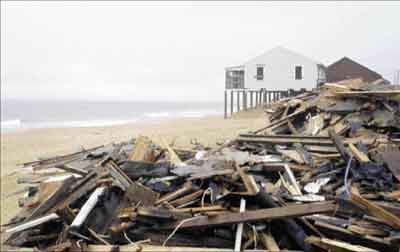
On the coast, the safest homes stand above the rest — on pilings
by Clayton DeKorne Decades of storm-damage assessments clearly demonstrate the need for more stringent foundation requirements in Coastal A zones
(Photo by Vince Lupo)
Along the eastern seaboard and Gulf Coast, most building codes require beachfront homes to be elevated on piling with little or no obstruction between vertical supports. In a severe storm, an elevated, “open” foundation will allow floodwaters to wash underneath the first floor without putting an excessive load on the structure and bringing down the house. Under current National Flood Insurance Program (NFIP) standards, which largely dictate local building codes in coastal communities, open foundations are required for homes in coastal flood zones that are rated for “velocity wave action” (V zones). This typically includes only the first row of homes on the beach. For homes in less exposed zones, piling foundations are widely recommended but rarely required, despite an overwhelming body of evidence that broader application of V-zone standards would mitigate much of the damage from storm surge.
SOURCE OF MAXIMUM DESTRUCTION
Storm surge is a swelling of ocean levels preceding a severe storm. The swirling winds created by hurricanes and other cyclones can push up a dome of water as large as 50 to 100 miles wide in front of the storm, leading to an increase in water levels ranging from 4 to 6 feet in a minor hurricane, to greater than 20 feet in big storms (when it combines with high tide). The level of the surge depends, in part, on the slope of the continental shelf along the coast. The shallower the coastal waters, the more floodwaters surge ashore. In most places, the shelf surrounding the Atlantic and Gulf shores is relatively wide and shallow, and most of this densely populated coastline lies less than 10 feet above mean sea level. Consequently, the danger from storm surge is tremendous. According to the Federal Emergency Management Agency (FEMA), in nearly every hurricane on record, storm surge is responsible for more deaths and more property damage than any other effect of the storm, even high winds.
In North Carolina, a 15-foot surge in front of Hurricane Floyd flattened Oak Island’s frontal sand dune, then took down homes like the one shown on the left, which once stood on a ground-level block foundation. Damage inspectors reported that the home likely would have been saved if it had been elevated on piling like that shown on the right. (Photo courtesy Dave Gatley/FEMA)
Waves can exert enormous pressures on buildings. While winds wield pressures in the tens of pounds per square foot, a 2- to 3-foot wave can exert pressures in the hundreds or even thousands of pounds per square foot, says Christopher Jones, an engineer from Durham, N.C., who wrote the current edition of FEMA’s Coastal Construction Manual-FEMA 55 (available free from FEMA; 800/480-2520). These are forces that ordinary solid walls can’t easily resist.
Despite the magnitude of the force, protection proves relatively straightforward: Simply elevate the house above the surge. In storm after storm, inspectors assessing damages report that homes elevated on piling survive relatively unscathed compared to older homes supported by solid foundations (see “Lessons Learned After the Storm,” below). Homes that are not elevated are frequently inundated with floodwater or swept off their foundations entirely.
LESSONS LEARNED AFTER THE STORM Reports from FEMA inspectors assessing the damage to coastal communities after major storms build a convincing case for broader application of V-zone requirements in Coastal A zones. The following excerpts relating to foundations are extracted from the “historical perspective” presented in the Coastal Construction Manual: Hurricane Frederic, Alabama and Mississippi, 1979: “Approximately 73 percent of front row homes were destroyed, while only 34 percent of second and third-row buildings. The destruction of non-elevated buildings was predictable; however large numbers of elevated houses built to the BFE enforced at that time were also destroyed. Analyses confirmed that much of the damage to houses elevated to the BFE occurred because the BFE was based on the stillwater level only. It was after Hurricane Frederic that FEMA began to include wave heights in its determination of BFEs in coastal flood hazard areas.” Hurricane Gloria, New York, 1985: “Oceanfront homes had been left vulnerable to flood, erosion, and wave damage by previous northeast storms. Accordingly, damage from Gloria included settlement of inadequately embedded pilings, loss of poorly connected beams and joists, failure of septic systems due to erosion, and water and overwash to non-elevated buildings.” Hurricane Bob, Buzzards Bay Area, Massachusetts, 1991: “Buildings constructed before the date of the Flood Insurance Rate Map (FIRM) for each community — referred to as pre-FIRM buildings — that had not been elevated, or had not been elevated sufficiently, suffered major damage or complete destruction…. Post-FIRM buildings and pre-FIRM buildings with sufficient elevation performed well during the storm.” Hurricane Hugo, S.C., 1989: “Post-FIRM buildings that were both properly constructed and elevated survived the storm. These buildings stood out in sharp contrast to post-FIRM buildings that were poorly designed or constructed.” Northeaster, Nags Head, N.C., Kill Devil Hills, N.C., and Sandbridge Beach, Va., 1989: “Failure of the pile-to-beam connection was observed where a bolt head lacked a washer and pulled through the beam…. Cracks in, or failed connection to, piles and deck posts were, in some cases, attributed to cross-bracing oriented parallel to the shore or the attachment of closely spaced horizontal planks.” Hurricane Fran, southeastern N.C., 1996: “Many buildings in mapped A zones were exposed to conditions associated with V zones, which resulted in building damage and failure from the effects of erosion, high-velocity flow, and waves…. Hundreds of oceanfront homes were destroyed by the storm, mostly as a result of insufficient pile embedment and wave effects.” Hurricane Opal, Florida Panhandle, 1995: “Damaged buildings [included] pre-FIRM buildings founded on slabs or shallow footings and located in mapped V zones, and post-FIRM buildings outside mapped V zones.” This duplex built on a ground-level foundation prior to the 1986 North Carolina State Code was knocked apart by storm surge from Hurricane Fran. (Photo courtesy Dave Gatley/FEMA) |
A-ZONE RISKS
Post-storm assessments suggest the need for a broad redefinition of design and construction standards in coastal A zones, but so far, nothing public has been written into the NFIP. At issue is how communities distinguish between places where homes must be elevated and places where solid foundations are deemed safe.
Currently, the NFIP literally draws this distinction on Flood Insurance Rate Maps (FIRMs) by specifying V zones and A zones. V zones, which are the only zones designated high hazard areas, include the shoreline subject to damage from waves 3 feet and higher. In V zones, the lowest portion of the first-floor framing must be elevated above the Base Flood Elevation, or BFE, and no permanent enclosures are allowed below the first floor (see “Deciphering Elevation Standards,” below).
DECIPHERING ELEVATION STANDARDS The flood zones (or Special Flood Hazard Areas) marked on flood insurance rate maps, show locations with a 1 percent probability of flooding to or above a specific elevation in any given year. For each hazard zone on the map, FEMA specifies the likely flood elevation, known as the Base Flood Elevation (BFE) — a height determined by a statistical analysis of the last 100 years of measured stillwater elevations and calculated heights for waves and wave runup. Stillwater elevations (a misnomer) are the elevations of the water surface resulting solely from storm surge, while wave heights mark the crests of wind-driven waves above the surge elevation. Wave runup is the rush of water up a slope or structure caused by breaking waves. The BFE marks the top of foundation piling in V zones under minimum NFIP standards. However, a community may adopt a building code that goes beyond this standard, identifying a Design Flood Elevation (DFE) above the BFE. The height exceeding the BFE is called a freeboard. NFIP STANDARDS FOR PILING FOUNDATIONAll first-floor framing must be above the Base Flood Elevation, and pile embedments must account for potential scour. |
By contrast, A zones comprise areas subject to only general flooding from the surge, but may include waves under 3 feet tall. Under current NFIP standards, closed foundations are allowed in A zones, as long as they include flood vents to equalize the pressure of floodwaters, and the top of the first floor sits at or above the base flood elevation.
The defining factor separating V zones and A zones is a 3-foot breaking wave, which proves to be a rather arbitrary cut-off point. Christopher Jones traces the 3-foot height standard to a study by the Galveston District in 1975, which defined the “Critical Wave” as “a wave possessing sufficient energy to cause major damage on contact with conventional structures.” An appendix in the study concluded that this critical wave is a 3-foot breaking wave. However, according to Jones, a closer reading of calculations in the study shows that breaking waves 2.1 feet high are capable of destroying conventional wood-frame walls and connections. In addition, Jones reports, full-scale laboratory tests by FEMA determined that breaking waves as low as 1 foot high consistently cause failure of traditional stud-wall construction.
This analysis is consistent with actual storm-damage reports, as well. Inspections following Hurricanes Hugo in South Carolina in 1989, Opal in Florida in 1995, and Fran in North Carolina in 1996, all documented extensive wave and erosion damage in A-zone homes that had been built in compliance with current A-zone standards. These reports prompted investigation of the 3-foot-wave rule, which led Jones and other floodplain managers to propose creating a Coastal A zone — a flood zone beyond the V zone where destructive waves less than 3 feet high are likely.
“Flood hazards in Coastal A zones are more like V zones than riverine A zones,” explains Christopher Jones. “Design and construction requirements in coastal A zones should be more like those in V zones, as well.” Slowly, design and construction requirements are catching on, but have yet to be fully integrated into standards. FEMA’s latest Coastal Construction Manual identifies the Coastal A zone apart from V zone and ordinary A zones. The manual “recommends” that foundations be built in Coastal A zones just as those required in V zones. Namely, it stresses the need to increase setbacks landward of the mean high-tide mark, and the need to raise the first floor above the base flood elevation on piling that is sized and spaced sufficiently to resist flotation, collapse, and lateral movement.
Piling for decks and porches must be embedded to the same depth as piling for the main structure, as shown on this home undergoing renovation in Wrightsville Beach, N.C. Several severe storms in the area caused excessive damage to buildings with decks or porches. The flood forces took out shallow piles, leaving the houses vulnerable to further damage once roof supports were gone and decks were separated from the main structure. (Photo courtesy Dave Saville/FEMA)
In addition, the American Society of Civil Engineer’s national load standard (ASCE 7) and flood-resistant design and construction standard (ASCE 24) both specify V-zone load combinations in Coastal A zones. Load combinations are an engineer’s shorthand for calculating a wide range of design loads — dead, wind, wave, uplift, floatation, overturning, etc. All these loads must be accounted for, but when they are tallied separately, they can lead to an unnecessary over-design. The ASCE sets a reasonable standard for combining loads without an excessive addition of them. Currently, the ASCE standards are referenced in the International Residential Code. However, in most cases they would influence the structural design of a home in a Coastal A zone only if an engineer were involved. So far, engineers are required to certify only V-zone houses.
A few coastal communities have voluntarily adopted V-zone standards in Coastal A zones — action that the NFIP rewards with lower insurance premiums for property owners under its Community Rating System (CRS). For example, the barrier island of Pensacola Beach in the Florida Panhandle adopted V-zone standards for all A-zone-mapped residential structures in Pensacola Beach in1987. The ruling paid off in 1995 when Hurricane Opal brought a storm surge that washed over the entire island. “We didn’t lose any structures that had been built to the code,” reports Debbie Norton, manager of the Santa Rosa Island Environmental and Developmental Services Department, the code authority with jurisdiction over Pensacola Beach. “Opal overwashed the entire island and took out [many] of the older houses on solid foundations. But every new house on piling survived.”
Pensacola Beach remains an exception, at least for now. “Bottom line,” says Jones, “the widespread use of open foundations in Coastal A zones will not occur until FEMA says, ‘Do it.'”
MAXIMUM UNBRACED AND BRACED PILING HEIGHTS: 8-IN. ROUND PILES IN SAND
Notes: 1. Building Dimension is the length or width of the building segment being designed. The design shall satisfy the smaller unbraced or braced height required by the building width or length. 2. Maximum Unbraced Height is the greatest distance above natural grade for a pile without knee braces. 3. Maximum Braced Height is the greatest distance above natural grade for a pile with knee braces. Typical piling heights above grade (see chart) may be compromised by erosion. The change in color on the support piers of this house in Kitty Hawk, N.C. (above), shows the amount of beach removed by the storm surge of Hurricane Isabel. (Photo courtesy Mark Wolfe/FEMA) | ||||||||||||||||||||||||||||||||||||||||||||||||||||||||||||||||||||||||||||||||||||||||||||||||||||||||||||||||||||||||||||||||||||||||||||||||||||||||||||||||||||||||||||||||||||||||||||||||||||||||||||||||||||||||||||||||||||||||||
BUILDING TO LAST
Jones and Norton stress that changing the code to account for Coastal-A-zone hazards is just the first step. The quality of construction ultimately matters the most. In particular, the depth of embedment and the quality of connections between the piling and the framing will ensure that a piling foundation can withstand the impact of a storm. “Inspectors can only do so much,” Norton adds.
Embedment. Unlike a foundation that rests on a footing, most driven piles support loads by friction along the length of their sides. The embedment depth depends on the soil characteristics, and most jurisdictions require an engineer’s soil analysis. A typical pile length for residential homes is between 20 and 60 feet.
The piling embedment specified by the engineer must account for predicted scour, the erosion around a fixed object. If the soil erodes around piles in a storm, the remaining embedment must still be sufficient to resist uplift and provide lateral support.
Girders and joists. Ultimately, all loads must resolve to the pilings by way of girders, blocking, and often, cross-bracing. Because of the complex load paths involved and the likelihood that the home will be tested by high winds, water, and impact from waterborne debris, most jurisdictions require that the entire structure be engineered.
In regions with prescriptive codes, girders supporting floors on piling must be comprised of a minimum of two CCA-treated 2x12s bolted together. Engineered beams, such as treated Parallam or glulams, are often considered labor-saving alternatives. Splices in beams are typically required over pilings.
Because of the difficulty of driving piling perfectly plumb, the outer pilings of a foundation array are usually placed 6 to 10 inches in from the building line. This means the joists will cantilever a short distance beyond the girders. As a rule of thumb, the cantilever distance should never exceed the girder or joist depth.
A home that was washed off its foundation by Hurricane Isabel underscores the need for a strong connection between the first-floor framing and the piling. (Photo courtesy Cynthia Hunter/FEMA)
Since the girders are rarely on the building line and may be slightly out of parallel, the trick is squaring the floor. A preferred approach is to lightly tack the joists to the girders. When all the joists are in place, the whole floor can be squared up and then each joist fastened to the girders with hurricane ties, such as the Simpson H6. It is easiest to install hurricane ties before the subfloor is installed, though they can go in later. Use only corrosion-resistant fasteners and hot-dipped galvanized nails, and paint the edges of any custom fabricated hardware made from galvanized steel with a cold galvanizing compound to stave off corrosion.
Girder connections. When a piling foundation fails in a storm, it’s usually because the connection at the top of the piling fails, which causes the house to wash off the foundation. A strong connection between piling and girder requires a notch in the piling and several galvanized 3/4- or 7/8-inch-diameter steel bolts. Although it might seem easier to simply flat-cut the tops of the pilings and use metal straps to secure the girders, this entails the added cost of additional bolts and metal straps, plus the added labor of drilling the extra bolt holes and cutting flat sections on the sides of the pilings for the metal straps.
The notch for a piling-to- girder connection should not be deeper than half the cross-section of the pile. The connections, which must be specified by an engineer for V-zone foundations, typically follow the bolting schedule shown at below. (Photo courtesy JLC and Boardwalk Builders)
REQUIRED BOLTS FOR BEAM-TO-PILING CONNECTION | ||||
| Spaced-Beam Method | Double-Beam Method | ||
| Building Type | Connection with Splice | Connection without Splice | Connection with Splice | Connection without Splice |
One Story | 2 bolts through each beam and pile (4 total) | 4 bolts through beams and pile | 2 bolts through each beam and pile and 2 bolts through plate and pile (6 total) | 3 bolts through beams and pile and 1 bolt through plate and pile |
Two Story | 3 bolts through each beam and pile (6 total) | 6 bolts through beams and pile | 2 bolts through each beam and pile and 2 bolts through plate and pile (6 total) | 4 bolts through beams and pile and 2 bolts through plate and pile |
The most common mistake made is over-notching the pile. By code, the depth of the notch should not exceed half the diameter of the piling. The entire girder rarely needs to bear on the seat cut of the notch. The engineer will often specify a bearing of about one-third the diameter of the piling. However, occasionally there are pilings where a deeper notch cannot be avoided — where girders meet at corners, for instance. In this case, or when a piling is so out of alignment that full bearing is not possible, engineers may require a steel L-bracket to reinforce the connection.
During Hurricane Floyd, the foundation of this Oak Island, N.C., home failed because the homeowners nailed horizontal planks to pilings to enclose a parking area, which increased surge forces on the piling. Also, a section enclosed by breakaway walls had been converted to living space, and the wiring added in the walls prevented the walls from breaking away. (Photo courtesy Dave Gatley/FEMA)
Piling does not have to fall perfectly on the building line. Typically, floor joists cantilever slightly (no more than the length of the joist depth) over the girders. The joists are initially tacked in place so the whole deck can be squared up, and then they are securely fastened to the girders with hurricane ties. (Illustrations courtesy Texas Department of Insurance)
Bracing. Cross-bracing at the pilings may be necessary to resist lateral loads from wind or water. However, the cross-bracing may also catch debris and impede the flow of water, increasing the load on the foundation. FEMA’s Coastal Construction Manual recommends using a larger pile and closer spacing to allow for an increase in unbraced piling height, rather than relying on an extensive amount of cross-bracing. If cross-bracing is used, it’s best to install it perpendicular to the shoreline, so the bracing does not become a barrier to incoming waves.
Grade-level enclosures. In V-zones, pilings can be enclosed only by lattice, screen, or breakaway walls. While allowed under NFIP standards, even the use of breakaway walls may be illegal in some jurisdictions because they are difficult to monitor after the house is occupied. Homeowners, anxious to maximize the space of their high-priced properties, are often tempted to convert enclosed areas to living space, and add wiring, plumbing, countertops, closets, partition walls and built-ins — all of which reduce the ability of these walls to break away easily in surge conditions. Instead, the surge forces are transferred to the structural piling, increasing the chances that the piling will fail.
OWNER EDUCATION
Building on piling is no picnic. Drilling 1-inch-diameter holes through 12 to 14 inches of piling for bolt connections 10 to 12 feet off the ground, and then cutting square notches in piling that’s anything but straight and plumb, will test the skills of the very best builders. But in the end, the most difficult task for contractors may be educating owners on the wisdom of increased setbacks and more expensive engineered foundations, particularly in Coastal A zones where they are not strictly required but where they make perfect sense. “People tend to forget if they haven’t lived through a hurricane,” explains Debbie Norton. “We don’t get many complaints anymore, not since Opal. But in places that have not seen a major storm, tougher standards for Coastal A zones are a hard sell.”
Clayton DeKorne is editor of Coastal Contractor.