by Tim Reinhold and Richard Reynolds
During a storm, the eaves of a home can expose the structure to the ravages of wind-driven rain on two fronts. The most obvious danger comes when soffits are blown out during a storm, but testing shows water intrusion also occurs when winds of 90 mph or greater drive water through vented soffits.
Following Hurricane Charley in 2004, some 75% of houses assessed for damage were found to have lost soffit materials. This level of damage prompted actions to address the problems in the Florida Building Code, which previously had no soffit requirements. A supplement to the FBC, effective December 2006, now requires that soffit systems be able to withstand the same design pressures that are applied to windows. This change came about in part because of a recommendation by the Institute for Business & Home Safety’s consultant Eric Stafford.
To learn whether soffit systems can be installed well enough to survive strong winds, IBHS worked with Bradenton, Fla., contractor Richard Reynolds on pilot tests of soffit performance. During the course of the testing, the team examined several homes under construction to determine what installation methods were typically being used. Almost none of the inspected soffits were being installed according to the manufacturer’s instructions. And in nearly every case, the installation methods had shortcomings that would likely result in the soffit becoming detached during a strong windstorm.
This report provides an overview of what questions were asked during the pilot testing, what the tests revealed, and what builders can do to avoid a repeat of the damage under real-world conditions.
Real-World Techniques vs. Manufacturers’ Recommendations
The first round of testing focused on the soffit components as well as on the anchoring methods and fasteners. One of the first questions we tackled was whether the installation methods recommended by manufacturers would stand up to the expected pressures. We began with wind-tunnel tests that exerted the same wind pressures on soffits as those used to test windows.
These static pressure tests showed promising results when the manufacturers’ installation recommendations were followed. However, because the manufacturers’ recommended procedures often are overlooked in favor of the “usual way” of doing things, the team decided to do further testing under real-world conditions.
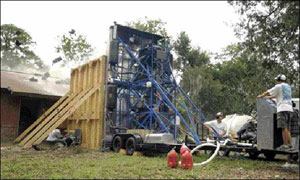
Tests conducted with the Institute for Business & Home Safety used a novel test rig developed at Florida International University to replicate roofing and soffit damage, which was common during the 2004 hurricane season (above). The apparatus (top), known as the “Wall of Wind,” relies on two air boat engines to deliver a torrent of wind and water.
Pneumatic staplers. Testing showed that aluminum soffits tend to tear when using pneumatic staplers without a depth adjustment to regulate the depth-of-drive at the nose of the stapler. When only the air pressure adjustments at the compressor were relied on to change the throw of the stapler’s drive pin, the results proved highly inconsistent. The tearing was not obvious to the naked eye, but the soffit material later tended to break loose. Upon closer inspection, when the connection was carefully disassembled and the aluminum examined, the tearing was visible.
These tests were performed using several types of woods with varying specific gravities, from 0.43 SPF to 0.53 SYP. Using a stapler with a drive-pin adjustment produced a consistent depth of penetration regardless of specific gravity or grain or staple orientation. Once the drive pin was adjusted, testing showed that the ratio of overdriven staples improved from 19-in-20 to 1-in-20 when fastening aluminum components.
This same success did not hold true for fastening vinyl soffit components. In almost every case when vinyl soffit components were used, the staples caused the vinyl to split. This problem was not prevented with a depth adjustment, and it worsened in colder temperatures. Based on these findings, the team recommended that staples be used as a means of fastening aluminum soffits but not be used at all for vinyl soffit materials. When installing aluminum soffit materials, they noted that it is also critical to follow the manufacturers’ instructions.
Although T nails were not tested, there was evidence from the hurricane damage that T nails as well as staples tended to pull through the bottom of F- or J-channel when loaded by wind. Using channels with thicker bottoms in conjunction with staples is recommended for a more secure connection for soffit installation.
Tabbing. One method of installing channel, known as tabbing, involves cutting a section of the J-channel and bending it up to allow nailing to the wall. Many contractors feel this is an unreliable means of attaching a soffit to the wall, but testing showed that it can work for some field installations.
A simple comparison of J-channel installations showed that tab spacing at 24-inch intervals was actually stronger than two other installation techniques. Tabs spaced at 12 inches weakened the soffit material because of the number of cuts required (Figure 1), and nails driven at 12-inch intervals through the bottom of the J-channel, without using tabs, resulted in weaker connections because the nails often pulled through the material as the J-channel rotated.
Figure 1. Typical soffit attachment details that resulted in blown-out soffits (shown) included securing the soffit with fascia cover or coil stock at the front and using tabbed J-channel against the wall. Tests found that tabbing can work if the tabs are cut 24 inches apart, but that tabs spaced more closely together tend to fail. Even though more fasteners are included with the closer spacing, the integrity of the J-channel is compromised by the repeated cuts.
Best practice. The most important finding to come out of the testing was that following the manufacturers’ recommendations for installation produced the most reliable results. For example, instead of J-channel, tabbed or otherwise, many manufacturers recommend securing soffit panel with F-channel, which is designed to attach to a vertical surface. In reality, the manufacturers’ recommendations may not always be the least expensive way, but it could mean the difference between a soffit that stands up to high winds versus one that fails and allows wind and water to blow freely into the attic.
Resisting Wind-Driven Rain
IBHS site investigations and exploratory tests using a novel test rig developed at Florida International University (photo below) provided insight on issues related to wind-driven rain. Not surprisingly, the testing and observations clearly showed that complete loss of soffit material led to the most critical cases for significant water intrusion. This issue can be addressed best by properly installing soffit materials to make sure they stay in place during a severe windstorm (Figure 2).
Typical Installation
Better Installation (under 16″ overhang)
Best Installation (over 16″ overhang)
Best Installation (under 16″ overhang)
Best Installation (over 16″ overhang)
Figure 2. Four options for securing soffit. The better options more closely resemble manufacturers’ recommendations, which tended to hold up better in static pressure tests than many of the accepted field practices.
But the tests also revealed significant water intrusion at eaves and vented soffits installed at gable ends. This problem was greatest on gable ends that had a drop-chord truss. A drop-chord gable-end truss allows outlookers to be installed on edge and cantilevered back to the top chord of the second truss.
Dye test. The wind-driven rain experiment was conducted by blowing winds up to 110 mph on a roof assembly with plumb-cut 2×6 rafter tails and a 24-inch overhang on a 6/12 roof. It produced a “boiling effect” as water pooled on the top of the panels and also worked its way up to the top of the 2×6 subfascia board.
Using a fluorescent tracer dye, it was possible to see water droplets accumulate in an attic with winds speeds as low as 90 mph (Figure 3). The same result could not be seen at 75 mph.
Figure 3. Even when soffits are not blown out of place by storm winds, water intrusion can still damage interiors. Here, researchers blew water treated with a fluorescent tracer dye to aid visualization, revealing how water droplets blown by sustained winds through a vented rake along the gable-end wall can accumulate in an attic.
The power of wind. The wind-driven water was blown into the space above the soffit panels through the vented holes of all types of soffit materials tested. As the pooled water continued to be agitated by the wind, it was aerosolized into droplets that were transported several feet into the attic. In addition, water was blown into the space between the bottom of the subfascia and the fascia cover.
This water first climbed up 5 1/2 inches between the 2×6 fascia board and the aluminum fascia cover and then into the nailed connection space between the roof sheathing and the top of the 1 1/2-inch face of the fascia board. It was clearly visible as puddles on the top of the subfascia board.
The amount of water injected into the attic would cause severe damage within less than an hour by saturating the ceiling drywall. It eventually would flow into the interior of a house, causing even more extensive damage to interior finishes.
The test showed winds will carry water droplets uphill and in through soffit panels (Figure 4). Slight differences were visible in tests performed on various soffit-panel designs. Still, the tests had a common finding: the amount of water entering the attic space was significant. Once trapped in such a space, the water is unlikely to drain out and will continue pooling as long as winds are strong enough.
FIGURE 4. This table illustrates how far a column of water can be blown uphill by wind. Testing revealed that air penetrates the water through vented openings, resulting in a “boiling effect,” and then blows the water droplets into the attic in a geyserlike display.
Possible solutions. One solution, which needs additional testing, is the creation of valve or baffle systems.
Valves would allow air to pass through under ordinary conditions but would be designed to close under high-wind conditions. The baffle system would block the direct path of water droplets being ejected from the surface of the soffit panel or cracks around the fascia boards. These systems could significantly reduce the amount of water entering through a vented soffit during a severe windstorm.
Soffit Materials
While the installation ultimately determined a soffit’s ability to resist high winds, some differences were found in the materials, too. Vinyl panels tended to perform a bit better in static pressure tests. The panels bowed dramatically before finally pulling out of the J- or F-channel restraints, unlike the aluminum panels that flexed slightly and then failed completely.
In Florida, all soffit materials must be approved, and the approval includes installation instructions. This approval system, called “Product Approval,” is described in detail by the Florida Department of Community Affairs, and products can be searched online at http://www.floridabuilding.org . Not all states have these requirements. Contact the local building department in your area to find out more.
Some manufacturers of soffits have product-approval engineering that is both practical and effective. Builders in Florida are not limited to this published engineering, but a prudent builder should not deviate without an engineering review. If the engineering does not cover a particular installation method, the builder has several options, including asking the manufacturer to provide it or getting an independent review. ~
Tim Reinhold, Ph.D., a former professor of civil engineering at Clemson University, now serves as vice president and director of engineering at the Institute for Business & Home Safety. He provides technical direction for the IBHS “Fortified … for safer living” new-home construction designation program and the Property Loss Database, a new IBHS program established to identify and analyze emerging property-claim trends. Richard Reynolds is a contractor in Bradenton, Fla., and chairman of the Florida Home Builders Association Codes and Standards Committee.
Before installing a soffit system, remember: |
• Vented soffit systems should not be installed on gable ends that have a vent space into the attic. • If vented soffit materials are used under the rake on a gable end for visual consistency with other soffit materials, block and seal the passages. This is especially important if drop-chord gable-end trusses are used. (Note: A vented rake is not needed for attic venting if a continuous ridge vent is used to balance the soffit vents.) • Select a soffit system rated for the design pressure that is consistent with what is required for walls with a similar elevation in the geographic area. • The length of the soffit panels should be consistent with the manufacturer’s product approval instructions for the wind pressure. • Corners and areas near entryways may require longer soffit panels, which may require additional framing. • Stick with parts approved by the manufacturer. Choose fasteners and panels from the same manufacturer. • Pay attention to fastener spacing. It should meet the manufacturer’s requirements. • Blocking may need to be added in order to secure longer soffit panels — a detail often overlooked in the field. |