The 2009 International Residential Code (IRC), due to be published March, will contain some significant revisions to the provisions governing bracing of walls against racking forces in moderate wind speed zones.
In wind speed zones of 110 mph and higher, the IRC requires engineered wall design — either a full analysis using ASCE 7 (the American Society of Civil Engineers standard for building design), or else a design that follows one of the prescriptive cookbooks based on ASCE 7, such as the Guides to Wood Construction in High Wind Areas published by the American Wood Council.
But for design wind speeds up to and including 100 mph, builders can rely on methods written right into the IRC. And the rules allow a lot of latitude: You don’t have to fully sheathe a building in wood structural panels (plywood or OSB) — you can use a wide range of methods, including wood or metal let-in bracing, gypsum board, or a smaller number of wood panels in strategic locations.
Source: APA – The Engineered Wood Association
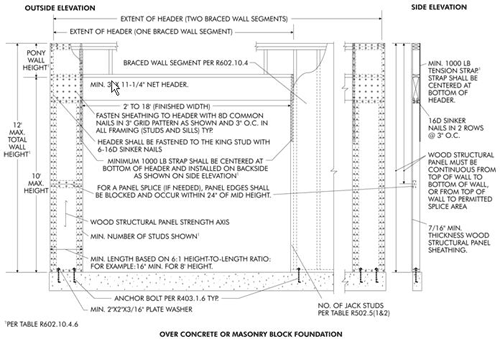
The 2009 IRC will offer multiple ways to brace walls in moderate wind-speed zones, including this updated version of the “portal frame” assembly developed by APA – The Engineered Wood Association. The closely-spaced fasteners and the extension of the header past the door opening into the sheathed wall create a stiff elbow at the corner of the frame that acts as a moment-resisting connection. Anchors and metal tie-down straps add to the strength of the assembly, and allow a narrow section of wall to effectively brace the structure. The new code is slated to be published in March 2009, but will only take effect after adoption by state and local governments.
But all that flexibility comes at the price of a lot of confusion in the code. For years, an International Code Council “Ad Hoc Committee on Wall Bracing” has been working to simplify the code language and organize the requirements into a more coherent presentation. The committee has also struggled to come to grips with some substantive structural issues. Coastal Contractor took a look at the wall bracing provisions of the 2006 IRC in an article entitled Wall Bracing and the IRC. But as states and localities adopt the updated 2009 edition of the IRC, some of those rules will change — and builders will have to get current on the modifications.
Jay Crandell, a consulting engineer who worked for years at the NAHB Research Center and is now principal of ARES Consulting in West River, Md., is a member of the wall bracing committee. Crandell says that the 2009 rules are an upgrade in terms of presentation. For example, to make the code more user-friendly, code tables will now spell out the length of “braced wall segments” in feet, rather than in percentages that require the builder and code officials to do the math.
But there are also some important technical changes:
New bracing tables for wind loads. The 2006 code uses the same table for wind loads and seismic loads, Crandell notes. This is not a big deal for small houses, but the bracing amounts could be inadequate for big houses with a lot of “sail area” for wind to work on. The 2009 code will have separate tables for wind and seismic loading — which means big buildings may need to have better bracing under the new rules. But the committee took considerable pains to make sure that the new rules were not unrealistically conservative. “Making this work without penalizing smaller homes and typical modest-sized homes in low-wind regions required some effort to develop new engineering methods and data that better agreed with experience and actual whole-building performance,” says Crandell. The committee spent a long time hashing out a way to account for building elements such as interior walls, drywall, and siding that add strength to walls but tend to be ignored by accepted engineering methods. The older methods, says Crandell, “consistently under-predicted actual whole-building system strength by more than a factor of 2.”
New uplift requirements. “When substantial wind uplift is transferred through braced walls, it has the compounding effect of weakening the strength of the bracing,” Crandell explains. To address this, the 2009 code will call for anchors and for uplift strapping between upper and lower story walls, “but mainly for longer roof spans on larger buildings in the higher wind regions of the IRC (greater than 90 mph),” says Crandell.
Mixed bracing methods. The 2006 code is unclear on whether different walls on the same building can use different materials to meet their required bracing amounts. The 2009 code will spell out that a builder can, for instance, use plywood on one house wall and let-in bracing on another wall. Similarly, builders will also be allowed to use one bracing system on a lower story and a different system on an upper story.
More versatile “portal frames.” The 2006 code adopted a method for stiffening the wall area around window or door openings called a “portal frame,” which used close nail spacing and beefed-up framing to stiffen narrow walls near big openings. The 2006 version is only permitted in fully sheathed walls, but for 2009, officials have approved a portal frame method for use in walls with only partial wood sheathing. Hold-down and anchor requirements for the portal frame method have also been reduced.
Even with the improvements, the IRC wall bracing provisions are still complicated. Crandell says the committee is already starting work on a 2012 revision, with the goal of further tidying up the presentation. Plus, he says, the committee hopes to develop a “bracing light” version that can be used for simpler homes, “without having to wade through the many options of the current bracing provisions, which are designed to capture a broader set of conditions but which add much complexity to the code that many users don’t need.”
Many builders, of course, fully sheathe their houses as a matter of course, and some wouldn’t build any other way. But the code’s multiple options for bracing are rooted in historical building practice from many regions. They’re also backed by industries such as the rigid foam sheathing manufacturers, who have set up a “Foam Sheathing Coalition” to advocate for wall construction methods that work well with rigid foam. The Foam Sheathing Coalition has followed wall bracing code development closely, and it’s a good source of information on the ins and outs of the code requirements, as well as some of the technical data behind the code engineering. Foam sheathing, of course, can be an effective component in a high-performance energy-efficient building, so builders may want to take a closer look at the foam industry’s views on structural issues. For information, check out the FSC website