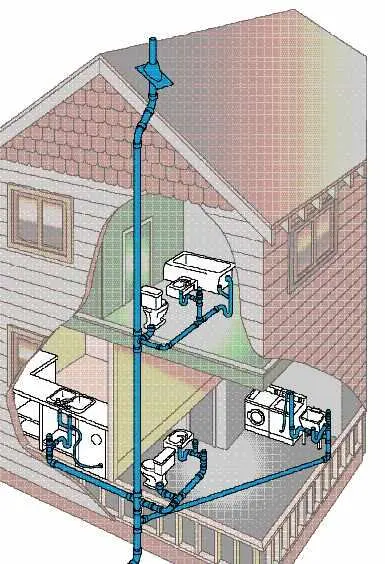
Plumbers hate cutting holes in roofs for vent lines: My left ankle is mostly stainless steel from cutting one too many of them. Vent lines are also a nuisance inside the house, running horizontally and vertically through floors, walls, and ceilings, and then on into the attic, following codes — and requiring holes — all the way. Not only can all these holes compromise the structural integrity of the framing, they can create potential fire paths. But vents are required by code for a reason. When fluids flow down an undersized drain line and completely fill it, air in the drain line is shoved ahead of the water flow (assuming there are no vents), creating positive pressure in front of the water slug and negative pressure behind. This negative pressure can create enough suction to siphon water out of a sink trap, allowing sewer gas to enter the house through the now-empty trap. And a drainpipe doesn’t have to be totally filled with flowing water to pull traps dry. Air tends to follow fast-flowing water, so water rushing down a vertical drain line can siphon water out of an adjacent horizontal branch.
More Than One Way to Vent
Individual vents placed within a few feet of each trap counter pressure problems by allowing outside air to enter the drain line. But there are situations where it is physically impossible to install a vent line behind the trap — when a long window is located behind a kitchen sink, for example, or when the fixture is located beneath a structural beam that can’t be drilled, or when the kitchen sink or vanity is located in an island.
Building inspectors always have a solution: expose the vent line, move the sink, move the window, or change the framing. It’s also possible to design a complicated, labor-intensive drainage/
venting system near the fixture to compensate, as is occasionally done for a kitchen island. But by far the simplest solution is to install an air-admittance valve, or AAV. These little miracle-workers almost make traditional vent lines obsolete.
AAVs aren’t new. Developed in Europe back in the ’70s, the Studor Air Admittance System (Studor, 800/447-4721, www.studor.net) was introduced in the United States in 1988. Now, AAVs are accepted by virtually all national building codes, including the SBCCI, BOCA, IRC, and IPC plumbing codes. Under the IPC, AAVs are listed for installation under Section 917; west of the Mississippi River, they’re covered under Section 301.2 of the UPC. While I’ve been installing Studor’s AAVs for quite a few years without a single failure, Oatey (800/321-9532, www.oatey.com) and other manufacturers offer them as well.
An AAV is simply a gravity-operated, one-way air valve that allows fresh air to enter a drain system without allowing sewer air out. You may have seen an AAV before and not known it. If you’ve ever tripped over a white mushroom-shaped object up in the attic, or seen a white cylindrical device under a kitchen sink, that was probably an air admittance valve. AAVs cost around $25 and up, depending on the size of the vent.
Don’t confuse AAVs with smaller and cheaper mechanical vents. Sometimes called “cheaters,” these tubular, spring-loaded $5 vents are rated for only 1/2 DFU (drainage fixture unit), and are not allowed under most building codes. To distinguish between the two devices, look for the testing protocol — ANSI/ASSE 1051 or ASSE 1050, and perhaps NSF 14 — stamped on the AAV’s body. You’ll also see code organization (such as the SBCCI) approval stamps on the packaging.
Available in different sizes, AAVs can be used to vent an individual fixture, a complete branch, or an entire stack of vents. There are specialty AAVs rated for use outdoors and in chemical environments, and even combination trap/AAV assemblies. (Studor’s compact version, the Combi-Siphon Plus, is sold almost all over the world, but not in the U.S. You can probably buy one, but if you are in an area governed by codes, the inspector won’t know what to make of it and won’t pass it).
Easy Installation
AAVs give you a lot of venting options, though a few limitations do exist. For example, you can install an individual AAV on each fixture and a larger AAV on the stack in the attic — and, as long as there is at least one regular vent to outside air, you’re done. Each AAV has to be accessible and have unimpeded airflow, so it can’t be sealed inside a wall. But if air and access is available — via a removable louvered panel or screen covering, say — it can be mounted there. AAVs must be installed vertically (no more than 15 degrees out of plumb), and they can’t vent multiple fixtures when the fixtures are on different floors. If placed in an attic, an AAV needs to be installed at least 6 inches above the insulation.
If you’re installing a new fixture, all you need to do is cut a tee in the line behind the trap. You may need to offset the rough-in pipe 4 inches to the side of the sink’s standpipe rather than bringing it in directly behind the standpipe. This sends the trap over to the side, making room for the tee just before it hits the back wall.
Next, on the upside of the tee, install a short 4-inch pipe with a glue-on female threaded hub, and then screw in the threaded AAV using Teflon tape. (Never use paste, as chemicals in some pastes could destroy the threads.) AAVs can interface with PVC or ABS, but with threads, you don’t have to match different plastics: They can screw into white PVC, black ABS, cast iron, steel, or even copper. Studor’s Mini-Vent — the one I use most often — is rated for up to a 2-inch vent and comes with a 1 1/2-by-2-inch reducing connector that slips onto a 2-inch pipe.
For adding a fixture or two during a remodel, or for using an AAV merely to eliminate running unnecessary vents during new construction, you don’t need to do any calculations. Just install the AAV — you won’t get into trouble by adding an AAV along with the fixture.
If you’re doing an entire house, you don’t want to overtax a particular AAV by putting too many fixtures on it (Figure 4). Simply follow the AAV’s guidelines. For example, Studor’s Mini-Vent can vent three DFUs on a 11/2-inch line (that’s the maximum DFUs you are allowed on that horizontal branch by code) and six DFUs on a 2-inch line (again, the maximum amount of DFUs allowed by code on that horizontal branch). Consult the DFU chart — Tables 709.1 and 710.1(2) in the International Plumbing Code, or the equivalent in the UPC — to see what fixtures fit into those numbers. On a 3-inch horizontal branch, the Mini-Vent can handle up to 30 DFU.
|
Drainage Fixture Units for Fixtures and Groups
|
Fixture Type |
Automatic clothes washer (residential) |
Entire bath group (water closet, bidet, lav, bathtub or shower) |
Bathtub or whirlpool |
Bidet |
Kitchen sink |
Laundry tray |
Lav |
Shower |
Water closet (residential) |
Floor drain |
Dishwasher |
|
Maximum DFUs Allowed on Horizontal Drains and Vertical Stacks
|
Drain Pipe Size (in inches) |
1 1/2 |
AAVs can vent more than one fixture, but their capacity must be matched to the total DFUs on the branch line they vent. AAVs range in capacity from 6 to 500 DFUs.
To vent a clothes washer with an AAV, I run a 1 1/2-inch pipe up from a tee located about 4 inches behind the 2-inch trap, terminating it in the washer box. That’s where I install the AAV; one box does it all. However, remember that the horizontal pipe the trap dumps into must be at least 3 inches in diameter.
Rex Cauldwell is a master plumber in Rocky Mount, Va.; a frequent contributor to JLC; and the author of several books, including Wiring a House.