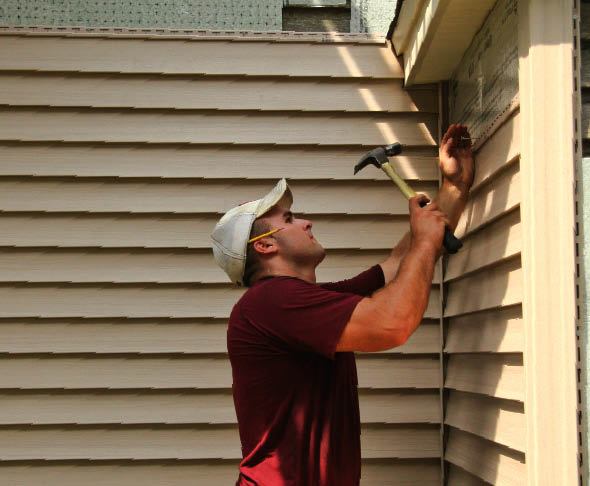
Fifty-some years after it was introduced, vinyl siding accounts for about one-third of all sales of residential siding, outpacing every other exterior cladding. The product’s minimal maintenance requirements and durability are certainly attractive to homeowners, but its popularity is probably best understood in terms of price. Hands down, standard-grade vinyl siding has the lowest installed cost per square — about 28 percent lower than that of either fiber cement or wood.
The flip side of costing less, however, is the accompanying stigma of being, well, cheap. Some consider the material insubstantial and flimsy-looking. And while that perception can partly be blamed on poor installation practices, it’s also true that there have been problems with the product itself — namely a tendency to yellow, fade, and chalk over time. To their credit, vinyl-siding manufacturers have spent the last decade addressing these issues, and as a result there are now a good number of high-quality, high-performing siding lines on the market, with far more color and style options than ever before. Moreover, major manufacturers are arguing that vinyl siding is a green building material — perhaps even the greenest of all siding options.
Is Vinyl Siding Green?
Vinyl-siding manufacturers make numerous claims for the “greenness” of their product, but many green-building consultants aren’t convinced. To get some insight into the issue, JLC asked industry expert Alex Wilson to weigh in. As the founder of BuildingGreen in Brattleboro, Vt. — which publishes Environmental Building News and GreenBuildingAdvisor.com — Wilson has been writing about these issues for decades. His comments follow.
As with a lot of building products, there are both pros and cons to vinyl siding when it comes to environmental performance. I do not consider vinyl to be a “green” product, but neither do I think it’s as bad as some make it out to be. The primary environmental problem with it is the chlorine chemistry. PVC is about 40 percent chlorine by weight, and in some situations, such as accidental fires or improper incineration, toxic chlorinated compounds, including dioxins, can be produced.
On the positive side, vinyl does not require painting or staining, so the environmental impact of maintaining it is relatively low. Vinyl is theoretically recyclable, though little if any vinyl siding is recycled after being removed from a building.
Many vinyl products contain lead stabilizers, but according to Jery Huntley, president of the Vinyl Siding Institute, lead stabilizers have never been used in North American vinyl siding. To comply with the IRC and IBC, vinyl siding must be certified according to ASTM D3679, which includes a test for lead.
Unlike flexible PVC, which is used in shower curtains, electric cable sheathing, and roof membranes, vinyl siding has never been made with phthalate plasticizers, which are under fire as “endocrine disrupters” — compounds that mimic natural hormones and can interfere with our endocrine systems.
It is also worth noting that vinyl siding takes less fossil-fuel energy to produce than some other siding materials — like fiber-cement — so the climate-change impacts and direct pollution emissions from its manufacture are lower.
On the other hand, both wood and fiber-cement siding — if they’re properly installed and maintained — can outlast vinyl siding. With these products, “properly installed” means prestained, protected by a substantial roof overhang, and installed over an air space (rain-screen detailing). In commercial building, there are some great terra cotta rain-screen cladding systems that I hope will come down in price and make their way into residential applications. — Alex Wilson
All of which raises a couple of questions: First, is vinyl siding a convincing substitute for the more traditional and costlier siding materials it mimics? And second, does it have a place in sustainable — or green — projects?
Composition
PVC (polyvinyl chloride) resin, the main component in vinyl siding, is derived from two basic ingredients — calcium chloride (salt) and ethylene (natural gas) — combined in a polymerization reaction. PVC contains smaller amounts of other ingredients as well, such as calcium carbonate (used as a dimensional stabilizer) — but it does not contain phthalates (a plasticizer) or lead, as many people believe (see “Is Vinyl Siding Green?,” below).
All vinyl siding consists of two layers — a relatively thick substrate and a far thinner capstock, typically .005 mils to .008 mils thick — heat-fused together. They’re produced by forcing the PVC resin — in powdered form — through extruders. Final siding thickness ranges from .040 mils in the entry-level product up to .050 mils in premium lines. Generally, the thicker the product, the more rigid and stable it is and the higher its impact resistance. Most professional installers won’t recommend anything below a .042 product.
The capstock contains various ingredients that the substrate does not, including titanium dioxide — a UV inhibitor used in many weatherable products — and pigments to produce the surface color. Vinyl waste produced during the manufacturing process is routinely ground to powder and returned to the substrate mix. In the least expensive lines — the thinnest, .040 mil entry-level products — carbon black pigment may be used to produce a uniformly colored substrate called grayback. Costlier grades avoid using grayback because it shows through scratches in the capstock. A better way to achieve color consistency — and the approach taken by almost all premium siding lines — is for the substrate to be pigmented to match the capstock.
Polypropylene. In recent years, cedar-shake, decorative-shingle, and even stone profiles have joined the plastic-siding stable. Unlike plank-style siding, these profiles are made not from PVC but from much thicker, solid-color, injection-molded polypropylene. Polypropylene — a thermoplastic polymer — is durable, impact-resistant, and versatile. Identified as a #5 in plastic recycling programs (PVC is a #3), it is commonly used to make bottle caps and large molded parts for automobiles. As with PVC, post-consumer polypropylene is not widely recycled.
Color
Until relatively recently, homeowners who wanted barn red, forest green, ocean blue, or any other dark-hued siding weren’t looking at vinyl. Problems with unacceptable color fading dictated a limited palette of whites and pale tints. But manufacturers discovered that using various acrylic formulations in the capstock — rather than PVC — made it possible to offer a much broader spectrum. Today, almost any color goes, even custom shades. For instance, Ply Gem sells more than 700 hues, with custom color matching available for a $75 swatch charge. Darker colors do come at a premium, though: They cost about 30 percent more than conventional, pale-hued PVC capstocks.
Virtual preview. Several manufacturers offer online color-visualization programs, which allow homeowners to model various trim and siding color combinations on different styles of homes. This is a useful, even critical tool when choosing vinyl siding, especially considering the product’s durability and the likelihood of living with the final selection for 30 years or more.
Certified color standards. With colors being developed so rapidly, many shades haven’t yet stood the test of time against fading. In 2006, the Vinyl Siding Institute (VSI) expanded its certification program for vinyl siding to include color retention; currently about 350 shades are listed. Colors continue to be added as they successfully complete the two-year outdoor accelerated testing, which uses the ASTM color retention standard for plastic siding. Certified colors are identified by specific package labeling and can also be reviewed online at vinylsiding.org.
As a relatively new exterior cladding, polypropylene siding has not yet achieved PVC siding’s certified-product status. According to VSI technical director Dave Johnston, a certification program for the polypropylene product is in the works. “Plans call for holding off on applying the color-retention certification until the basic product certification is in place,” he says. “ASTM D6864 [the standard for color retention] includes ‘plastic’ siding within its scope, but we want to study its applicability to polypropylene before going further.”
Lower luster. For many homeowners, one of vinyl siding’s less desirable characteristics is its telltale plastic shine. But over the past decade or so, manufacturers have modified the capstock formulations in their product lines to minimize the objectionable sheen. “We’ve been able to dial down the gloss a little bit more than in the past, to give it a more fresh-painted look,” says Ply Gem marketing VP Jerry Blais.
Embossing — an attempt to break up the sheen with a wood-grain effect — has also improved. Baltimore specialty remodeling contractor Bert Labhar insists that Crane’s “triple-6 and double-7 inch profiles really and truly look like cedar.” And indeed, with imprints taken from actual cedar boards, many of these textures are quite convincing. However, since it effectively thins the material, embossing can degrade the impact resistance of the siding, so it’s best to choose a thicker (read costlier) product if the homeowner wants a wood-grain look.
Insulated Siding
Contoured EPS foam backers for vinyl siding were first introduced about 10 years ago, pioneered by Vipco (now called Crane) in cooperation with Progressive Foam Technologies (800/860-3626, fullback.com). With a flat back and a profiled face designed to fit snugly behind the vinyl profile, foam backer lends the siding a firmer feel. “One of the things people tend not to like about vinyl siding is that it doesn’t feel very rigid,” notes Ply Gem’s Blais. “Foam gives it what we call knockability — you can touch it and it feels firm and substantial. It helps a lot.”
Most manufacturers have started offering a premium, composite siding product — a distinct category identified as insulated siding — with foam integrally bonded to the vinyl. Progressive also offers a field-applied “drop-in” product it calls the Fullback Thermal Support System. With nearly 800 distinct profiles available, it can be fit behind every lap siding profile on the market — and it qualifies for the current 25C tax credit of up to $1,500. In either approach, contoured insulation adds an estimated 30 percent to the cost of a typical siding job.
Insulated siding products offer a couple of advantages over standard hollow-back panels, namely easier handling and faster installation — primarily because they eliminate the need for a foam underlayment. Also, laminating foam to vinyl profiles allows manufacturers to produce vinyl profiles with larger, flatter faces — 6 to 9 inches wide — that would otherwise lack sufficient rigidity.
Impact resistance. Errant baseballs and stones thrown by lawn mowers can result in cracked or punctured siding. (It’s a good idea to order a little extra siding and store it for incidental repairs, since matching siding may be difficult to find later on.) Foam backer helps in this regard, too, because it improves impact resistance. Testing shows that, when insulated, a previously hollow-back product’s impact rating jumps from 60 to 90 psi to 160 to 340 psi.
R-value. Originally, insulated siding R-values were determined using the ASTM “guarded hot box” test, an apparatus used to measure the thermal conductivity of full-size materials or assemblies. But testing a multitude of panel profiles was expensive and time-consuming, so manufacturers now rely on a computer simulation of the hot-box method to rate new profiles. While the resulting R-values are fairly reliable, VSI is currently spearheading an effort to develop an ASTM standard specification for all products designated “insulated vinyl siding.” The objective is to establish a verifiable minimum baseline R-value (tentatively R-2) and thereby gain building-code recognition for insulated siding as a distinct insulating product.
As to how the varying thickness of a contoured profile may affect R-value, Tim Holt, Progressive’s director of product development and innovation, says, “If you average the foam between the thickest and the thinnest parts and get 7/8 inch, the R-value of the foam will be consistent with 7/8-inch-thick foam.” EPS foam has an R-value of 5 per inch.
Quieter? Finally, various manufacturers’ product literature refers to insulated siding’s “sound-deadening” qualities, but this is neither a scientifically verified attribute nor a claim made by Progressive Foam for the general product.
Performance
Vinyl siding requires less maintenance than any other siding option. An occasional wash with soap and water is all it takes to keep the product looking good for many years.
Exactly how long vinyl will last on the wall remains anybody’s guess. The product came into widespread use more than 30 years ago, and much of the siding from that time is still up and going strong. Most manufacturers estimate service life at around 30 years. Others consider 50 years a reasonable expectation, while a 2007 NAHB study predicts “lifetime” durability.
Standard (noninsulated) vinyl siding is also a first-rate rain-screen cladding, because its hollow-back format allows for air circulation and drainage. Unlike other siding products, it requires no strapping or other means of providing an air space between cladding and housewrap. At this point, it’s not clear whether adding contoured backer compromises the siding’s ventilating performance; no independent testing has been done in this area. However, we do know that EPS has a relatively good permeability rating of 5 per inch, and field studies indicate that the many seams and venting slots in the vinyl allow water vapor to dissipate. Furthermore, the contoured foam backing appears to reduce the amount of wind-driven rain that typically penetrates the hollow-back product.
Wind resistance. High wind can be an issue for vinyl siding; storm news commonly shows vinyl panels flapping in hurricane winds and walls stripped bare. Yet all certified siding products meet the ASTM standard for PVC siding, which requires products to withstand pressure equivalent to 110-mph winds. And for certain premium grades, the wind ratings go up to 240 mph. Given these ratings — and the generous warranties that back many grades — it seems more likely that blow-offs are due to poor installation practices than to product quality.
Stray rays. PVC is inherently a fire-resistant material; it doesn’t readily support combustion — which is not to say it never burns. It can definitely melt — for instance, if an outdoor grill is operated too nearby. Also, bizarrely enough, when it’s warm on one side of window glazing and cold on the other, low-E panes can become distorted and concentrate reflected sunlight in beams that raise vinyl siding’s temperature to the melting point. Siding installed opposite east- or west-facing windows is most vulnerable. VSI and various window makers are allegedly discussing this problem, but so far the only solution seems to be to ask neighbors to shade the offending glazing, or to plant vegetation to run interference.
Installation Upgrades
As with any exterior cladding, it pays to spend a little more for good looks, especially in an upscale neighborhood. Specialty remodeling contractor Bert Labhar, for one, believes that contoured backing is “100 percent the way to go.” Skip the backing, he says, and “the job won’t look inferior the day it’s done — but it will within a year or two. Siding expands and contracts, it buckles and bows, seams start to show, you get bubbles and indentations, and pre-existing wall lines telegraph through. It just looks cheap.”
Lap reduction. The best way to reduce or even eliminate repetitive patterns of double- or triple-course lapped butts — a dead giveaway that the siding isn’t wood — is to use longer siding lengths (Figure 5). Panels of up to 16 feet 8 inches are sold by all major siding manufacturers and, when compared with standard 12-foot lengths, can reduce the occurrence of lap joints by 40 percent. Single-course planks — with 5- and 7-inch profiles — are also available; with these the random butt patterns seen in wood or fiber-cement siding can be mimicked even more closely.
J-channel. Like wood siding, vinyl expands and contracts with temperature fluctuations, but with proper nailing, the elongated slots in the nail hem accommodate the movement. At window, door, and corner terminations, the siding must be cut short by 1/4 to 3/8 inch and the ends concealed in J-channel trim.
On some homes, this can pose a problem: Outlining every window, door, and corner board with channel just doesn’t look right on a traditional facade. Some historic districts prohibit J-channel trim altogether — which is no doubt why, when you look at vinyl-siding product brochures, it’s conspicuously absent from most of the images.
Probably the most common solution is to use trim coil and integrate the channel when cladding over the existing trim. Dedicated trim products — window lineals and corner-post profiles — are also available with the channel built in, for an uncluttered, “normal” appearance (Figure 6). Strategic shimming behind standard trim can also create the necessary recess.
Dave Holbrook is a JLC associate editor.