Questionable Assumptions
Critics of the AGARD study focus on key assumptions
underlying the sizing guidelines — input parameters, they
say, that give vent-free appliances the benefit of considerable
doubt. Depending on the characteristics of a particular house,
weather conditions, homeowner use patterns, and the pollution
levels you consider acceptable, following AGARD’s sizing
guidelines may not ensure acceptable air quality.
Nitrogen dioxide
standard
. Since the United States has no official
indoor air quality standards, the AGARD study has picked its
own "recognized guidelines" from among air-quality
recommendations made by a variety of organizations. Of these,
the most problematic is the use of ASHRAE’s standard for
maximum nitrogen dioxide (NO2) exposure of .50 ppm (parts per
million). This is double the .25 ppm standard set for outdoor
air by Canada, California, and the World Health Organization,
the only governmental bodies that have set short-term NO2
exposure standards; it is ten times higher than the average
annual allowable exposure set by the U.S. Environmental
Protection Agency (EPA) for outdoor air (Figure 2).
Figure
2. In dealing with the issue of nitrogen dioxide (NO2)
emissions, AGARD has chosen a short-term exposure guideline
that is double the standard set by California and Canada.
AGARD-sized units would also exceed the Consumer Products
Safety Commission recommendation in most climates. In northern
climates, AGARD's computer predicts that even the
AGARD-preferred standard would be exceeded. Some measurements
in test houses and in real homes have shown NO2 levels created
by unvented gas heaters that exceed all recommended
guidelines.
The ASHRAE standard is also higher than a proposed Consumer
Product Safety Commission (CPSC) overall limit of .30 ppm.
As the AGARD study points out, the EPA is unsure of a safe
level for NO2, but the agency has described the .50 ppm ASHRAE
standard as a "level of significant harm."
Maximum CO output
.
Insufficient oxygen supply is one known cause of carbon
monoxide (CO) production. Since the early 1980s, every unvented
heating product has come equipped with an oxygen depletion
sensor, or ODS — a thermocouple in the pilot flame of the
burner that sends an electric current to a fuel cutoff switch.
If oxygen levels fall below a set point (usually around 18.5%),
the flame cools, the thermocouple stops sending its signal, and
the switch trips, shutting off the gas.
However, experts I talked to pointed out a number of factors
besides insufficient oxygen that can degrade the field
performance of the gas burners over time. Burners that become
clogged with dust or animal hair can burn inefficiently and
produce greater amounts of CO; drafts coming through a damper
or air inlet can disturb the flame and increase CO output; even
improper arrangement by the consumer of the ceramic logs in a
gas log set can obstruct the burner and lead to higher CO
levels.
In the AGARD computer model, unvented heaters are assumed to
emit pollutants at no more than the maximum rate permitted
under ANSI Standard Z21, the test new appliances must pass in
the factory. As units age in service, however, they may not
perform that well. No comprehensive studies have been done to
measure the actual CO output of existing older gas-log units
and unvented heaters in real homes, but there are scattered
reports of CO concentrations at the 90 ppm to 200 ppm level
— less than a lethal dose, but enough to cause headache,
fatigue, nausea, and dizziness in people exposed for two to
three hours. With millions of vent-free units already in place
and sales growing each year, occupants of some homes may
experience long-term CO exposure above the 15 ppm to 25 ppm
limits accepted by the AGARD study.
Additional pollution
sources
. The AGARD model assumes that the vent-free
heater is the only source of pollutants in the space, but this
may not be the case in many homes. If a family cooks with a gas
oven and range, for instance, the NO2 level in the space could
start out at the .02 ppm to .04 ppm level. Since gas ovens also
produce CO, the background level of this gas may be higher as
well.
Heating load
. In
designing the AGARD model, the researchers relied on each
heating region’s "1,000-hour temperature" to estimate the
heat load unvented units would need to satisfy. This means that
for 25% of the heating season, weather would be colder than the
calculations assume. They also relied on a single value for
heat loss through the skin of the building, when, in fact, heat
loss in actual buildings depends on such factors as the area of
glass, type of windows, effectiveness of insulation, and
conductivity of framing in the wall. Taken together, these heat
load assumptions may underpredict heating demand in cold
weather, when the unvented burners are likely to consume more
fuel and create more indoor pollution than expected.
Homeowner Behavior
While the unvented appliance relies on a large open space for
its combustion and dilution air, AGARD assumes that much of the
heat for that space is supplied by the home’s main
heating system. If homeowners chose instead to set back their
main thermostat and rely on the unvented heater for a larger
share of the house’s heat, the pollutant load could
exceed AGARD’s prediction.
The results produced by the AGARD computer also depend
heavily on the assumption that unvented units will be operated
for no more than four hours a day. Used by the study to define
"proper" operation, the "four-hour burn" is based on a
telephone survey conducted by a marketing agency but is
contradicted by data from a GRI-funded study of 157 homes in
Texas by the research firm Geomet, Inc. In the Texas study,
homeowners used their unvented heaters more heavily as weather
got colder, running the units for 80% of the day when outdoor
temperatures were 25°F colder than indoor temperatures.
This use pattern resulted in overpollution of indoor spaces in
many of the Texas homes, including about 10% of the homes that
used unvented heaters only for supplemental heat. The AGARD
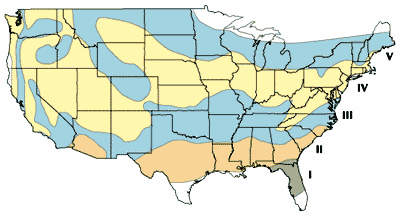
model predicts that units in DOE heating zones IV and V —
roughly, the half of the country that is colder than Kentucky
— would exceed target levels for NO2, CO2, and water
vapor between the fourth and eighth hour of use, but would stay
below carbon monoxide targets.
Cool start
. The AGARD
model further assumes that the four-hour period of use starts
with the room already at 72°F. If a homeowner lit the
burner when the room was cooler by 10°F or more,
particularly in cold weather, the fire might need to burn
continuously for several hours to reach 72°F, rather than
cycle on and off as AGARD assumes. Such cool-start,
continuous-run conditions actually existed in one test of a
10,000-Btu unvented heater conducted by the GRI’s Roger
Hedrick in the GRI Conventional Test House, a 1950s structure
located near Chicago, Ill. In that test, NO2 levels in the
building surpassed the .50 ppm limit by the second hour and
peaked within eight hours at over 1.0 ppm, double AGARD’s
own limit and quadruple California’s standard.
Ventilation
. The AGARD
study assumes a minimum ventilation rate in buildings of .35
ACH (air changes per hour), the minimum recommended by ASHRAE.
An estimated 25% of new homes, however, are built tighter than
that. Also, the natural air change rate in a real building
depends mostly on the wind, so the rate in a "leaky" building
could be either above or below .35 ACH, causing pollution
concentrations to vary from predicted levels.
Sizing guideline: Get small.
According to the AGARD model, unvented heaters must have low
fuel inputs and must be operated for only brief periods of time
to avoid overpolluting the space. The big 30,000- and
40,000-Btu/hr. heaters would exceed the recommended size in
many situations. In typical spaces, units would have to be
sized in the 10,000- to 20,000-Btu/hr. range; even then,
operating them for more than four hours a day could create
excessive concentrations of NO2. For many spaces, AGARD’s
calculations result in size recommendations so low that the
industry does not make appliances small enough to comply.
What About Water?
The problem vent-free devices are most likely to create —
a problem that grows worse as weather gets colder — is
excessive moisture (Figure 3).
Figure
3. Gas combustion produces water vapor as a byproduct,
in known quantities: 100,000 Btu of gas puts out about 1.1
gallons of water. This chart compares the water vapor output,
in pints per hour, of various size gas burners with the typical
moisture produced by a family of four during normal household
activities.
The AGARD analysis uses ASHRAE’s recommended humidity
levels for human comfort as a guideline for water vapor
concentrations, allowing a relative humidity from 40% in the
northern region to 60% in the southernmost U.S. As most
builders realize, however, the problem with indoor moisture is
not the humidity in the air, it’s condensation. While the
AGARD report mentions condensation as a concern, it does not
address the problem in realistic terms.
Gallons of water
. The
AGARD study estimates that a 28,000-Btu/hr. vent-free heater
will contribute about 4.6 gallons of water a day to a house if
operated all day long for comfort. Building research architect
Bill Rose, of the University of Illinois Building Research
Council in Champaign-Urbana, put that moisture output in
perspective: "The typical moisture contribution from a family
of four is 2.9 gallons per day, from all activities —
showering, cooking, breathing, and so on. From the AGARD
report, a 28,000-Btu/hr. unit will generate 4.6 gallons in a
24-hour period. So you are more than doubling the moisture
contribution to the space."
Even if the homeowner runs a 28,000-Btu/hr. unvented unit
for only four hours — AGARD’s definition of
"proper" operation — the building might have to cope with
an extra gallon of water within the space of four hours.
This problem is likely to increase in cold weather, when the
likelihood of increased heater usage combines with cold
temperatures on windows and walls and within building
structures, magnifying the potential for condensation. As
independent hearth consultant Paul Stegmeir explains, the
consequences in extreme cases could be dire: "At any building
penetrations, you could have moisture in the cracks and soaked
insulation. In the attic you’d have condensation and ice
under the roof, and when it warmed up you’d have rain in
the attic." Stegmeir relates an anecdote of a Minnesota resort
owner who winterized some summer cabins to attract
snowmobilers, and heated the buildings with vent-free
equipment. "There was ice on the floors," says Stegmeir.
This extreme example represents a misuse of the equipment
that violates all industry recommendations. But installing
vented units in those winter cabins would have avoided the
moisture problem, and the example illustrates how heating
equipment that adds moisture to a space complicates
considerably the builder’s moisture control strategy.
What about ventilation?
The Vent-Free Alliance’s marketing brochure advises
homeowners that modern houses may have less than the .35 air
changes per hour assumed in the vent-free sizing guidelines,
and may therefore have excess humidity. In that case, the
brochure recommends that homeowners ask their builder if the
house has enough venting.
But in a British Columbia condominium project where
residents of units with unvented heaters complained of odors,
stuffy air, colds, and headaches, fan-forced venting failed to
solve the problem, according to retired B.C. Gas Safety Board
official Peter Priebatsch. Outdoor air moved directly from the
inlet vents to the exhaust vents, without taking along a
significant amount of pollutants. This would not surprise most
ventilation experts, who recommend first removing the source of
moisture before adding ventilation. In the end, B.C.
authorities prohibited unvented units in multifamily
construction, and restricted their use in single-family
construction.
An Ongoing Discussion
When contacted by fax with questions about the AGARD
team’s work, researcher Robert Borgeson defended the
team’s assumptions as reasonable. "The intention of our
work was to develop general recommendations on how to use a
properly functioning vent-free product," he wrote. "It is not a
failure mode analysis, which is properly the domain of a
product designer. It is also aimed at the general population,
not folks with special health problems."
With regard to NO2, Borgeson said the team assumed a slower
decay rate for the gas than that observed in tests, noting,
"The CPSC and other limits you mention are aimed at the
‘sensitive’ population, such as pregnant women and
those with existing respiratory problems. We felt it was more
appropriate to use an ambient air quality standard, coupled
with our conservative decay rate."
With respect to variations in heating load, Borgeson
conceded that "if the conductive heat loss is higher or lower,
with the air change rate constant, then the pollutant level
will change accordingly." He pointed out, however, that if
increased infiltration is the cause of the added heat load, the
infiltration will tend to dilute the additional combustion
byproducts.
Judging from Borgeson’s response to questions about
excessive moisture production, the AGARD team is relying on the
four-hour operating limit set in their guidelines. "In reality,
the homeowner will probably reduce the output of the appliance
to maintain the desired setpoint temperature, or an automatic
thermostat will do it for them," wrote Borgeson. With regard to
concerns about how the appliances would be used during cold
periods, Borgeson discounted the possibility that homeowners
will instead turn down their main heating source, saying, "The
product, by code, is meant as a source of supplemental heat. We
cannot make useful recommendations based on improper use, and
hope that this work will help to reduce this behavior."
From Borgeson’s response to questions about how actual
pollutant emissions might differ from factory tests, it appears
that the AGARD team is comfortable relying on homeowners to
follow its guidelines. "It is clear that proper inspection and
maintenance is desirable," Borgeson wrote. "We hope that you
can see the need to assume proper operation for the purposes of
developing reasonable use guidelines."
According to Borgeson, the AGARD guidelines are subject to
modification. "As more information regarding product design,
health impact, and appropriate sizing criteria become
available, we are open to refining the recommendations. The
process of developing this information is an ongoing one."
Making the Choice
To date, the AGARD sizing guidelines have not been adopted by
any code group — but in areas where the vent-free units
are legal, some current codes allow them to be sized as much as
six times larger than the report recommends. So for now,
it’s up to the builder and the customer to decide how
strict the design guidelines should be. A builder contemplating
a vent-free installation would be well advised to get a copy of
AGARD’s report and read it closely. (The report is
available from the American Gas Association Research Division,
8501 E. Pleasant Valley Rd., Cleveland, OH 44131;
216/524-4995.)
However, if your goal is to provide equipment that can
supply plenty of heat in any kind of weather, with much lower
concern about indoor pollution or water damage, the solution is
obvious, as Bill Rose points out: "If the homeowner wants to
know, ‘How can I ventilate this house so that I can use
this vent-free heater?’ here’s the answer: The
builder should install a vent system that picks up the
pollutants directly and takes them to the outdoors. In other
words, a chimney."
Improvements in combustion technology have significantly
reduced the output of nitrogen dioxide and carbon monoxide in
the exhaust stream. On the other hand, if you burn gas,
you’re going to get carbon dioxide and water in
predictable amounts.
Depending on their concentrations in the air, any of the
following combustion byproducts can cause problems:
Water vapor
(H2O) makes
up about 60% of the output of a gas fire. In itself, water
vapor is harmless to human health, but too much can damage
building components, support rot, and foster the growth of
unhealthy mold and mildew.
Carbon dioxide
(CO2)
accounts for close to 40% of a gas burner’s combustion
byproducts. It is a health hazard only at very high
concentrations. At moderately high concentrations, however, CO2
causes discomfort: It raises people’s breathing rate and
may cause minor eye irritation, particularly in people who wear
contact lenses. Ventilation engineers use indoor CO2 levels to
estimate air exchange with the outdoors, but standards set for
that purpose mostly reflect comfort issues, not health
concerns.
Carbon monoxide
(CO),
which makes up a tiny fraction (less than .1%) of the exhaust
stream from a correctly functioning gas appliance, is a deadly
poison. At high concentrations, it can kill people in minutes;
at lower concentrations, it can worsen the symptoms of heart
disease, or cause headache, dizziness, nausea, and fatigue.
Low-level CO poisoning is often mistaken for the flu.
Sensitive groups who are especially vulnerable to low-level
CO effects include pregnant women and developing fetuses, and
people with cardiovascular or cerebral vascular illnesses.
Nitrogen dioxide (NO2) is a
corrosive oxidant gas that can injure lung tissues at high
concentrations. At lower concentrations, there is evidence that
NO2 can hamper the body’s immune defenses, creating
increased susceptibility to respiratory infections. Researchers
also report indications that the gas reduces lung function and
increases the allergic response of some asthma sufferers.
Ted Cushman is an associate editor at the Journal of
Light Construction.