
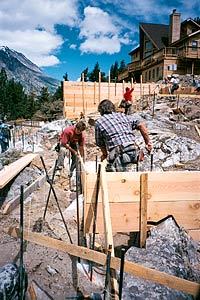
When a couple from Fallbrook, Calif., approached me last year and asked if I would design and build their Eastern Sierra vacation home, I remember thinking I was in for a hard start. Their 10,000-square-foot lot consisted largely of a terraced granite cliff, with grades as steep as 50 degrees. Getting a house to stay put on that rock hillside was going to be a challenge. On flatter lots, rock outcroppings are often blasted away to accommodate the floor elevations. Since this lot dropped away from the road access, the floor levels finished above the outcroppings, and we were able to form to undisturbed ledge. The method used to fasten a foundation to ledge depends on the type of rock and its shear strength, and it’s important to bring in an engineer early in such a project. We were fortunate that the ledge material we were working with was hard, stable granite, which allowed us to pin directly to the rock without having to blast away any loose or shattered material. Rough Start From the beginning, forming to the ledge presented challenges; even the first step of staking the corners required a rotary hammer. To erect batter boards, we drilled 3-inch-deep holes in the ledge, inserted 4-foot-long steel form stakes, and attached horizontal 1×4 wooden form stakes with drywall screws, screwing through the predrilled holes in the steel stakes (see Figure 1).
Figure 1. When working on ledge, even the batter board stakes must be supported in drilled holes. |
We found that a 3/4-inch-diameter bit produced the proper-size hole to support the form stakes. We used the same method to position and hold the first few courses of 2×12 form boards. We ran strings, then used a plumb bob and spray paint to lay out and mark the stake holes for the outside form. After drilling and placing the outer stakes 4 feet on-center, we measured in 11 inches and drilled holes for the inside form stakes. This dimension took into account the 8-inch-thick stem walls, plus two 11/2-inch-thick form boards. Scribing to Ledge
To begin assembling the outside wall form, we first scribed the bottom 2×12 form board to the rock outcroppings (Figure 2).
Figure 2. Carefully scribing form boards to within 3/4 inch of the irregular rock ensured a neat concrete pour. |


