
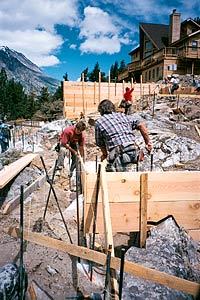
Gluing the Dowels
After drilling the holes, we used compressed air to blow out
the dust before setting the dowels in epoxy. We used an epoxy
cartridge system from Covert Operations (1940 Freeman Ave.,
Longbeach, CA 90804; 310/986-4212) to meet the strength
requirements called out by our engineer. We found both the gun
and cartridges easy to work with. The epoxy did not generate
heat as it set up, and did not emit the foul odor I’ve
encountered with other brands. (This last point may not seem
like a big deal, but the smell from some epoxies I’ve
used stuck to me like glue. When I started noticing that people
were looking funny at me when I was in a crowd, I decided to
switch brands.)
We injected an inch or so of epoxy into the hole, coated the
portion of the dowel that would be embedded, and inserted the
dowel in the hole, working it up and down to get a good coating
on both the dowel and the walls of the hole. Then we removed
the dowel, injected another inch of epoxy in the hole, and
reinserted the dowel. Properly embedded dowels would show signs
of epoxy squeeze-out. We averaged one tube of epoxy for every
20 dowels.
After the dowels were in place, we tied a continuous run of
#4 rebar to the dowels. We used a hand-held rebar bender to
shape the bar to the contour of the rock before tying it off 4
inches above the ledge.
With the footing bars in place, we began building the inner
wall forms in the same manner as the outer wall forms,
installing form ties as the inner form went up. Form tie
spacing varied between 18 inches and 4 feet, depending on the
height of the wall.
Bracing the Forms
Bracing our formwork to the surrounding rock called for a
little ingenuity. Drilling holes for angled bracing stakes
proved too troublesome, so we created a bracing system using
MST framing straps, 2x4s, and expansion bolts (Figure 4).
Figure
4. Simpson MST framing straps and 2x4 strongbacks,
anchored with expansion bolts, braced the forms to the
irregular rock outcroppings.
The 2-inch-wide framing straps are manufactured by Simpson
Strong-Tie (4637 Chabot Dr., Suite 200, Pleasanton, CA 94588;
800/999-5099) from 10-gauge galvanized steel; they’re
typically used to resist lateral movement.
We nailed one end of the framing strap to the form, and
placed the other end on the surface of the rock, pounding it
with a hammer to shape it to the configuration of the rock. We
drilled a 1/2-inch-diameter hole 21/2 inches deep in line with
the framing strap hole and inserted a Rawlplug tap-in expansion
bolt (Rawlplug Co., 200 Petersville Rd., New Rochelle, NY
10801; 914/235-6300). To add rigidity and compressive strength,
we nailed a 2x4 strongback to the strap through the prepunched
nail holes.
After stripping the forms, we were able to straighten the
straps and reuse them for the framing.
Preparing the Piers
This project also had 13 pier footings that needed to be
doweled to the ledge. Our engineer specified that a flat
surface be jackhammered into the sloping rock where the piers
were located, and that two dowel pins be provided per pier
(Figure 5).
| Figure
5. For pier footings, a flat surface was
jackhammered into the ledge and two epoxied dowels
inserted. |
We scribed the forms to the rock and held them in place in
the same manner as the wall forms.
Utilities and Drains
Care should be given to protect pipes and wires from abrasion
when bringing utilities into a foundation that is built on top
of rock ledge. We wrapped all water lines, sewer lines, and
conduit with Flex Wrap (WrapCo, P.O. Box 8043, Citrus Heights,
CA 95621; 916/723-2121), a closed-cell foam that protects
against puncturing or cracking (Figure 6).
| Figure
6. To protect against puncture and cracking, all
utility lines were wrapped with a closed-cell foam
wrapping (at left in photo). |
We used 4-inch perforated drain pipe in a bed of 3/4-inch
stone for seep water, and placed a 6-inch rigid drain line on
the high side of the house to pick up runoff water from the
hillside above and direct it completely around the house.
Swales at critical points directed runoff to intakes in the
6-inch drain line, and all drain outlets exited onto rock slabs
to prevent erosion problems.
Added Costs
We drilled more than 300 holes to prepare for a foundation that
required nearly a 100 yards of concrete. Forming to a rock
ledge can increase costs by 30% or more when compared with a
typical "dug" foundation. In our case, the excavation costs
were lower but labor was 30% higher and materials about 20%
higher.
I found building on rock ledges as satisfying and rewarding
as the time I spend climbing on them. It’s not that we
conquered the mountain; rather that with a little vision,
ingenuity, and patience, we achieved a goal worthy of standing
back and saying, "Been there, done that."


