
Builders nationwide are becoming increasingly familiar with shear walls, especially along the earthquake-prone West Coast and in the wake of recent hurricanes in the East. They’re aware of the kinds of metal connectors involved, and they’re accustomed to having the inspector check plywood nailing schedules and framing layouts.
But shear walls are just one element of earthquake- and wind-resistant construction. Less obvious, and somewhat more difficult to build, are the collectors. Also known as drag-struts or drag-ties, collectors gather the lateral earthquake loads from a large area of a building — a roof or floor diaphragm, for example — and deliver them to a structural element, such as a shear wall, that can resist the force. But unless the collectors are properly built, the shear walls will be ineffective.
The lateral forces from earthquakes or high winds are spread out over the entire area of the roof or floor diaphragm. And yet many contemporary custom homes have only small areas of shear walls compared with roof and floor areas. A collector gathers the force spread through the diaphragm and transfers, or “drags,” it to the shear wall.
Tension and Compression Forces
For a collector to work, it must meet the following conditions:
- Forces must actually get to the collector.
- The collector must be continuous (or be composed of elements joined together to act as one continuous member).
- It must have tensile capacity.
- It must be able to resist compression.
Seismic forces cycle back and forth, which is why the collector is stressed alternately in compression and then in tension. To design a collector that will resist both tension and compression, engineers must consider that high winds may come from any direction.
The most common collector in a typical wood-frame house is a wall top plate. But with more complex house configurations, there’s not always a wall plate available to act as a collector. In such a case, you may have to use another member for the collector — a truss or beam, for example — or you may need to assemble one from blocking and metal strapping.
Top Plates as Collectors
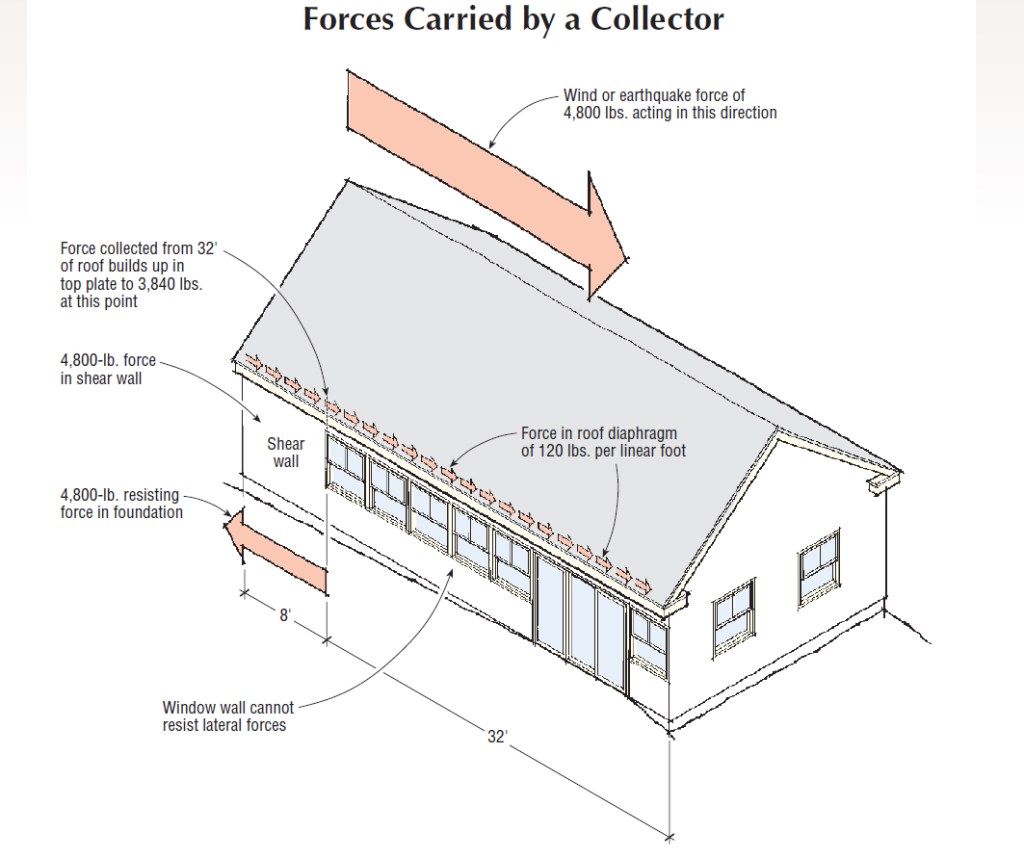
Look at the example in Figure 1, a 40-foot-long house with a long window wall along the eaves. Lateral forces transfer from the diaphragm sheathing in the roof to the eaves blocking, and from there into the top plate. To ensure a complete load path, you must nail the sheathing into the eaves (frieze) blocks, which in turn must be securely fastened to the top plate.
In a typical house, these forces might range from 80 to 120 pounds per foot along the eaves. In this house, the designer left only 8 feet at the end of the window wall for the engineer to use as a shear wall. We have 32 feet of windows that can resist no shear, so the top plate must collect all the force in the 32 feet of roof diaphragm above the windows and drag it to the shear wall.
The diaphragm force in this example — 120 pounds per lineal foot of roof, acting parallel to the eaves wall — builds up in the collector as we get closer to the shear wall. At the right end of the house, the force is zero. Ten feet closer to the shear wall, the force is 1,200 pounds (10 feet x 120 pounds/foot = 1,200 pounds); another 10 feet closer, the force is 2,400 pounds. Finally, when we have collected all 32 feet worth of diaphragm force, we have a total of 3,840 pounds of force in the top plate. Note that we’re showing tension force in the illustration, but if the wind was blowing in the opposite direction, or the earthquake forces were reversed, the collector would act in compression along the top plate.
Top plate collectors can typically carry the compression force, but they often need additional tension capacity. A single 2×4 top plate in a standard grade would not be able to carry 3,840 pounds of tension force. A double top plate might work if we reinforced any splices in the plates. As a minimum, the IBC (International Building Code), the IRC (International Residential Code), and the UBC (Uniform Building Code) all require eight 16-penny nails at lap splices. This requirement was new as of 1994 and essentially doubled the required nailing at splices. Even so, using allowable code values, this minimum nailing requirement would resist only about 1,000 pounds, assuming you used sinkers. Because this is far short of the 3,840 pounds we need in the example, we need to splice across the joints in the double plate with sheet metal straps to carry the tension force.
Other members as collectors. Trusses, joists, rafters, and other such continuous elements can easily serve as collectors. Figure 2 shows two instances where a shear wall is connected by a strap to a collector element in line with it. The strap provides tensile capacity.
To resist compression, the truss must bear against eaves blocking, which in turn must connect to the top of the shear wall.
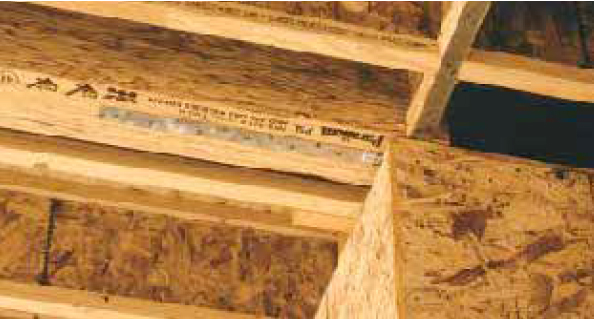
The strap in the photo above carries tension forces from the collector truss to the shear wall beyond (lower left in the photo).
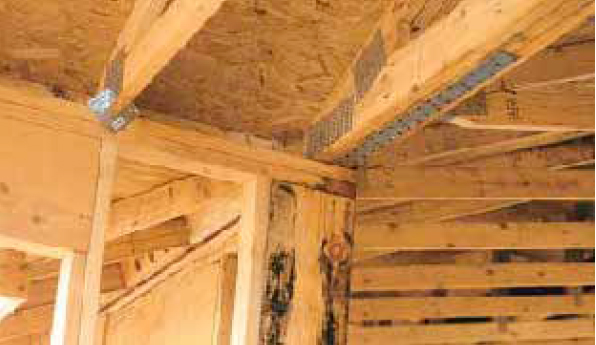
In this photo, straps running in both directions connect the wood I-joist second-floor framing to the shear walls below.
Building Collectors From Scratch
When you don’t have a continuous member to act as a collector, you have to build one. While it’s easy to reinforce the splices in a top plate, assembling a collector that runs perpendicular to framing members takes greater effort.
Figure 3 below shows a collector assembled between second-floor framing by installing blocks tied together with a steel strap. In this case, the strap and blocks are collecting the force from the floor diaphragm and carrying it to a shear wall beyond.
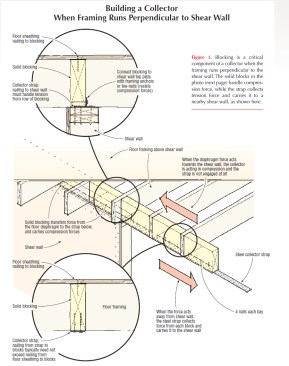
Blocking is a critical component of a collector when the framing runs perpendicular to the shear wall. The solid blocks in the photo (next page) handle compression force, while the strap collects tension force and carries it to a nearby shear wall, as shown here.
Blocks. The nails from the diaphragm sheathing into the blocks transfer a small amount of lateral force from the diaphragm into each block. How the force gets from each block to the shear wall depends on the direction in which the force acts. If the diaphragm force is pushing toward the shear wall from the row of blocks (from right to left), the collector is acting in compression and the steel strap is not engaged at all. Starting with the block farthest from the shear wall, each block pushes against the next in the direction of the shear wall. The second farthest block from the shear wall has one other block pushing against it; the next block has two blocks pushing against it, and so on. By the time we reach the shear wall, the last block in line pushes against the shear wall with the force collected from the whole row of blocks.
Strap. When the force in Figure 3 acts in the opposite direction, each block transfers a small amount of force to the strap. The strap collects the force from all the blocks and delivers it to the shear wall.
You can nail the strap either directly to the blocks or through the sheathing into the blocks. Figure 4 shows a strap nailed to the top of the blocks before the floor sheathing was installed.
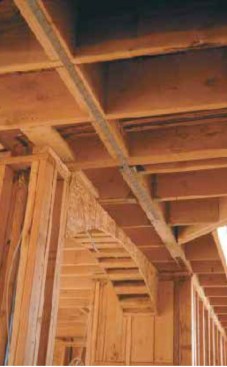
This strap was installed from the top before the floor sheathing was nailed down.
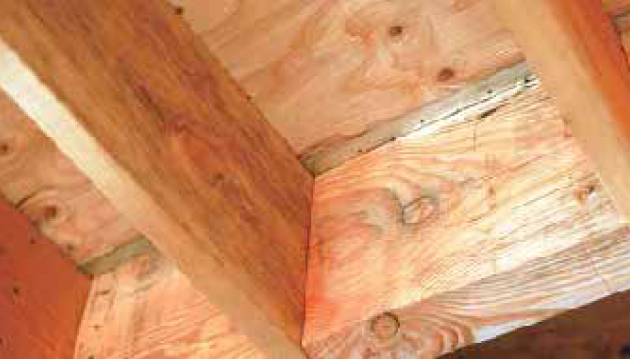
The carpenter routed out the tops of the framing members to avoid a bulge in the carpeted floor.
The carpenter routed a 1/8-inch slot for the strap so it would not create a lump in the sheathing. Note that this requires nailing the strap to the blocking, then nailing the sheathing to the blocking. If a strap is installed on top of the sheathing, as in Figure 5, the same nails can connect both the strap and the sheathing to the blocks. Remember that the blocks are important not only because they provide backing for the strap but also because they carry the compression forces when the collector acts in compression.
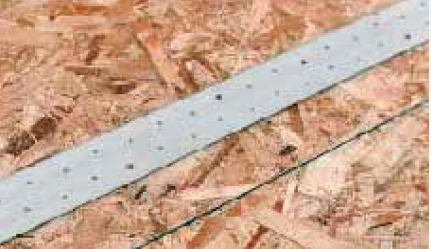
This strap was nailed to blocking below through the floor sheathing.
Figure 6 below shows a collector assembled from wood I-joist blocks. The strap nailed along the bottom of the blocks collects the force from each block and carries it to a shear wall just outside the photo.
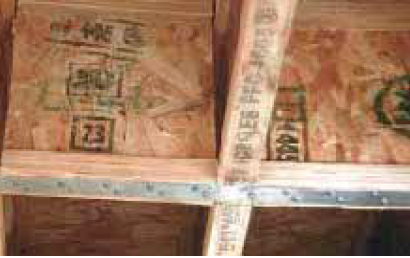
This collector was assembled from wood I-joist blocks and strapping. Ideally, the ends of the I-joist block webs would bear solidly against web fillers in the floor joists.
Note that because there are no web stiffeners in the I-joists, the blocks bear solidly only at the joist flanges and have gaps at the webs. When the sheathing exerts a force in one direction at the top of the block and the strap exerts a force in the opposite direction at the bottom, the block will want to roll. Connecting the ends of the blocks to the joists will prevent this. For a relatively small collector such as this one, I would usually consider that the blocks are held tightly enough on three sides so that they will not tend to roll. But if this collector was designed to carry a large load, the blocks would need to be toe-nailed to web stiffeners installed on both sides of every I-joist. Obviously, compared with using solid lumber framing, this becomes very labor intensive.
Use only as many nails as needed. Believe it or not and contrary to common advice, you don’t usually have to fill every nail hole in a strap used for a collector. Remember that what you’re doing is transferring forces from the floor sheathing into the strap and then to the shear wall. Look at Figure 6 again. Notice that the strap has about ten nails connecting it to each block — obviously installed by a carpenter intent on filling the holes. Yet how many nails do you think connect the sheathing to each block? If only three or four nails connect the sheathing to the block, we certainly don’t need more than three or four nails from the block to the strap. Too many nails may actually split the wood member, which would defeat the purpose of the strap. Some inspectors may insist that you nail all the holes in a collector strap. If you want to push your luck, you could try to explain to the inspector why straps do not always need complete nailing. Otherwise, do what the inspector tells you, trying your best not to split the wood.
The strap in Figure 5 was designed and inspected by a structural engineer. It has just the right number of nails to collect the forces along 45 feet of diaphragm and deliver them to a shear wall.
Follow the Load Path
The collector provides the load path to the shear wall. But the forces we want to collect are in the floor or roof diaphragm. So it is critical to nail the sheathing to the collector truss or beam, or to the row of blocks acting as the collector. If the collector member does not fall on the regular framing layout, it’s possible that nailing the sheathing to the collector will get overlooked and there will be a gap in the load path.
Figure 7 below shows a strap that will connect to a roof truss. Because none of the roof trusses in the regular 24-inch on-center layout fell in line with the shear wall, the builder had to add an extra truss to pick up the strap. In a case like this, the carpenter nailing off the sheathing must be careful to nail the roof sheathing to that truss to complete the load path. The plans should clearly note this additional nailing requirement. Similarly, when collectors run perpendicular to the framing, it is easy to overlook nailing the sheathing to the row of blocks unless the strap happens to land on top of the sheathing to remind you. Again, the plans should show these connections.
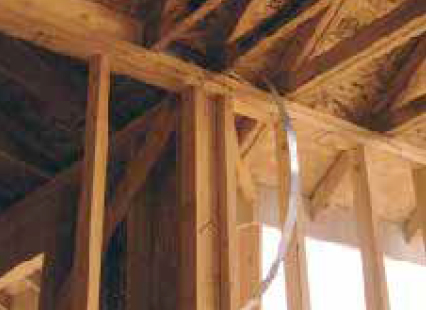
This strap, which runs from the top of a shear wall, will connect to the bottom of a roof truss above. Note that none of the trusses on the regular layout fell in line with the shear wall, so the builder had to add an extra offlayout truss to catch the strap. The roof sheathing will also have to be solidly nailed to this truss so that it picks up lateral forces in the roof diaphragm.
The photos in Figure 8 below show a logical framing sequence. First, the straps get nailed to the top plates of adjoining support walls. Then, after the roof trusses are installed, the straps get nailed to the bottom of the girder truss and to the blocking between the common trusses. The girder truss, blocks, and straps all act as the collector. Nailing the main roof sheathing to the blocks completes the load path from the roof diaphragm to the shear wall.
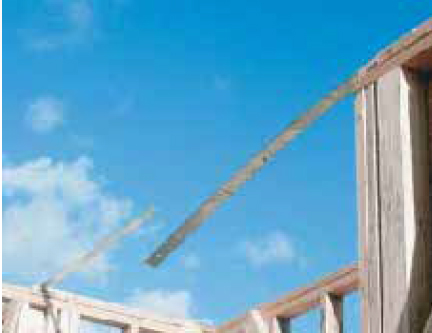
In this framing sequence, straps attached to the tops of shear walls are left hanging.
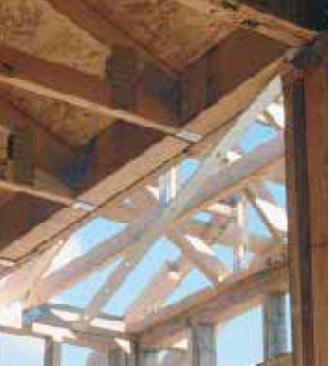
The installation of a blocked girder trus acts as the collector for a section of roof.
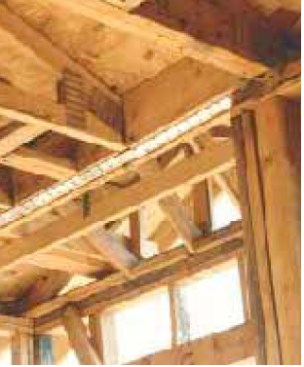
Finally, the straps are nailed to the bottom of the girder truss.
Common Collector Pitfalls
Most problems with collectors arise when the framing members run perpendicular to the force we need to collect.
Many short straps do not equal one long strap. The line of blocks shown in Figure 9 below will serve as a collector in compression, but will fail miserably in tension.
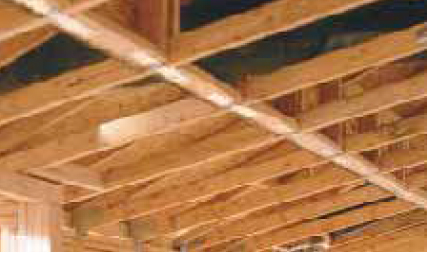
These photos illustrate a common mistake in building collectors — using many short straps instead of one long one.
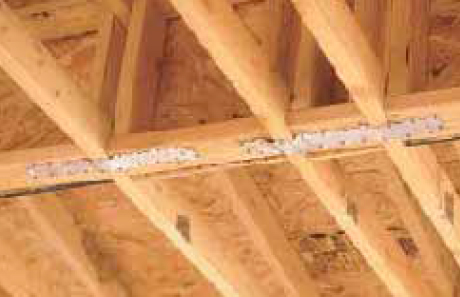
Each short strap must carry the cumulative load to that point in the collector, meaning that the strap near the end of the collector is likely to fail.
At some point along the line, the collected forces will overwhelm the individual strap connections. Think of it in terms of a game of tug-of-war. If the members of one team are each holding a separate length of rope, they’ll have a hard time beating a team whose members are combining their grips on a single length of rope (Figure 10) below. The person at the very front of the line on the separate-rope team would be the only person holding the rope that the other team is pulling on, and his grip would have to hold the combined force of his entire team.
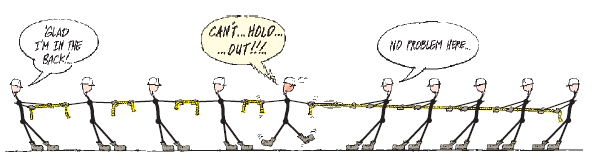
Think of a collector strap in terms of the game of tug-of-war. The team holding many short ropes will have a tough time beating the team whose force is combined in one continuous rope.
It’s important for building designers not only to account for the tension force that a collector must carry, but also to detail how to build the collector. Problems like the grossly overloaded collector in Figure 9 can arise when the plans use vague notes like “drag-tie” or “block and strap in line with wall.” Engineers shouldn’t expect carpenters to build something that is not shown adequately on the plans.
Gaps in rows of blocks can lead to failure. In contrast to the collector in Figure 9, Figure 11 shows a collector that will fail in compression. The gap in the row of blocks will need to close before the collector can deliver much force to the shear wall to the right (outside the photo). You can bet this gap would not close gently during an earthquake. While the floor sheathing would handle some level of lateral loads, the repeated back-and-forth movement of the house would cause this gap to close and open many times, slamming the separate building segments against each other with thousands of pounds of force.
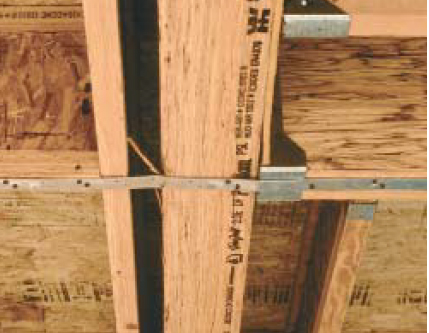
The missing block in this collector between the girder and the I-joist to its left could prove costly in an earthquake: The back-and-forth cycling of the quake will smash the two members together, folding and stretching the strap below until it fails.
Furthermore, the strap spanning the gap will buckle and then straighten out each time the gap closes and opens. After several cycles, the strap will fatigue and break, which could allow the gap to open up. Then the two building sections might separate completely or just bash each other to bits.
Many commercial buildings collapsed or suffered major damage in the 1994 Northridge earthquake due to collector failures. Those failures prompted code changes that reflect the importance of collectors. When sizing collectors in such buildings, designers must now use an additional safety factor of about 175% of what the codes previously required. These changes do not yet affect buildings with wood-framed shear walls, but they do indicate an awareness of the importance of collectors to structural safety.
Just because you can bend straps doesn’t mean you should. For a steel strap tie to work effectively, it must be installed without kinks, bends, or twists. The strap shown in Figure 12 has lost some of its strength because of the twist pounded into it.
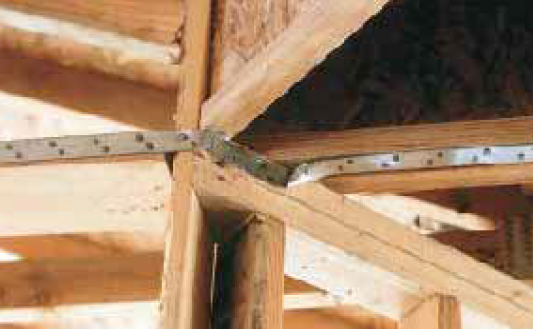
Straps should not be bent: The kink in this strap weakens it.
It will also tend to straighten out when it’s put in tension, which in this case could displace the top plate or the joist that it connects to, as well as rip nails out of those members.
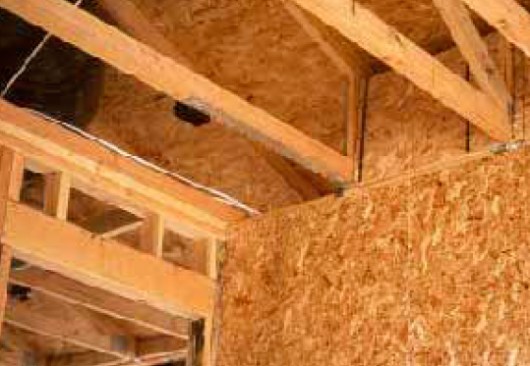
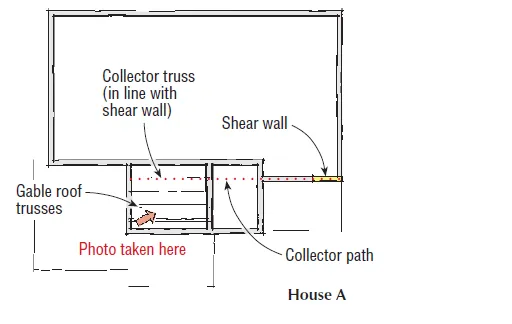
Watch out for plan changes. Figure 13 photos below show what can happen when a stock plan gets changed without accounting for the lateral load path. These two houses are located in the same tract and have identical floor plans. Presumably to make the houses look different, the front-facing gable of House A was changed to a hip in House B.
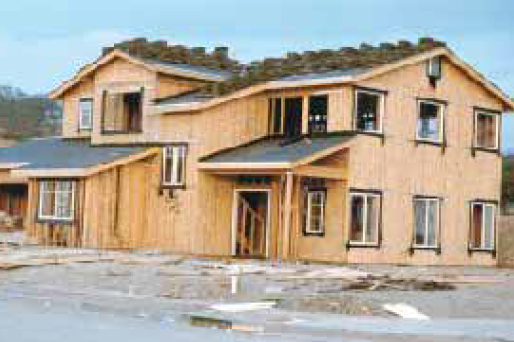
These photos were taken of two nearly identical houses in the same tract and illustrate how a change in the engineered plans can render a collector useless.
In House A, which was built according to the stamped plans, the section of roof in the small front-facing gable is tied by a strap running from a shear wall at the corner of the house to a collector truss running in the same direction.
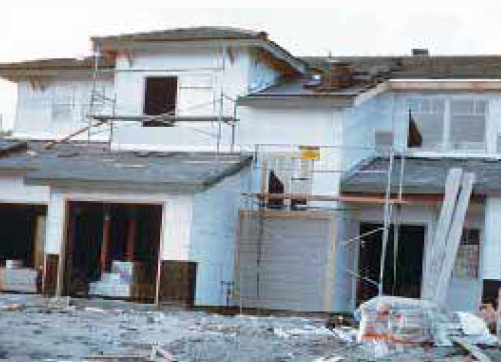
In House B, the builder chose to modify the small gable by making it a hip roof. That resulted in hip trusses running perpendicular to the shear wall. The carpenters made an effort to connect the strap to something solid by adding some blocking between the first two hip trusses.
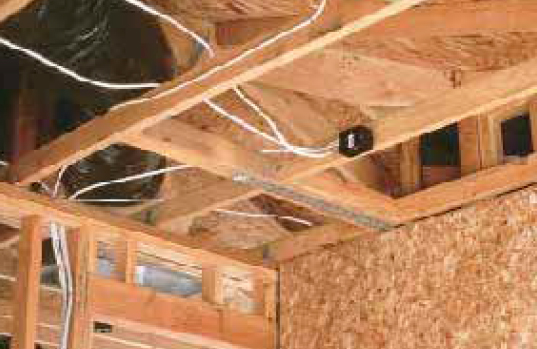
However, since the blocking doesn’t extend to the roof, where it could connect to the sheathing, it will do a poor job of transferring diaphragm forces from the roof to the shear wall.
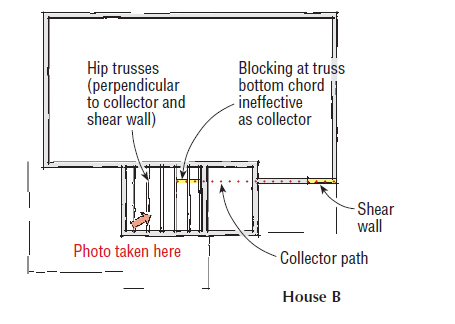
The effect was that the same strap running from the shear wall to the collector truss in House A runs to nowhere in House B. The carpenters had nothing to connect the strap to in House B, so they added some blocks perpendicular to the bottom chords of the first two trusses. But because the trusses have almost no strength in that direction, there’s no way for the forces from the roof diaphragm to even get to the strap and the shear wall beyond. Correcting this problem would involve installing sheathed frames between the trusses from the bottom chord to the roof sheathing, then nailing the strap along the entire row of frames at the bottom, and nailing the roof sheathing to the frames at the top. As installed, the blocks shown in House B will not collect any force except from the ceiling; during an earthquake or windstorm, they would do no more than rip out a small area of ceiling drywall.
This is a common problem in tract home construction. Too often the plans get changed by the architect, owner, or truss manufacturer after they have left the engineer’s office. That is one reason hiring the design engineer to observe construction progress is recommended almost universally by the experts who examine destruction after hurricanes or earthquakes.


