
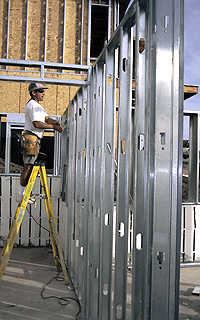
Though it’s initially more expensive than wood framing, steel will save you money by eliminating many callbacks by Jeff Loughead
We’d been building wood-framed houses for more than two decades, but seven years ago, we decided it was time to make the move to light-gauge steel framing. The quality of the lumber we’d been getting was just terrible. At one point, we found that we were only using a little more than a third of every truckload of lumber, and the price was going through the roof. I had read about the advantages of steel, but with no practical experience of our own, we were anxious about making such a big change. We discussed it with several local steel suppliers, and got a lot of help from one sales rep who was willing to spend time training us.
At the time, we thought lumber prices were just going to keep going up. As it turned out, things started to stabilize within a couple of years, but by that time we were using nothing but steel and could see the advantages for ourselves. Now we wouldn’t think of going back.
Preconstruction Benefits
It’s a lot easier to do takeoffs and bids on steel-framed jobs, because steel suppliers will hold a price for 30 days or more, and their prices usually go up only once a quarter. If you’re using wood, most suppliers won’t guarantee a price for more than a week, two at the most. If it takes the client a month and a half to get back to me, I’ve got to have language in the contract that says the price is subject to change if lumber prices go up. But on a steel job, I can pull up the list from a job I did last month, reference it for the takeoff I’m doing today, and get an accurate price out there a lot sooner.
Waste not, want not.
We also save time because the material itself is so consistent. Every stud is perfectly straight, so I don’t even have to go meet the trucks at the drop site. Everything but the headers comes precut – if you need 9 foot 6 inch studs, that’s what you order. All the framing waste from an 1,800-square-foot house fits into one 32-gallon trash can. Instead of paying someone to haul it away, I just drop it off at a local metal scrap yard.
Labor
When I first started looking at steel, I thought I could just go down the street and hire some of the commercial guys who were finishing a big supermarket. But there’s a big difference: In most commercial jobs, the building is held up with structural steel, and the light-gauge stuff is only used for partitions. We found that the commercial guys had the basic skills, but they didn’t know anything about load-bearing walls.
Square one.
At first, I had to snap and measure the layout for each wall myself. I’d take a sharpie pen and mark the rough openings with a K for a king stud and a T for a trimmer. But most of the commercial guys caught on pretty quickly. In fact, we found that it was easier to convert the commercial guys to residential steel than it was to retrain carpenters to work with steel. Steel framers are already used to working with the material, and know how to use screw guns and chop saws. Steel either fits or it doesn’t, and if it doesn’t you’ve got to unscrew it and fix the problem. Steel guys know that, but it’s an adjustment for wood framers, who are used to hammering on things until they fit. Some of our wood framers did make the switch to steel, and the guys who wanted to stick with wood now frame our I-joist floors and truss roofs.
Design and Construction
Our first project was a tract of 46 houses. The first unit took us nearly three weeks to frame, when it should have taken less than a week. There’s no way to avoid taking an initial hit when you make the switch – but if you plan ahead, you can make it a lot less painful.
Engineering.
Framing with steel is slower than working with wood. That increases your costs, so if you don’t compensate by using the material efficiently, you’re in trouble. That means having an engineer gauge the material and design the header systems from the ground up, rather than taking a set of wood-frame plans and converting them. When we started out, there were no prescriptive tables for light-gauge steel. It’s easier now, because the engineer can reference the charts and come up with the specs in a lot less time. Steel is stronger than wood, so the studs can easily go 24 inches on-center. Our joists and roof trusses use the same layout spacing so all the loads line up and transfer right into the foundation.
Division of Labor
Although all of our bearing walls and partitions are framed with steel, we use wood I-joists in our floors. Like steel, they’re straight and consistent, but we think they provide a nicer floor. When you jump on them, they produce a satisfying “thud,” rather than the disconcerting “boing” of a floor supported by steel joists.
Because we have separate wood and steel crews, we work on two houses at once. The steel crew finishes framing the first-floor walls, then the wood crew moves in and installs the floor joists and subfloor. By the time they’re done, the steel crew has the first-floor walls of the next unit ready.
Work smart.
When a carpenter grabs a piece of material on a wood-framed job, all he has to do is get the right dimension. But a steel framer has to choose between 18-gauge material for a bearing wall, and 20-gauge for a partition. We order materials on a per-home basis, so if the framers use material from the wrong pile, they’re going to come up short somewhere. All the walls are built in place, rather than assembled on the deck. Once we’ve bolted the bottom track to the slab, we brace the corners in position, run string lines across the top to check for level, and screw the top track in place.
Headers.
Next, we fill in the remaining studs, and header off the rough openings (Figure 1). This is a critical area, because every header has to be made up on site as specified by the engineer (). On some jobs, there might be six different header types and gauges, although we can usually reduce that number by using heavier headers than we need for some openings. This wastes a little material, but it simplifies things and saves time. Another difference between wood and steel is that steel headers are attached to the top track, with cripples extending down to the opening, rather than sitting at the top of the opening with cripples extending up to the top plate, as in a wood frame (Figure 3).
| Figure 1.In steel framing, walls go up piece by piece, rather than being preassembled on the deck. Self-locking clamps hold the studs in position while the framer drives screws through the side flanges of the top and bottom tracks – the steel equivalent of the top and bottom plates – and into the studs. |
| Figure 3.Cripples extend downward from the header beneath the top plate, and terminate at the rough opening. |
Quality framing starts with accurate material. Steel won’t warp or twist, but that doesn’t help if the material isn’t correctly sized to begin with. Cross-sectional dimensions and gauge are always consistent, but unless your supplier cuts the material to length accurately, you’re in trouble. There’s no problem with studs that are 1/8 inch long or so, but if the variance is much more than that the material has to be recut. Because steel framing is labor-intensive to begin with, this isn’t something you can afford. Studs that are too short will fit, but they’re a structural problem because a short stud is just hanging from the screws. That’s not so bad in a partition, but in a bearing wall the studs must butt tightly against the top and bottom tracks.


