
Indoor Mold Causes & Cures
Over the last few years, “mold” has turned into the ugliest four-letter word on the job site. The mold monster has become the bane of builders, insurers, realtors, and homeowners from coast to coast.
The effects of mold on human health are not fully known, and there’s a lot of debate about it. But whatever the effect on personal health, there is no doubt that mold can threaten the health and even the survival of your business. To prevent problems, all builders need to know what mold is, how to prevent it from growing indoors, and how to get rid of it when it gains a temporary foothold.
There’s no real mystery to this. As a building science consultant based in Texas, I’ve gotten pretty familiar with mold, and I’ve come to see the issues in terms of elementary building performance principles. The practical solutions are found in simple good construction practice.
Many of today’s mold problems are related to recent changes in building materials and techniques. Every house is actually a complex system made up of interacting components, materials, and subsystems. Change one, and others may change in unanticipated ways. In some of today’s houses, this has resulted in conditions that favor the growth of mold.
But while many types of construction problems can lead to mold, mold prevention starts with one basic principle: Keep the building dry. Build it dry to begin with, design it to stay dry, and make sure it can dry out if it does get wet. And if you tangle with a building that has an existing mold problem, remember that every mold problem is a water problem first. To fix the mold, you have to fix the water problem.
Some of the answers are as simple as drains that work and pipes that don’t leak. We also need to pay careful attention to water-shedding exteriors, air and vapor barriers, insulation details, and hvac system design, and consider how those systems affect one another.
JLC deals with some aspect of dry building details in almost every issue; in this article I’ll just hit a few high points, then discuss ways of tackling existing mold problems. But first let’s take a look at the beast itself: the mold organism.
Why Mold Grows
Molds are fungi, a group that includes 100,000 known species. Mildew in an old trunk, mushrooms in the woods or fields, brown and white rot in a woodpile, and black mold growing in a basement are all closely related organisms.
Fungi exist for a reason: They serve to recycle organic material on earth. They help keep the planet in balance, because for life to continue, everything that grows must decay and break down again.
Mold and other fungal spores are everywhere: Every cubic foot of air contains thousands of them, and every surface — natural or manmade, indoors or out — is covered with thousands more. When the environment is right, the spores sprout and grow. They need only three things: food, water, and the right temperature conditions.
Food. Anything that was once alive can serve as food for one fungus or another. In the wild, molds invade dead trees and grasses and consume the sugars stored in their cells. Mold colonies can live on the surface of sawn lumber, but they really thrive on products in which the wood has been prechewed and predigested, like OSB, particleboard, and paper-faced drywall.
Water. To germinate and grow, mold needs high levels of moisture — meaning greater than 60% relative humidity, or a surface that stays damp for about three days. Without water, molds die or go dormant (but only after releasing millions of spores into the air). From the builder’s perspective, this need for water is where mold is most vulnerable: If we can keep the building dry, we can stop mold in its tracks. But if we build any part of the building wet, or let it get wet in service, we’re inviting mold to move in.
Temperature. Molds can handle temperatures from 40°F to 100°F; their ideal zone is 50°F to 90°F. Generally speaking, if the temperature is reasonably comfortable for you, mold will be happy, too.
Mold in the Modern World
Builders at my training sessions often ask why we seem to hear so many more reports of mold problems these days than in the past. Several factors are involved. For one thing, houses are tighter now than in the old days. Tighter homes also tend to dry more slowly, so they may accumulate more moisture.
Increased levels of insulation also play a role. Heat flow through walls and ceilings is expensive, but it does dry out wet assemblies. The uninsulated or poorly insulated homes of a generation ago could dry before mold had a chance to begin growing. Better insulation cuts heat flow and slows the rate of drying, so even a minor leak in a home insulated to modern standards can lead to persistent wetness that can allow mold to flourish.
The other big consideration is that today’s building materials are better mold food. We’re using less brick, stone, and concrete (substances mold can’t process); when we use wood, we’re using juvenile lumber that contains a higher proportion of mold-prone sapwood than the lumber of years past. Sawn lumber has been replaced by OSB and particleboard — materials that are easy for water to penetrate and that have lots of the sugars and starches that molds can readily break down and absorb. And instead of traditional plaster, which is a hostile environment for mold, we’re using paper-faced gypsum, which amounts to mold candy (see Figure 1).
Figure 1.Paper-faced gypsum board is ideal mold food. This photo shows a firewall between two multifamily units that stood in the rain before the building was closed in. After odor complaints from residents, every firewall in the project had to be removed and rebuilt. Wet conditions during construction are a major cause of mold in buildings.
To these factors you can add all the small things that contribute to moisture in homes: air conditioners that achieve greater energy efficiency at the price of reduced dehumidification, exhaust-only ventilation systems that suck in moist humid air in warm climates, leaky air ducts, vinyl wallpaper that acts as a wrong-side vapor barrier — the list goes on and on.
All of these problems are avoidable, but they won’t take care of themselves. We need to actively address each one.
Preventing Mold in New Houses
Stopping mold in homes is mainly a matter of attending to a few key elements, starting with the building envelope. Remember that there’s no such thing as a waterproof wall. Windows, doors, brick, and wood siding leak; every joint leaks, and all caulks and sealants eventually leak, too. So water protection in walls is not about waterproofing — it’s about drainage (see “Water-Managed Wall Systems,” 3/03). If you don’t want mold, you can’t let rain into the walls.
Many leaks result from bad flashing details (Figure 2). For roof leaks, poorly detailed chimneys and wall-roof intersections are major culprits. Make sure your employees and subs handle those details right, and you’ll avoid most roof leaks (see “Troubleshooting Roof Leaks,” 10/99).
Figure 2.Bad flashing at a deck ledger attachment allowed water to soak this walkout basement wall. The OSB sheathing shows both mold growth and white rot fungus.
Foundations. Basements and crawlspaces are notorious for being damp and smelly, and they are a common location for mold growth (Figure 3). Moisture in the basement or crawlspace often moves directly into the home above, and then into the attic. It’s a common source of condensation on air-conditioner supply grilles in the South and of frost under roof sheathing in the North.
Figure 3.Damp basements are a friendly environment for mold. Extensive mold growth is visible on a drywall panel in a humid basement (left). The sawn lumber, which is less moisture absorbent and has less available nutrition for mold, has not been colonized. At right, high relative humidity has allowed mold to grow on engineered I-joist floor framing in a basement.
Building codes may say otherwise, but from the standpoint of building science, the best way to keep crawlspaces dry is to stop ventilating them with outside air. Seal them up, insulate the perimeter, cover the floor with a continuous vapor barrier, and introduce a small amount of conditioned air from the main house. The ground cover is key: Left bare, the soil in a crawlspace evaporates 12 gallons of water per thousand square feet of exposed soil per day. Ventilating a crawlspace with damp exterior air only adds more moisture. Whether your crawl has vents or not, sealed crawlspace expert Jeff Tooley warns that you must place an effective barrier to block ground moisture before you close in the building. Otherwise, you create humid conditions while the house is still under construction, inviting fungi to attack.
Research also tells us that we should insulate a cold-climate basement on the outside of the wall, because this keeps the wall interior warm and dry. And in any climate that gets rain, gutters, downspouts, and good foundation drainage are important to protect the foundation against water intrusion (see “Foundation Drainage,” 3/99).
Warm-side vapor barriers. In the northern U.S., the primary vapor flow in homes takes place in the winter, as warm-humid interior air moves toward the dry exterior. But in the South, the forces switch sides of the wall: The warmer, more humid conditions are found on the outside of the home during most of the year, and the vapor drive is toward the dry, air-conditioned inside. Literally speaking, northern homes dry out, but southern homes “dry in.”
Vapor barriers should be positioned accordingly: on the interior wall face in cold climates, and on the exterior face in hot climates. In the South, vapor barriers on the inside of the wall actually tend to cause condensation, mold, and rot (Figure 4). Building codes in many areas are starting to catch up with this reality.
Figure 4.In hot, humid climates, vinyl wallpaper forms a vapor barrier on the cool, air-conditioned side of the wall, causing exterior moisture to accumulate under the wallpaper and support the growth of mold. Walls should be vapor-permeable on the side facing dry air, and vapor barriers should be placed on the side facing moist, warm air.
Indoor Mold Causes & Cures, continued
Ventilation. Tight homes do trap moisture. We don’t need to build homes leaky again, but we do need to install mechanical ventilation in homes, as we have for decades in commercial buildings.
In the North, you want to create a neutral or slightly negative air pressure inside, so any air leakage will be cool, dry exterior air leaking in, not moist, heated air pushing out. Exhaust ventilation works well in cold climates. But be sure to use sealed-combustion appliances, or conduct a “worst-case depressurization test” to make sure any natural-draft appliances draw properly, even when all other equipment that can cause negative pressures is running.
In the South, we need to pull in extra air and pressurize the home to keep the humid outside air at bay. One solution is a direct air intake into the plenum of the air conditioner, which leads incoming air through the air filter and cooling coil before introducing it to the indoor space. Even better, install a whole-house dehumidifier, ventilator, and filtration system in parallel with the air conditioner. This will do a better job of maintaining year-round moisture control without over-cooling the house.
It’s very important not to oversize the air conditioner, because oversized units do a poor job of reducing humidity. Always have the equipment sized using the Air Conditioning Contractors of America (ACCA) Manual J (www.acca.org).
Bathrooms. The bathroom is a wet place by definition, which makes it a common place to find mold (Figure 5). Contrary to popular belief, “moisture-resistant” drywall (“green board”) is not a mold-resistant substrate for tile. Use a cementitious backer board instead. An even better approach is to skip the tile and use a nonporous sheet material like solid surfacing. The fewer cracks and gaps you have to seal, the better the odds of keeping the system dry.
Figure 5.The bathroom is a naturally humid environment and is also prone to plumbing leaks that create continual wet conditions. Drywall, whether moisture resistant or not, supports thriving mold colonies in moist conditions. Use backerboard and tile instead, or a synthetic material like solid surfacing.
Always install a good bathroom ventilation fan, even if you have a window. There are plenty of quiet, efficient models on the market, with controls that can respond to humidity or motion. Timer-linked controls are also effective. Vent the fan to the outside, not into the attic, or things have a way of turning ugly overhead (Figure 6).
Figure 6.A dryer vent and bath fan were improperly vented into this attic, causing condensation to form on the sheathing and support mold growth.
Plumbing. Let’s not forget the pipes. According to insurance industry statistics, plumbing leaks are the biggest source of water damage claims. Don’t put pipes where they might freeze and burst. Pans under water heaters and washing machines are good insurance. Leave easy access to drains under sinks or in cellars, so leaks can be quickly detected and easily fixed. And be absolutely sure that plumbing is tested for leaks before anything is closed in.
Mold in Existing Buildings
What if you encounter mold during a remodeling job, or get a mold-related complaint in a home you’ve built? Now you’re looking at cleanup (or to use the modern 50¢ word, “remediation”).
Your cleanup methods have to keep the mold from spreading by minimizing dust and spore dispersal. You also have to provide personal protection for people who are exposed to the mold (including the building occupants and your crew) and protect yourself from any greater liability.
Know the standards. In particular, you must not leave yourself open to an accusation that you made the situation worse by not exercising due diligence. I’m no lawyer, and I won’t go into details about liability issues, but I can say that it’s a good start to know and apply well-accepted national standards for handling mold in buildings. If a case goes to court, it’s nice to be able to tell the plaintiff’s attorney, “We got there as quickly as possible, did a thorough visual and moisture meter investigation to determine the extent of the damage, identified and stopped the water intrusion at its source, and then proceeded according to nationally respected guidelines.”
Those guidelines are out there, and it’s your business to know about them. If you ignore the guidelines or, worse, knowingly violate them, your position is very weak.
A panel of national experts convened by the New York City Department of Health issued mold remediation guidance in 1995. New York’s guidelines have served as a template for the Environmental Protection Agency (EPA) and other groups in creating their published guidance materials. All these organizations agree on the main points, and the rules aren’t hard to follow. New York’s guidelines are available from the city’s Department of Health website at www.ci.nyc.ny.us/html/doh/html/epi/moldrpt1.html. EPA’s guidelines are posted at www.epa.gov/iaq/molds.
Let’s go over the key points.
Act fast. Timing is critical. Treat every water intrusion complaint like a report of a small house fire — because just like a fire, the problem will quickly get worse if you ignore it. Don’t say you’ll be over when you have time, get there now!
You won’t see or smell mold for the first 48 hours after the materials get wet. If you can get to the job before mold starts to grow, stop the water at its source, and remove or dry all the wet material quickly, mold may never be an issue.
Try to keep the relative humidity levels in the area below 60%, because mold has a difficult time growing beneath that threshold. In fact, to speed the drying of materials, the drier you can keep the air, the better.
By eye and nose. If you don’t arrive on the scene until things have already been wet for several days, you may well have a mold problem. Do a thorough visual examination of the area and all associated areas where the water might have gone. You need to determine the source of the water and the extent of the damage. Don’t start repairs or remediation until you find and eliminate the source of the water — rebuilding or cleaning the damaged area is useless unless you’re sure it will stay dry. Remember to look in the hvac system, the ceilings of areas below the source, and walls associated with the general area, too.
A good moisture meter is vital for the initial investigations. There are good pinless meters now available that don’t leave holes in the wallboard, tile, or other finish materials.
Don’t ignore your sense of smell. Molds have a distinct odor, and our noses are finely tuned for detecting it. If you notice a “moldy” or “musty” smell, track it down. Odds are it’s mold.
Don’t test the mold. Somebody may suggest testing the mold to find out what type it is. Don’t do it. Identifying the species doesn’t serve any purpose in the cleanup process. No matter what mold species it is, we want it out of there, and you will proceed with your remediation the same way regardless. Air sampling for spores is also not helpful in most cases.
Whether there’s mold or not, you need to stop any leaks or condensation problems. If you do find mold growth, consult the remediation guidelines and decide whether the cleanup is a job your crew can handle, or it’s time for a specialist to take over.
How much is too much? The New York guidelines lay out a graduated response that depends on the amount of mold present. The goal is the same — stop the water, protect the occupants and workers, and get rid of the mold — but for larger amounts of mold, the guidelines call for qualified supervision and more stringent measures to isolate the work area.
The guidelines recognize four levels of contamination, which are defined in terms of the square footage affected by mold. These range from “small isolated areas” of 10 square feet or less to areas of “extensive contamination,” which cover 100 contiguous square feet or more. There are two intermediate classifications — “mid-sized isolated areas” of 10 to 30 square feet, and “large isolated areas,” which cover 30 to 100 square feet.
The appropriate cleanup procedure for any given case will depend on the contamination level. Levels 1 and 2 — areas of mold less than 30 square feet, or about the area of a sheet of plywood — can be handled by a general contractor’s crew or a building owner’s maintenance staff, as long as the workers get appropriate training, have the correct equipment, and follow the steps laid out in the standard.
Areas of mold covering between 30 and 100 square feet (Level 3) require “personnel trained in the handling of hazardous materials and equipped with respiratory protection, gloves, and eye protection.” When contamination exceeds 100 square feet (Level 4), the standards require full containment under HEPA-filtered negative air pressure, complete isolation of the work area, and airlocks. This is unquestionably a job for professionals.
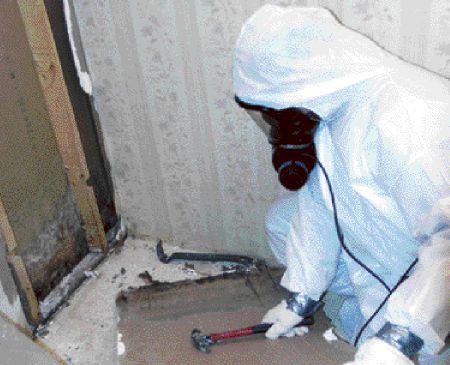
Large areas of mold growth call for crews trained in hazardous materials handling.The area should be depressurized with a HEPA-filtration blower and entered through a sealed “clean room.” This crew wears protective suits with hoods, booties, and gloves, along with full-face positive-pressure powered respirators equipped with activated carbon filters to remove VOCs. But the crew leader says, “This is not HAZMAT gear. It’s not good enough for asbestos or a chemical spill. It’s really just very good dust protection. We use the charcoal canisters because we don’t like the smells, not for safety reasons. And the blowers help keep us cool inside our hoods.” Careful dust-control practices prevent mold or anything else from being spread around during demolition. These trained mold remediators carefully cut away drywall with knives and place it in plastic bags for disposal; they use a shop-vac to suck the air out of the bags and close them with duct tape. The bags of debris (bottom) are not toxic waste, however, and can be taken to a regular landfill — the purpose of the containment and dust control is just to avoid exposure to allergens and irritants. |
The square-foot thresholds are somewhat arbitrary, and the standards don’t claim to be based on any proven relationship between area of mold growth and alleged health effects. It’s really a judgment call: Can a crew get rid of the mold without spreading it or exposing anyone to elevated levels of spores or contaminated dust in the air? The more mold there is, the harder it is to contain the pollution; every contractor has to make his own decision on where to draw the line.
Cleanup Basics
Let’s look at the minor jobs that can be undertaken by a building owner’s regular maintenance crew. The standards recommend that the crew should “receive training on proper cleanup methods, personal protection, and potential health hazards.” You can do this yourself with the help of some publications available free from the EPA (www.epa.gov/iaq/molds/mold_ remediation.html).
Protective gear. You need to be very strict about personal protection — you’re open to a comp claim or lawsuit if anyone starts to feel sick. The crew should wear masks that meet the N95 disposable respirator standard. These are now widely available at all of the big-box hardware stores for a couple of dollars each. (Don’t confuse these with much cheaper “nuisance dust” masks.) The crew should also wear latex gloves and goggles, because some people may get allergic skin reactions to the many substances molds produce.
Who should move out? The work area should be unoccupied, but with certain exceptions, the family can stay in adjacent areas. The exceptions include children under one year old; people with chronic lung diseases like asthma, severe allergies, or emphysema; and anyone with a compromised immune system (such as chemotherapy patients, people with AIDS, and transplant patients). People who fall into one or more or these groups should move out of the building until the work is complete.
Containment. Disturbing moldy materials can greatly increase the levels of spores and contaminated dust in the air. Contaminated materials must not be allowed to spread beyond the work area. The key to preventing this is something called containment — essentially a matter of isolating the work area with overlapping sheets of plastic that are sealed at their edges. Containment is not required for small moldy areas under 10 square feet but is recommended for areas between 10 and 30 square feet.
I recommend that containment with plastic be employed on all cleanup or demolition jobs. It’s cheap and effective. At this level, there’s no need to create a negative pressure field by exhausting the air from the work area through a HEPA filtration unit. That’s not a bad idea, but the guidelines don’t direct you to do it.
To depressurize the workspace on small jobs, I sometimes buy an inexpensive box fan and a 1-inch pleated-media filter (such as a 3M Filtrete filter) the same size as the fan. I tape the filter to the fan and seal the fan in the window, creating a simple exhaust system with a filter that will easily capture mold spores. The air is drawn from the house, pulled through the contaminated work area, then filtered and exhausted to the outside.
In any case, do what you can to suppress dust during your work. One effective way is to mist the areas before cutting into them. You don’t want to soak them, just dampen them enough that you don’t stir up a cloud when you work.
Reuse or discard? Some building materials can be easily cleaned and reused, while others can’t. Porous materials that can’t be easily cleaned, including insulation, drywall, carpet pads, carpet, and ceiling tiles, should be discarded. Any materials you remove must be placed in plastic bags and sealed before being removed from the work area. Moldy possessions — furniture and the like — also have to be cleaned or discarded; but if antique or valuable fabric or carpet has mold growth on it, a professional cleaning and restoration contractor may be able to save it.
Nonporous materials such as metal, glass, and hard plastic, and the semi-porous materials like wood and concrete, can be cleaned instead of removed. But in the case of wood, decide whether it is still structurally sound. Processed wood products like particleboard and OSB are more sensitive to water damage than solid lumber. No materials of any kind should be left in place unless they are sound, dry, and visibly free of mold.
Cleaning. People often think they should use bleach on mold, but the industry standards recommend against it. Bleach does not kill mold spores, and the bleach itself is an irritant and can be harmful to workers and building occupants.
In any case, sanitizing or killing the mold is beside the point. Mold is an allergen whether it’s dead or alive. If the area is clean and dry, mold will not grow; if it’s wet, mold will grow back even if you wash with bleach.
The answer is to use a good strong soap and water solution. Mold spores have a waxy surface that repels water; the soap is a surfactant that breaks the water’s surface tension and lets it pick up the spores and dirt for effective cleaning.
When you’re finished, the surfaces should be clean and free of mold growth. All surfaces must pass a white-glove inspection. Any wood should then be allowed to dry completely. Test wood with a moisture meter to make sure it’s below 15% moisture content before enclosing it again. When you’re sure everything is white-glove clean and dry, and will not become wet again, you can rebuild the area.
Communication. Before you take on mold, it’s vital to make sure you have the owners’ full understanding and full agreement. The owners need to be comfortable. Communication is critical to this: You must talk to the clients frankly about what you’ve found, and what you are about to do in their home. Show them the guidelines, explain what you intend to do and how long it will take, and answer their questions regarding safety and other issues affecting their family. Important communications should be supported by a written follow-up. The NAHB has some good guidance on this issue.
To be frank, the customer may not fully trust you. I am often hired by builders to work as an independent third party to ensure compliance with the standards, and property owners often speak to me about their concerns. I’ve found that even people who like their builder often suspect — rightly or wrongly — that his real goal is to cover his own butt. You need to do whatever you can to dispel this idea, and full disclosure is the best available remedy. Remember, suspicion can lead to a lawsuit.
The best method is to assign one person to be the customer’s point of contact on this job. This should be an individual who has good people skills, and who knows the remediation process front to back. Ideally, this contact person should be on the job regularly, overseeing the process and checking on details. This way, the residents can see that the person they’re dealing with knows what’s actually going on. This extra care will pay off in successful conclusions for you.


