
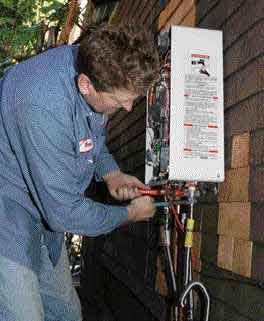
In recent years, about half of my remodeling customers have chosen to replace their conventional water heaters with on-demand — or “tankless” — models. Long popular in Europe and Japan, on-demand water heaters first showed up here during the 1970s energy crisis. Their use never became widespread, however, because energy prices fell and early models had reliability problems that made plumbers suspicious of this technology. Today’s fully electronic models are very reliable, and with energy prices on the rise, they are generating renewed interest.
What Customers Want
The main reason my customers choose to go tankless is because it’s a great way to pick up floor space in a remodel. They also want to reduce their energy consumption and are willing to spend more up-front to do so. Other reasons for installing on-demand heaters include the promise of never again running out of hot water and the security of knowing the equipment will last 20-plus years — much longer than conventional models.
The key question for contractors is whether on-demand heaters are better than conventional models. I think they are, but it’s important to understand the differences between the two types of heaters. The purpose of this article is to explain how tankless heaters work and how to install them on remodeling jobs.
Basic Operation
To appreciate the differences between conventional and tankless models, it helps to understand how each kind works.
Conventional water heater. A conventional residential water heater — let’s assume it’s gas — is built around a tank containing 40 to 75 gallons of water. When the water inside falls below the thermostat’s set point, typically between 120°F and 140°F, the burner comes on and heats the water.
If the unit is properly sized, there should be enough stored hot water to provide a buffer against periods of heavy use. But if demand is too high, the store of hot water is depleted and the tap runs cold. The burner will eventually heat the incoming cold water, but it will take a while because the burner is quite small compared with the volume of water it has to heat.
Also, because hot water must be stored 24 hours per day, conventional heaters are prone to large standby losses (heat escaping from the tank).
On-demand water heater. On-demand heaters are smaller and more efficient than conventional units; they have no tanks and don’t store any water. Instead, they are equipped with burners powerful enough to heat water almost instantaneously as it flows through the unit.
On-demand models are available for use with natural gas, propane, or electricity, but let’s assume here we’re talking about gas. When a hot-water tap is opened, cold water flows into the heater and passes through a control device that senses the amount of flow. If the flow rate is sufficient, the controls activate a burner that heats the water as it passes through a heat exchanger. The moment the flow stops or is interrupted, the burner turns off.
The burners in early tankless models had only two settings — on and off — so the temperature of the output water varied with flow. Most of today’s models, by contrast, are modulating: If the flow increases, the burner puts out more heat. Water comes out at a consistent temperature that can be set on the machine or with a remote wall-mounted controller.
An Endless Supply of Hot Water?
Manufacturers market on-demand heaters with the claim that they’re capable of providing an endless supply of hot water. This is true — but only if the heater is sized to meet peak demand, which is measured in gallons per minute (gpm).
For example, a heater might be just large enough to provide an endless supply of hot water to two showers. But if a third person were to turn on a shower at the same time, demand would exceed capacity and the temperature of the output water would immediately fall. There are several ways of dealing with this: stagger the showers, get a bigger heater, or buy a second heater and wire it to kick in whenever the first heater needs help.
Calculating peak demand. To calculate peak demand, add the flows of the appliances and fixtures that are likely to run at the same time. Here are some typical flow rates.
| Low-flow faucet | 0.5-1.5 gpm | |
|---|---|---|
Dishwasher |
|
1.5 gpm |
Showerhead |
|
2.5 gpm |
Clothes washer |
|
4.0 gpm |
Whirlpool tub |
|
4.0 gpm |
If the customer wants to shower and run the dishwasher simultaneously, the heater must be capable of producing at least 4.0 gpm — roughly the minimum required for whole-house water heating.
If two people want to shower while the dishwasher is running, the heater must produce 6.5 gpm at the desired temperature. The 2.5-gpm figure for showers assumes that the hot water coming from the water heater is reduced to 104°F at the shower’s mixer valve. If the client likes it hotter, the shower will account for more than 2.5 gpm of output.
Temperature rise. The volume of water that an on-demand unit can heat is determined by the temperature of the incoming and outgoing water. A heater can produce more hot water when water comes in at 75°F (summer in Florida) than it can when water comes in at 45°F (winter in Wisconsin). Increasing the setpoint temperature of the outgoing water has the same effect on capacity as lowering the temperature of the incoming water.
Unless the customer wants to cut back on hot-water use in winter, you will need to install a unit powerful enough to produce the desired flow at that time of year. Heater specifications usually include test data showing how many gallons per minute a unit can heat for a given rise in temperature. Most — but not all — manufacturers list maximum output based on a temperature rise of 77°F.
Electric models. The average household uses more hot water than a single electric on-demand heater can heat. Most electric models produce less than 2.5 gpm; the largest I know of requires three 40-amp breakers and produces less than 4 gpm in cold weather.
Electric models are best suited to point-of-use applications (installing individual heaters in rooms where hot water is used). I wish I could install point-of-use electric heaters on my jobs, but where I work, the energy code makes it illegal to replace gas water heaters (even inefficient ones) with electric models. Conventional electric and tankless electric models can be extremely efficient, but because electricity is so much more expensive than gas in most areas, they are still more expensive to operate.
Running Hot and Cold
One problem with on-demand gas heaters is that “slugs” of cold water can get sandwiched between sections of hot water in the supply line. There are two ways this can happen.
Ignition lag. Before the burner can switch on, a control device must first measure the volume and temperature of the incoming flow. As a result, a certain amount of water passes through unheated. We have installed a number of Takagi heaters, and their manual says it takes three seconds for the burner to ignite. (The glitch is not confined to Takagi; all gas-fired models have similar lags.) Once on, the burner produces a steady flow of hot water, but if you turn the tap off and then back on again, more cold water passes through before the burner reignites.
Most homeowners don’t even notice the slug of cold water, but some do. A remodeler I know installed a tankless heater for a client who liked to wash the counter with very hot water. She’d wet the sponge, turn off the water, and clean. When it was time to rinse, she’d turn on the water and rewet the sponge. Every time she did this, some cold water entered the hot-water line. Frustrated, she finally got the plumber to install a small conventional heater (10-gallon electric) between the on-demand unit and the sink. This approach worked but reduced the efficiency of the system.
Minimum flow. A second problem with gas on-demand models is that they won’t switch on if the flow is too low. The cutoff is usually around .7 gpm; the exact level varies by model. Customers have complained that when they turn the water down to shave, it goes cold because the burner won’t come back on. Also, if there is just enough flow to keep the heater going, flushing a toilet or opening a cold-water tap may cause the burner to shut off by temporarily reducing flow.
The default output temperature for most tankless models is around 120°F. Many people adjust this up, which increases the supply of warm water (by mixing it with cold). This works fine for most uses but makes it easier to accidentally switch off the burner during periods of low flow.
Installation Issues
An on-demand heater can be installed where the old water heater used to be, but the existing gas and water lines may be too small. Don’t expect to use the old flue.
Electrical needs. The new unit will require 115-volt electricity to power an internal computer board, electronic ignition, and a venting fan for the flue. If the power goes out, the household will have no hot water. Although I haven’t done it myself, I have heard of people installing battery backup units (the kind used for computers) to prevent the heater from suddenly turning off while someone is showering.
Bigger gas and water lines. One reason on-demand models heat so quickly is that they hold only about 1/3 gallon of water. (The other reason, of course, is that they put out an enormous amount of heat.) A conventional 40-gallon heater produces about 40,000 Btu, while an equivalent tankless model might put out 200,000 Btu — and thus requires a 3/4-inch gas line. Most tankless heaters require 3/4-inch water lines, but some need 1-inch lines. Undersizing either line can cause malfunctions.
Before installing an on-demand unit, check to see that the gas line into the home is big enough to power the heater and furnace at the same time. Having to replace gas and water lines adds cost, but if you’re relocating the heater (as often happens in remodels), you’ll be doing it anyway.
More expensive flue. Conventional water heaters use inexpensive B-vent flue. On-demand models typically require 4-inch Type III stainless-steel flue pipe — which costs about $16 per foot. Stainless steel is necessary because tankless models have a fan-induced draft, which can leave acidic combustion products in the flue when the burner turns off.
Locating the Heater
As a remodeler, the thing I like most about on-demand heaters is that they are small — typically 24 inches by 18 inches by 9 inches — and will fit in places conventional heaters won’t. Since basements are not common in this area, water heaters have traditionally been housed in a closet or attached garage. Changing over to a tankless model allows us to put this space to better use.
It’s possible to vent the heater through the roof, but venting through a sidewall minimizes the flue run and frees up additional space where the flue used to be. We frequently remove masonry chimneys that can’t meet seismic code and, with no need for a vertical flue, pick up space on both floors of the house. If you consider what it costs to add square footage during a remodel, spending more for a tankless heater may be the least expensive way to go.
Combustion-air requirements. On-demand heaters burn gas quickly, so don’t install them in enclosed spaces without providing an adequate supply of combustion air. The manual will tell you how much you need. One way to deal with this complication is to use a direct-vent model; combustion air is piped directly to these units from outdoors. We have installed a number of tankless heaters in crawlspaces, which is legal provided the access door is large enough to enter the area and service the unit.
The area where I work has a very mild climate — it never freezes. For this reason, it’s common to install on-demand heaters outdoors on the side of the house. This frees up interior space and eliminates the cost of installing a flue. Units designed for outdoor use have an internal electric heating element that prevents freezing, allowing outside installations in climates cooler than ours. But if the power goes out, the heater can freeze and be seriously damaged.
Also be aware that the heating element protects only the heater — the water lines must be insulated and may require heat tape or a conditioned chase.
Clearances. As with any heating appliance, certain minimum clearances are required around the unit and between the flue and flammable materials. The rules are straightforward and can be found in the installation manual. Clearances apply indoors and out. For example, the flue outlet for a side-vented unit needs to be some minimum distance from doors, operable windows, and intake vents.
Setback rules can be an issue, too. There have been instances where we were unable to install the heater on the side of the house because we were too close to the property line.
Cost to Install
When ballparking jobs, I carry a few hundred dollars in material for a conventional water heater and $1,000 or more for an on-demand model capable of providing water for an entire house. Depending on what you buy, you could easily spend $1,600 for the unit.
Installation labor and the cost for gas lines and flue are extra. If it’s a remodel and we’re changing the location of the heater, my plumber might charge $2,500 in material and labor to install a tankless model. This is about $1,000 more than it would cost to do the same installation with a new conventional heater.
In new construction, the cost would be less.
Efficiency and Cost to Operate
Every new water heater comes with an Energy Guide label that shows its estimated annual fuel cost. The estimate is based on a specified fuel price and a set of assumptions about water temperature (intake and output), hot-water usage, and other variables. One assumption is that the homeowner uses 64 gallons of hot water per day.
Because there are so many assumptions involved, it’s hard to gauge how closely the Energy Guide estimate will match your specific installation. But we do know that the cost to operate a water heater is likely to be much higher than the tag says. For example, whereas the label on a tankless model I installed last fall listed gas costs at 91 cents per therm, my most recent utility bill pegged them at $1.58 per therm. I consider this an argument in favor of on-demand models, because they use fuel more efficiently than conventional ones.
Water-heater efficiency is rated by energy factor, or EF. This number is calculated by dividing the energy delivered as hot water by the amount of energy consumed to produce the hot water. If no energy was lost and it all came out as hot water, the heater would have an EF of 1. Most conventional gas water heaters have an EF of around .59. On-demand gas heaters are typically rated between .81 and .85, making them on average about 40 percent more efficient than conventional models.
Payback period. If you know the EF and the local cost of natural gas (or propane), you can perform the same calculation used on the Energy Guide label and come up with an approximate yearly cost based on current fuel prices. And once you know the annual operating cost, you can determine the payback period for installing a more efficient water heater.
To find the cost savings achieved by switching from a conventional gas heater (EF .59) to an on-demand model (EF.82), use the following method.
Formula: .41045 x cost per therm of gas x 365 / EF = yearly cost to operate with gas
Example 1, conventional model: .41045 x $1.58 per therm x 365 /.59 = $401.20
Example 2, on-demand model: .41045 x $1.58 per therm x 365 / .82 = $288.67
Yearly cost savings: $112.53
To calculate payback, I’d use the $1,000 difference my plumber quoted for installing a tankless model vs. a conventional model in a new location in an existing home. Then I’d divide the added installation cost ($1,000) by the annual savings in operating costs achieved by going tankless, as follows: $1,000 / ($401.20 – $288.67) = 8.9 years
The payback period will be shorter if energy prices continue to rise or if the homeowner uses more than 64 gallons per day. It will be significantly shorter if the homeowner is switching from a conventional electric model.
David Grubbis a remodeling contractor in Berkeley, Calif.


