
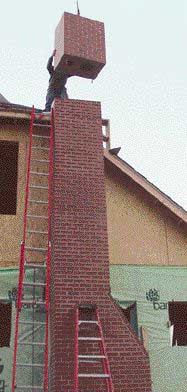
Several years ago, while on vacation at Disney World, I was struck by the variety of “brick” and “stone” surfaces created with cast concrete. My partner, Keith Knickerbocker, and I wondered whether it would be possible to use this method to manufacture a good-looking precast fireplace and chimney system that could be delivered to job sites in sections and erected with a crane.
We were sure there would be a ready market for such a product. In his 20 years as a general contractor, Keith had experienced the expensive delays that can occur when the mason is running behind schedule. This has caused many builders in our part of southern New England to exchange traditional masonry for “zero-clearance” manufactured fireplaces and metal flues. This is a workable solution, but the limited life expectancy of the metal components and the boxy appearance of the wood chase make it a second choice for many homeowners.
Developing a System
Most precast concrete products aren’t much to look at, and we knew that builders and homeowners wouldn’t accept a fireplace that looked like a Jersey barrier. To get the level of quality we wanted, we built a custom aluminum mold that closely duplicates the appearance of real brick, adapting embossed aluminum panels widely used in commercial precast work. We also adopted the staining technique used in commercial precasting, which creates realistically red “brick” while leaving the “mortar joints” natural.
Taking the heat. Another challenge was coming up with a cement formula that could withstand the heat of a fireplace firebox. It took us a couple of years to develop our proprietary cement formula, perfect the product appearance, and get an approval to UL standard 127 (the standard for factory-built fireplaces). But with the crucial development work behind us, we can now deliver an approved precast concrete fireplace and chimney to any job site within a two-hour drive of our plant in Higganum, Conn. We have plans to expand our operations within the next year or so.
Options and features. Although the range of possible chimney styles and sizes is potentially unlimited, for now we’re making a single model, which is available in a choice of three colors. This initial product offering is meant to cover most standard applications. It consists of a single firebox with an 8-inch flue and an additional 7-inch flue for a furnace or boiler.
The 36-inch-wide by 30-inch-tall by 23-inch-deep firebox is lifted from the truck. The design includes a 60-degree throat slope and a rounded smoke shelf for increased performance. A built-in ash dump, with a removable drawer, is located below the firebox.
The location of the chimney is up to the builder. It can be lowered inside the structure before the roof goes on or installed on an exterior wall. Most of our customers have opted to put the chimney outside the house. Many masons and building scientists advise against this approach, because the resulting cold flue can lead to a reduction in draft. So far, though, none of our customers have experienced any problems, probably because our cast refractory has better insulating qualities than traditional masonry. This keeps exhaust gases hot and provides a strong draft.
Other benefits. In addition to the obvious benefits of speed, fewer weather delays, and improved quality control, there are other advantages to precasting. Our refractory concrete formula contains no lime, so it’s not affected by the efflorescence that can disfigure real brick laid in conventional mortar. The steel-reinforced, monolithic sections are also much stronger than site-built masonry, and there’s no future repointing.
Finally, there’s price. We can install a typical two-story chimney for about $4,500, or 20% to 40% less than a comparable site-built chimney. That’s about equal to the installed cost of a manufactured metal fireplace, which lacks the additional flue that’s standard with our product.
Planning and Ordering
Although we can go lower or higher, most of the chimneys we sell range from 16 to 37 feet in height. But because precast chimneys can’t be altered in response to changes in the original plan, as a site-built masonry chimney can be, careful measurement and planning are essential.
For an exterior installation, a correctly dimensioned chimney bumpout must be formed into the foundation. Height is also critical. The builder needs to provide us with information on the height of the floor system so we can dimension the cast bottom section of the fireplace to make the hearth line up with the finished floor. We also provide a template for proper placement of the dowels that anchor the bottom chimney section.
Finally, we need to take the overall height and roof pitch into account. We adjust the individual chimney sections in 6-inch increments to achieve the correct height and make sure that our one-piece flashing system lines up with the edge of the roof. To make sure this happens as it should, we require an accurate set of elevation drawings before the foundation is poured.
So far, most of our customers have been modular builders. Factory construction methods practically guarantee that the as-built dimensions will match the dimensions shown on the plans. But a builder who doesn’t have good plans could create problems for both of us, and we stress this from the beginning. Scheduling a delivery requires a two-week lead time. After getting the call, we confirm that there haven’t been any significant changes to the original design and make arrangements for our three-person crew to install the fireplace.
Delivery and Installation
It ordinarily takes about six hours to complete an installation, and we can show up on the site any time after the foundation has been poured. When possible, though, we prefer to wait until the house is framed and sheathed, because this lets us install the attic tie without making an extra trip.
Site access. For best results, we need to be able to pull our boom truck to within 30 feet of the chimney footprint. Our truck has the reach and capacity to boom over the roof, but the lack of visibility makes that pretty nerve-racking. It’s a complication we try to avoid whenever possible and one reason we’ll consider setting the fireplace before the house is framed.
The modular chimney sections arrive on the site in a ten-wheel truck. It’s up to the builder to provide unrestricted access to within 30 feet of the chimney footing so the modules can be boomed into position.
Stack ’em and grout ’em. When we get to the site, we check the chimney bumpout for size and level before lowering the first section into place. That’s followed by the firebox section, which is joined to the first with grouted dowels and refractory sealant. The joint between sections is tuck-pointed with mortar, leaving it indistinguishable from those above and below.
The chimney bumpout is poured with the foundation but generally needs to be about 4 inches higher (depending on the floor system) than the foundation walls. The first section is lowered and protruding dowels are grouted into it, making the final assembly strong enough to be completely free standing.
The aluminum flashing piece fits into the joint that falls at the roofline. Although the chimney is designed to be completely free standing, we also install an attic tie to appease nervous builders and inspectors. Once the final section is lowered and the cap installed, it’s tough to tell our chimney and fireplace from site-built.
Section lengths can be adjusted in 6-inch increments so a joint occurs at the roofline, where a one-piece aluminum flashing will be inserted. Although tests have shown that the free-standing chimney has the strength to withstand 120-mph winds, an attic tie is also installed at this point.
The completed chimney is difficult to distinguish from site-built masonry because stencils prevent the red stain used on the “brick” from discoloring the naturally gray “mortar joints”; realistic “corbelling” below the cap enhances the brick effect. A rain capspark arrestor completes the installation.
We’re often asked what happens if the chimney is damaged after installation. One builder wanted to know what would happen to the chimney if he ran into it with his backhoe. The answer is that while we don’t recommend bashing it with heavy equipment, a cast chimney is much tougher than one made from bricks and mortar. Minor damage can be easily field repaired with mortar and touched up with stain.
One chimney to go, please. The word is slowly getting around about our products, but for now we still get some strange looks while we’re on the road. A few weeks ago, a truck with ladder racks was following us on a state highway. The driver, who was talking on a cell phone, craned his neck at our unusual cargo as he passed. Apparently still unsure about what we were carrying, he stopped up ahead, put down his phone, and got out of the truck for a better look. I don’t think we’ve heard from him yet, but we’re expecting a call any day now.
Rick Rossi and his partner, Keith Knickerbocker , are owners of Chimneyworks, manufacturers of precast chimneys in Higganum, Conn.


