
Laying A Stone Floor
-
Continued
Mud Time
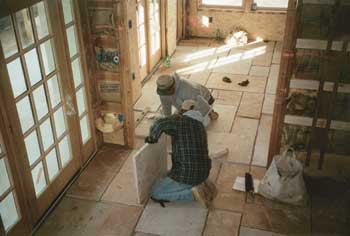
The mason mixed a rich, thick mortar of one part cement to two
parts sand, plus an acrylic fortifier. Because of the uneven
thickness of the slabs, he worked one stone at a time, leveling
from our reference marks and from adjacent stones (Figure 6).
He used a pointing trowel called a slicker to press the mortar
down tight between stones and to remove any excess mortar. We
finished this stage by sponging the stones clean
| |
Figure
6. The mason was responsible for cutting in
around passages and other obstructions (left). Because
the stone was of varying thickness, each piece had to
be carefully leveled in reference to the finish floor
height (right). |
Sealer
We waited several days before sealing the stone, and as it
fully dried, we could see that quite a bit of cement residue
and dirt remained on the stones. In the meantime, we researched
and tested various sealants and finally settled on a
solvent-based sealer with a color-enhancing matte-finish top
coat (Figure 7). We used two coats of Miracle Sealants' 511
Porous Plus (800/350-1901; ) and one coat of their Mira Matte.
Before sealing, we also used their recommended cleaner, Grout
and Concrete Film Remover, to clean the stone, which we had to
do twice.
|
Figure
7. After cleaning the stone with a proprietary
cleaner, workers applied two coats of solvent-based
sealer and one top coat to finish the job. |
After cleaning, we waited two days and then applied the
first coat of sealant. That was a bit tricky because the
sealant has the consistency of paint thinner, and since the
stones were not yet grouted for the first coat, we had to keep
the sealer from running onto the edges of the stone. We used
foam paintbrushes and painted the floor stone by stone, wiping
up excess sealer after ten minutes of drying time. This was a
slow process and required patience on the part of my crew, as
well as good ventilation, rubber gloves, eye protection, and
kneepads.
Grout
The following day, the mason grouted the stone, carefully
squeezing the grout into place from a grout bag and using the
slicker to tool the joint. After sponge cleaning, we waited
another day before sealing both the stone and the grout. We let
everything dry overnight and then applied the Mira Matte finish
coat, which brought out the color of the stone without making
it shiny.
The finished floor was beautiful, but we still had all the
wall finishes and trim to install. To protect the floors, we
rolled out kraft paper, then put down a layer of 1/2-inch
drywall. This makes a wonderful protective cover because it
absorbs bumps and dings, has enough mass to stay in place, and
can be swept off.
Cost
The cost of the 460-square-foot floor came out around $30 per
square foot, not including supervision, broken down as
follows:
8 tons of stone plus delivery, $4,225; 500 pounds of grout,
$170; cleaner, sealer, and finish, $445; labor for sorting and
cutting, 132 hours; dry-fitting, cleaning, sealing, 56 hours;
mason's setting labor, $5,000.


