- Q. Can anyone explain the actual technical concern and reason that building codes are requiring specific structural improvements on garage door “lug walls” (the short walls next to the garage door opening)?
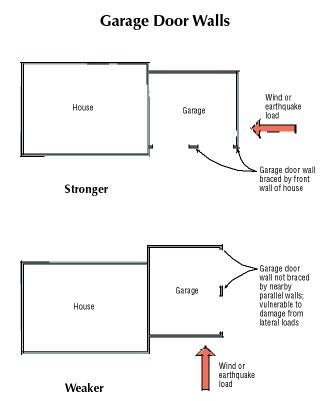
A.Bryan Readling, P.E., responds: Studies have shown that walls containing garage doors perform poorly when subjected to lateral wind and seismic forces. This is especially true when the wall containing the garage door is offset by more than a few feet from other braced wall lines parallel to the garage door (see illustration, below).
In that case, the open-ended side of the garage enclosure is not braced well by the remainder of the home, and the often narrow walls on either side of the door are subjected to relatively large lateral and uplift forces collected within the garage portion of the structure.
Making matters worse, garage doors themselves are vulnerable to failure from relatively minor windstorms due to wind pressure and flying debris. When a garage door is breached, the resulting pressure on the interior walls of the garage can add dramatically to the lateral and uplift forces already present in this vulnerable area. Since few structural redundancies generally exist in the garage area, failures tend to be catastrophic in nature.
The International Residential Code requires “braced wall panels” at the corners and at regular intervals (typically every 25 feet), as well as bracing of the wall line at a certain minimum percentage. Most of the wall-bracing options listed in the IRC are not possible at narrow garage return walls since the required minimum braced-wall length is typically 48 inches. Anything less than 48 inches is generally too flexible and weak.
An exception in the code states that when “continuous structural panel sheathing” is used, the width of wall segments considered as “braced” can be reduced from 48 inches to as little as 24 inches depending on the height of openings adjacent to the segment (IRC, R602.10.5). For garage return walls, a 24-inch width is allowed if there is no story or bonus room above.
“Continuous structural panel sheathing” means that all exterior wall surfaces (and in some cases interior braced wall lines) are sheathed entirely with plywood or OSB wall sheathing, including the portions of walls above and below window and door openings. This change, introduced to the IRC by the National Association of Home Builders, is based on extensive full-scale testing showing this type of construction to be inherently stronger and more redundant than walls with structural sheathing only at the corners and at regular intervals.
But what about popular designs with a bonus room or second story above the garage? For that scenario, a site-built solution known as the Narrow Wall Bracing Method, developed by APA The Engineered Wood Association, can be used to provide a braced wall as narrow as 16 inches. This approach builds additional strength into the framing around the garage opening by creating a rigid connection that resists rotation between the garage return walls and the garage door header. This is achieved by extending the header beyond the rough opening (almost to the corner) and lapping the wall sheathing over both the wall studs and the header.
Besides more nails, additional details include more robust 2x2x3/16-inch plate washers on the anchor bolts, three-stud corner framing, and a 1,000-pound strap connecting the back of the wall studs to the header. With this relatively inexpensive site-built method, outlined in APA publication D420, side walls can be reduced to as little as 16 inches in width, even with a bonus room above. The Narrow Wall Bracing Method is now being proposed for inclusion in future versions of the IRC and has already been adopted for use in some states and local jurisdictions. It is available for free download at www.apawood.org/bracing. For a description of how to build and detail the narrow walls, see the article in this issue of JLC.
Bryan Readling, P.E., is a structural engineer with APA’s Field Services Division in Davidson, N.C., specializing in wind damage and the use of engineered wood products and building structures to resist hurricanes and tornados.
Strengthening Garage Door Walls
3 MIN READ