Fatal Chicago Porch Collapse Highlights Flimsy Connections
Chicago officials were quick to blame heedless crowding for the three-decker porch collapse that killed 13 partygoers in the city’s Lincoln Park district on June 29. “It is a tragic case of overloading the back porches,” Chicago Fire Commissioner James Joyce told CNN. The Reuters news agency quoted Joyce as saying, “It appears to be a case of too many people in a small space.” City Emergency Management Director Cortez Trotter told the press, “Common sense should prevail at some point.” But in the following days, the city sued the building owner and the contractor who built the porch, charging that the porch was unsafe and was built without a permit. In turn, attorneys for the estates of people killed in the catastrophe have sued the city as well as the owners and builders, saying Chicago fell short of its duty to inspect properties and regulate construction. Suits focused immediately on undersized joists.
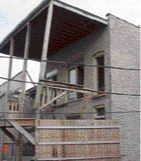
Seeking clues to the catastrophe’s cause, attorneys and forensic experts are poring over dozens of blurry digital images released by the City of Chicago. The images show some of the construction details. At top left, the main posts away from the house are still in place, supporting the roof. At top right, a ledger board intended to carry joists at the end next to the house has separated from brick exterior. The ledger board was installed in pieces and fastened into the wall face with bolts (bottom left). View of the ground level (bottom right) shows concrete post piers. Victims on the ground- and second-floor levels were crushed by the weight of falling upper stories.
At least one expert view runs sharply counter to the off-the-cuff comments of city officials about “overloading.” Frank Woeste, P.E., Ph.D., a professor of engineering at Virginia Tech and one of the authors of the heavily researched new Manual for the Inspection of Residential Wood Decks and Balconies (available in October from the Forest Products Society, 608/231-1361), told JLC, “From what I could see from TV reports, it is hard to believe that porch was overloaded. The code says the allowable live load is 40 pounds per square foot. The average person weighs 160 pounds, so that deck should support one person for every 4 square feet — a 12 by 20 area should safely support 60 people.” Early eyewitness reports estimated the crowd of partygoers at 70 people sharing all three levels of the three-story porch structure and its staircases.
“I don’t know what that fire chief based his statement on, or why the media kept repeating it,” said Woeste. “But if you know the code and take 30 seconds to do the math, you would think this deck should not have failed.”
Woeste was critical of press coverage of the collapse, saying, “All day long, the television rebroadcast that fire official saying the deck was overloaded. That gives people all over the country the idea, ‘I don’t have to worry about my deck — those fools in Chicago just had too many people out there.'” In fact, says Woeste, most decks are not built strong enough to handle allowable loads. “When we went out and surveyed decks for our manual,” he says, “we didn’t find one that was totally code compliant. Not one.”
Collapses are common. Deck failures occur every year across the country. Collapses that cause mass casualties at Independence Day celebrations or special occasions such as weddings and birthdays tend to get the most press, but decks often fail under lighter loads. Two weeks before Chicago’s tragic disaster, for instance, four porches collapsed at once on a row house building in Camden, N.J., under no unusual load at all (the story was not widely reported).
Failed ledger connection is visible in photo released by the Chicago building department to justify removing the porch wreckage as a hazard. The ledger board was not continuous and was attached by bolts driven into mortar joints in the brick exterior, witnesses said.
Like Woeste’s research team, Chicago city inspectors found widespread deficiencies in their belated inspections of 700 decks and porches after the tragedy. Officials cited at least 545 structures for violations, and condemned 70 outright.
Ounces of prevention. But Chicago policymakers continued to focus on overloading in discussions of post-disaster reforms. Some proposed to solve the problem with signage: State lawmakers Susan Garrett and John Fritchey announced plans to introduce a bill requiring signs limiting porch capacity to be posted near porch entrances, while Chicago Alderman Edward Burke brought a similar measure to the city council.
Other aldermen wanted to reemphasize the distinction between a “deck” and a “porch,” and limit “porch” use to smaller groups, although none had any immediate plan for making the case-by-case distinction or enforcing any limits on the size of gatherings.
But some city leaders began to consider how to make sure that decks were built to support the numbers of people that can actually fit onto them.
John Roberson, executive director of the city’s newly created Department of Construction and Permits, proposed that the city require an architect’s plan before granting a permit to repair or replace a porch. And Mayor Richard Daley’s office revived an idea to require licensing for general contractors.
But the mayor dismissed calls to increase staffing at the city’s building department, saying, “I can’t hire 25,000 inspectors. Everybody would go bankrupt. You would be paying huge property taxes, and people don’t like to pay property taxes.” And building owners and deck builders continue to resist reforms, citing the problem of added costs and delays. Meanwhile, the city is talking about a “ghost payroll” scandal at the building department involving an inspector who filed bogus inspection reports for buildings he never visited.
Paying the price. Whether or not Chicago’s building owners, contractors, and city government want to shoulder the responsibility for safe construction in the future, lawyers intend to force it on them retroactively in the case of June’s tragedy. And if precedent is a guide, the argument of “overloading” is likely to prove a weak one for the defense. On July 29, for instance, a Memphis court awarded $1 million to seven people injured (not killed) in a deck collapse at a 1999 graduation party — despite defense arguments that 16 people on the 9×34-foot deck was too large a group.
Do the math. Concerned builders needn’t wait for the dust to settle to take action. As Woeste’s observations above make clear, many decks are underbuilt and survive only because they rarely if ever see full code design loads. If you build decks or porches, apply the code’s 40-pound live load to the entire area and consider whether the structure is truly up to the task. It’s relatively easy to choose joist size and spacing, but don’t overlook ledger attachment (see “Attaching Deck Ledgers,” 8/03) and post stability, especially as the deck gets higher. Revisit and inspect past jobs; if they’re not up to snuff, reinforce the structures. If you have any doubts, call an engineer.
Housewrap Aims to Drain Walls
Housewraps are intended as “weather resistive” materials that block water as well as wind. But they defend best against rain when there’s an air space between the cladding and the wrap; when water is held against the wrap by tightly nailed siding, wraps may leak, especially if the water contains surfactants from paint or extractive compounds from wood. This is the rationale behind “water-managed” or “rainscreen” wall designs, which typically call for vertical strapping over the housewrap, with siding nailed to the strapping. But GreenGuard RainDrop, a new product from Pactiv, Inc., aims to cut out the middleman. Vertical cords worked into the new housewrap’s woven plastic are thicker than the rest of the sheet and don’t compress when siding is nailed over them. The result, claims the company, is an array of channels big enough to break the capillary bond and allow water to drain.
A new housewrap product called RainDrop has heavy cords worked into its plastic weave to allow free drainage of water, even under tightly nailed wood or fiber-cement siding. The wrap should be applied with cords aligned vertically.
Company marketing exec Dan Partrich says, “In tests, we sandwich the stuff between two layers of Plexiglass, clamp it down, and pour water in the top. Water scoots right through, and air can also run up the back side.”
The wrap won’t work directly under stucco, says Partrich, because the cement will bond to it. It might be effective with a layer of regular paper between the stucco and the RainDrop wrap, he notes, but Pactiv has not tested that application. “Eventually, we’re going to have a wet stucco wrap anyway,” he says. “Where this really works best is under fiber cement or wood clapboards. Of course, you have to remember to put it on with the cords in the up-and-down direction.”
Partrich says housewrap prices fall into tiers, with premium wraps like DuPont’s Tyvek and Pactiv’s Ultra Wrap at the top. Pactiv’s Value Wrap is priced at the bottom to compete with regular building papers, and their Classic Wrap is somewhere in the middle. “RainDrop will come in higher than our Classic Wrap and lower than our Ultra Wrap,” says Partrich. For drainable systems, however, it should offer significant savings compared to the labor and material cost of nailing on strapping and adapting windows, doors, and trim to the fattened walls.
For information on RainDrop, go to www.green-guard.com.
New Wood Treatments May Be More Corrosive
Wood treaters and hanger manufacturers are circling warily around an issue that makes the whole industry nervous: the tendency of alternative preservative treatments including alkaline copper quaternary (ACQ) and ammoniacal copper zinc arsenate (ACZA) to eat through steel and galvanizing coatings much faster than the chromated copper arsenate (CCA) formulas they are replacing in the market. As treaters make the switch from CCA to alternative formulas in January 2004, corrosion questions will throw new uncertainty onto the field performance of treated wood structures. This galvanized base connector, placed under a post treated with a nonarsenic ACQ formula, is rusting after only a few months in service. Wood treating companies continue to recommend either hot-dipped galvanized or stainless-steel fasteners for use with wood treated with new preservative formulas. But Simpson Strong-Tie execs say extra-heavy galvanizing will be needed to protect connectors, and they will not predict how long galvanized connectors will hold up in service.
The issue is becoming contentious already. Simpson Strong-Tie sales exec Mike Bugbee says, “The treating companies are upset with me for even bringing it up.” University experts we called wouldn’t talk openly about the issue, reluctant to jeopardize connections with industry colleagues. But some test numbers show that in the laboratory, ACQ corrodes steel about four times faster than CCA does, and removes galvanizing coatings twice as fast. In fact, one lab report found that ACQ-treated wood attacked galvanized metal slightly faster than CCA corroded the mild steel used for ordinary nails.
No one is sure what the lab numbers imply for treated-wood structures in service, but hanger manufacturers like Simpson Strong-Tie are plainly uneasy. Simpson has done more than 1,700 tests of various metals in contact with treated wood samples, but the company’s website is vague about what the tests revealed; it says only that new formulations may corrode metals at a different rate than the old ones did. Simpson advises using hot-dipped galvanized products at a minimum and stainless steel where possible, but warns against mixing the two, which can cause a reaction that will degrade the galvanized coating. With ACZA (which contains both zinc and arsenic but is not being phased out), Simpson recommends only stainless steel.
Other factors being equal, Simpson points out, heavier galvanizing coats last longer. The company provides a line of heavy-duty galvanized products as well as some stainless-steel items. But citing the “many variables involved,” Simpson won’t recommend any specific galvanized coating or provide an estimated service life for any hangers or fasteners.
Meanwhile, wood treaters are hustling to reduce the corrosiveness of their formulas. In the case of ACQ, chlorine in the salt solution used to carry the active ingredients may be replaced with a less corrosive carbonate. But EPA approval of any new formulas takes time. For now, say experts, builders should turn to the wood manufacturer for guidance on fastener choice.
Polka Dot Paint Job Makes Protest Point
Homeowner Stan Pike was frustrated this spring when the Historic Preservation Commission in Avondale Estates, Ga., wouldn’t approve his plans for a round porch on his newly purchased house. Pike thought the decision was a bit arbitrary — his 1950s-era home wasn’t historic itself (just located within the historic district), and it already had a round room on one end.
So Pike decided to exercise his own arbitrary powers as a homeowner. The commission couldn’t stop him from painting the building lime green with fluorescent purple polka dots — so he did.
Some neighbors disapproved, but others expressed support, even to the extent of adorning their own properties with purple dots (although one couple used plastic cutouts).
After a brief moment of fame including an interview on NBC’s Today show, Pike won his appeal of the commission’s ruling and repainted his house a sedate off-white. Pike told reporters he was glad he’d stood up on behalf of residents who thought the preservation commission needed to unbend a little. But town mayor John Lawson wasn’t conceding any points of principle. The commission had turned down only 4 of 114 plans in 2 1/2 years, he said, and required changes in 20. Said Lawson, “I think the numbers speak for themselves.”
Offcuts
North Carolina officials are studying options for “buffer zones” to limit housing and commercial development around the state’s military facilities. State planners hope that leaving the bases some open space to work with will help them survive the Pentagon’s next round of base closings. Large installations such as Fort Bragg and Camp Lejeune generate jobs and incomes for local communities, but encroachment of housing and other civilian uses near the bases can reduce their value to the military by restricting training activities such as low-level flights and heavy equipment airdrops. No one is entirely satisfied with Florida’s newly passed reform of the state workers’ compensation law, according to a report in the Palm Beach Post. The bill passed on a party-line vote in the Republican-controlled legislature, but the Post says even one Republican legislator labeled it “horrible,” while Senate President Jim King called sections of it “problematic” and promised to study the issues further. The new law limits attorney fees in comp cases, toughens fraud provisions, and provides a backup system to insure contractors with clean safety records who can’t get coverage in the market. Most of Florida’s large comp carriers have left the state, leaving many builders unable to get coverage at any price.