
Q. I have a client who wants me to build a 30×40-foot unheated barn-garage with a slab floor. The area where the building will sit is very flat, with no lower terrain nearby, so it’s not feasible to build a typical 4-foot stem wall with a daylight drain. Frost depth is 48 inches around here (northern Vermont). I wonder if a shallow frost-protected slab would work in this application. Do I need to thicken the edges? And do I need a rebar grid in the slab?
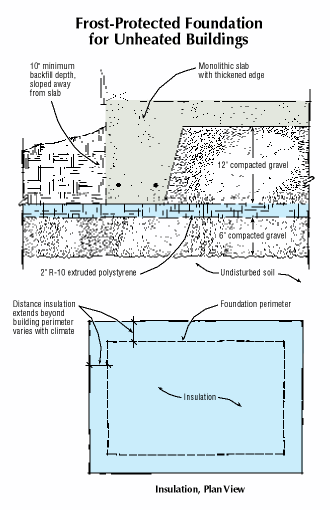
A. Bill Eich responds: You have an ideal application for a frost-protected shallow foundation. The method has been approved for use in the 2003 International Building Code. The design guide for heated structures is published right in the Code. For unheated structures, the Code references ASCE32-01, and that’s where you have to look to find the design standards. At your location in Vermont, you have an air freezing index of 2,000 freezing degree days, and a mean annual temperature of 45°F. According to table A8 in ASCE32-01, your ground insulation should have an R-value of 10. It should extend 60 inches beyond the building perimeter and be at least 10 inches below finished grade (see sketch). You should place this insulation on 6 inches of non-frost-susceptible fill (sand or gravel).
By combining rigid foam insulation with a well-compacted, free-draining substrate, a frost-protected shallow foundation prevents heaving damage, even in an unheated building in the coldest climates.
You also need to check the building loads to make sure you don’t exceed the bearing capacity of the rigid foam. This tells you how wide the base of your thickened footing must be.
Extruded foam boards are available in a variety of compressive strengths: 15-psi, 25-psi, 40-psi, and more. Some products — Dow Blue Styrofoam and Pactiv GreenGuard — come standard with 25-psi compressive strength. This gives 3,600 psf, typically strong enough unless you have a heavy point load. Other foams, like Owens Corning Foamular, commonly come in both 15 and 25 psi, so you need to watch what you’re buying. If you need a stronger foam, you can get it as a special order. I usually use a factor of safety of 2.5 to 3.0 on the foam loading to account for long-term creep potential.
To build the foundation, first prepare your subgrade pad 24 inches below the top of your finished slab. Remove vegetation and loose dirt and either cut the high spots or use compacted gravel fill to level the pad. Extend this prepared area 5 feet beyond your building perimeter.
Next, place an additional 6 inches of compacted, non-frost-susceptible gravel fill. Then lay 2 inches of rigid foam insulation over the gravel, under the entire building area, extending the foam board 5 feet beyond the building perimeter.
Now form the slab perimeter. The Code requires a minimum depth of 10 inches dirt cover over the foam. So assuming you want your slab to be 6 inches above finished grade, the thickened slab edge will be 16 inches tall. I usually use a 14-inch- to 15-inch-tall edge form. This is a little shorter than the required 16-inch slab edge, but it allows for some irregularities in the subgrade.
Drive your form stakes right through the foam. Then place 12 inches of compacted gravel fill on top of the foam inside the building and shovel out the thickened edge around the perimeter. Install rerods, and you’re ready to pour. I would definitely use two 1/2-inch rerods in the thickened edge. The grid in the slab provides extra insurance if the budget allows but is not necessary if the base is properly prepared and compacted.
Pour the slab, strip the forms, backfill the outside with 10 inches of dirt, and you’re done. Good luck.
Bill Eich owns Bill Eich Construction in Spirit Lake, Iowa. He has built many homes on frost-protected foundations, with never a callback.


