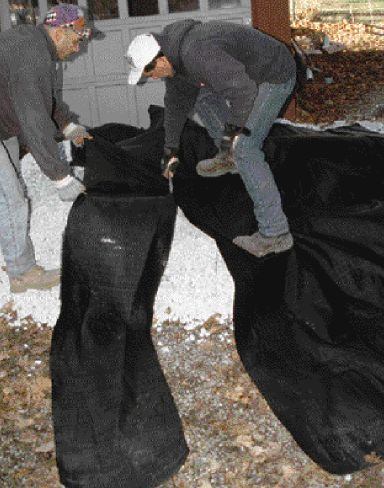
Excavation and site work are an important cost category on many construction jobs. Early in the job, they’re also a major unknown — you can never be absolutely sure what’s down there until you start digging.
Those underground unknowns can also mean unexpected costs. Installing drainage for a wet soil, excavating and replacing a weak soil, or simply compacting a difficult soil can add days to the schedule and strip big dollars off the bottom line. Soil erosion that pollutes waterways or clogs storm drains can bring on major penalties, or even shut down the job. And when you think the job’s long over, site work can come back to haunt you: Problems and failures related to soil issues top the list of expensive callbacks and claims.
Given all that, builders are glad to hear about any technology that can take some of the uncertainty out of earth work. In recent years, answers are coming from a new class of products known as “geosynthetics.” Tough plastic fabrics, grids, and cells are helping to handle all kinds of soil-related concerns. With the right product, you can reduce erosion, improve drainage, stabilize slopes, and boost the bearing capacity of soil — often at a fraction of the cost of placing sand and gravel or casting reinforced concrete.
There are now dozens — maybe hundreds — of geosynthetic products on the market. Some are geared mainly to commercial or industrial construction, although they’re occasionally used by residential builders as well. Others, like woven-poly silt fencing and the filter fabric wrapped around gravel drains, have become commonplace and are on the shelves at every lumberyard.
Problems and Solutions
Geosynthetics can solve a wide range of problems, but most of those problems fall into a few broad areas (see Figure 1).
Figure 1.The range of uses for geosynthetics continues to expand as companies develop new materials and customers find new applications. Most soil engineers now recognize the value of geotextiles for separating gravel from soft subsoil (top left) and holding soil in place against water action (top right). Geogrids have proven their value as a reinforcing element in earth-retaining walls (above left), and geocomposite drainage systems are gaining popularity because of their simplicity and effectiveness (above right).
Separation. When you mix gravel and mud, you don’t get more gravel — you get more mud. Fabrics placed between a gravel roadbed and soft underlying soils keep traffic from driving the gravel down into the mud, or “pumping” mud up into the gravel. This maintains the gravel’s drainability and strengthens the road or driveway, prolonging its life.
Reinforcement. Different soils have different properties, but no soil on earth has any tensile strength to speak of. Synthetic fabrics or grids can introduce a tensile component into the equation: They distribute forces sideways through the soil and prevent soil from slumping, slipping, or compressing. The result is a stronger subgrade with less fill or compaction work, or a steep stabilized bank with no expensive concrete work.
Filtration. Silt washing out of fine soils can quickly clog foundation drains or even municipal storm drains. Synthetic filter fabrics block the silt and let the water through, protecting permanent drains and keeping site runoff from polluting streams and ponds.
Drainage. All soils perform best in a well-drained condition. Placed appropriately, a thin synthetic sheet product weighing just ounces a yard can replace tons of granular fill as a drainage medium. Composite products — filter fabrics wrapped or laminated over a free-draining center — make a fast-draining assembly that is cheap, effective, and quick to install.
Erosion control. Federal and state regulators are getting tough on silt-laden runoff from construction sites. To comply with strict permit provisions, builders need to use “Best Management Practices” (BMPs) that can stand up to regulatory scrutiny. Natural and synthetic fabrics are an important part of the strategy to keep soil from washing off slopes, to trap silt that does run off, and to protect seeds and help quickly revegetate exposed earth.
Fabrics
Geotextile fabrics were the first geosynthetic product, and they’re still the most common, at least in residential work. They’re also highly versatile. Geofabrics can be engineered to provide solutions to all of the project categories just mentioned, from separation of soil and fill to erosion control (Figure 2). Some varieties are woven from spun yarn, some are woven from “slit film” strips cut from sheets of plastic, and some are nonwoven — spun-bonded or laid down in a mass and formed into a sheet with heat, pressure, or chemical action. Some, especially the very open-weave fabrics made with heavy, stiff fibers, are “needle-punched” — tangled together mechanically by barbed needles.
Figure 2.Geotextiles have become a commodity product, with many companies competing to provide choices across the whole range of strength, porosity, and other properties. Silt fences (left) and filter wraps for trench drains (right) are familiar uses to most builders.
Picking the right fabric. Geotextiles are a commodity item — most companies that have geotech materials can offer the whole range of fabrics for any need, and although comparable products from competing manufacturers may be constructed differently, they have to live up to the same industry standards. Companies publish values for important traits like tensile strength, puncture resistance, pore size, flow rate, and chemical resistance. Price and availability may affect the final choice, but geotech professionals generally try to match a product’s characteristics to the role it has to play on a case-by-case basis.
For reinforcement under a road, for example, strength and toughness are key considerations (Figure 3). For simple filtration, on the other hand, a high flow rate and the correct pore size may be more important. Many designers take the short cut of following some sort of standard spec (state departments of transportation publish lists of “prequalified” products that are accepted for specific uses under given conditions). But the choices aren’t simple: The nature of the site soils as well as the product can affect performance. If your application is at all demanding, it’s wise to consult an engineer.
Figure 3.For roads ranging from temporary access roads to superhighways, tough woven fabrics isolate the gravel road base from soft soil subgrades, stabilizing the road structure and dramatically prolonging its life.
Beyond bales. Although they’re still useful in many applications, silt fences and hay bales are no longer the state of the art in temporary erosion control. And for permanent installations, rip-rap and concrete culverts are old hat. Modern geosynthetics, and natural-fiber erosion control blankets with or without synthetic reinforcement, are doing the job more effectively and often at less cost (Figure 4). The tougher geofabrics can serve as a permeable undercourse to heavy concrete or stone armor to protect shores against waves and currents; seawalls made with this system can outlast rock-only systems by decades. Heavy open-weave fabrics can anchor vegetation in swales to create natural “living armor” that protects better than stone or concrete, and also captures silt and other pollutants effectively.
Figure 4.Tangled open-weave fabrics made from heavy plastic strands (left) provide a tough anchorage for plants to resist stormwater erosion and trap silt. Wrapping heavy fabrics around soil on an exposed river or lake bank can hold the bank in place and help plants stay anchored (right).
The more complex permanent measures are engineered applications, but many temporary measures are simple. Any good landscaping supply house can point you to natural or synthetic products that will protect the area around your job site from silt-laden runoff.
Geogrids
Heavier open meshes of tough plastic called geogrids provide even greater strength and are used mostly to lock soils together into a strong, stable mass. They’re often used as soil reinforcement under roads and behind segmental retaining walls (Figure 5).
Figure 5.Tough, large-weave plastic geogrids are used primarily for structural soil reinforcement. One important use in residential work is to tie together the soil mass of a segmental block retaining wall structure. Although the grids typically interlock with the individual block (top left), they function mainly to lock the soil into a stable mass, not to tie back the block. With internal soil pressures managed by the geogrid reinforcement, segmental block walls can readily reach 30 feet or more in height (right).