-
Q.
I am having a problem that’s not uncommon in my area (north-central Florida). I recently built a nice custom deck for a customer who wouldn’t accept pressure-treated wood because of its appearance. I used kiln-dried southern pine 5/4×6. We primed all sides of the boards with oil-based primer before installation, then applied three coats of oilbased enamel when the deck was in place. We ran the boards perpendicular to the house, and sloped the deck so that water would drain away from the building.
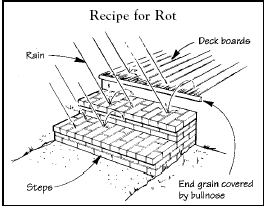
Still, some boards are rotting at the ends, where stairs join the deck (there’s a decorative bullnose nailed to the edge of the deck there). What’s causing the problem? A.Paul Fisette responds: I understand your client’s reluctance to use treated boards in a beautiful custom project. But the problem is caused by using untreated wood in an exposed location.
Your choices for installing and finishing the deck boards were sound ones. But the end grain of the wood is absorptive, like a sponge. Water is splashing off the stairs onto the ends of the boards, soaking in, and encouraging rot. Unfortunately, no paint job can stop that.
The bullnose over the ends of the boards makes matters worse: It lets water seep in, but then blocks it from evaporating out.
The only thing you should have done differently is to use pressure-treated southern pine. To prevent shrinking, cracking, and cupping, use “kiln-dried after treatment” (KDAT) deck boards and have the boards additionally treated with a water repellent at the treating facility.
You could also use a naturally decay-resistant wood species (redwood or cedar), if you can accept the fact that those are relatively soft woods for decking.
Paul Fisette teaches wood science at the University of Massachusetts (Amherst).
Q&A: Splashback Causes Deck Decay
Splashback Causes Deck Decay
1 MIN READ