I was speaking recently with a contractor who was explaining his pricing structure to me. He charged a fixed hourly rate for labor, added a 10% markup to subcontractor costs, and added 15% to material costs. He confirmed that his supplier gave him the locally standard 10% + 5% discount. So he was getting the “10 and 5”
discount, and then for his customer, he was applying a 15% “markup” to the discounted price, which in his mind brought the material price back to the retail price.
Let’s leave aside the question of whether or not it’s reasonable—because of the cost of selection, delivery, storage, security, and warranty—to expect customers to pay more than retail on materials (they probably should). The contractor’s assumption—that adding 15% to a cost that has been discounted 10% + 5% brings it back up to retail—is both commonplace and incorrect. Let’s see how the numbers work out.
We make two assumptions:
- The project materials cost $100.
- The discounts are successive; that is, first 10% is deducted from the retail price, and then 5% of that result is deducted.
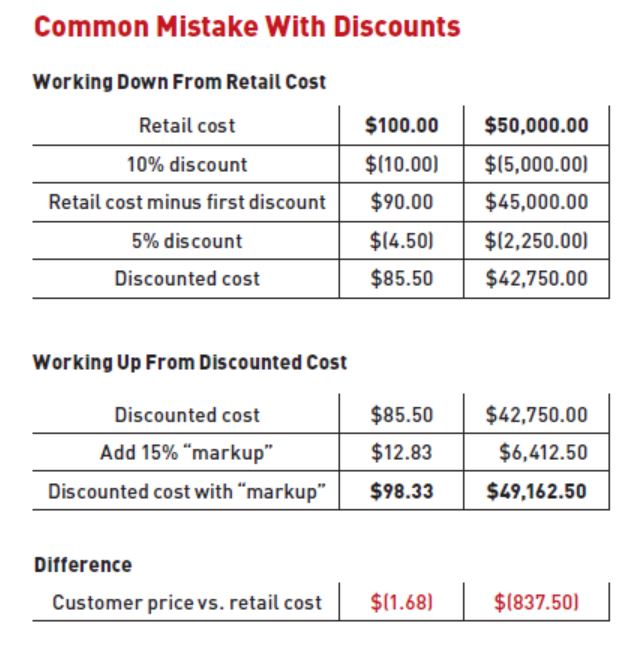
In the charts below, you can see how the math works (or doesn’t).
The contractor’s method (shown in “Common Mistake with Discounts” chart) actually results in his customer paying less than retail for materials.
While this loss of $1.68 per hundred may seem trivial, the greater the materials cost for the project, the larger the loss. On a project with an estimated $50,000 in material costs, for example, the loss is $837.50.
Bear in mind that this loss comes directly from your gross profit, reducing the number of dollars available to cover overhead and contribute to profit. Think of it this way: A loss of $1.68 on $100 of materials represents a gross margin loss on materials of 1.68%.
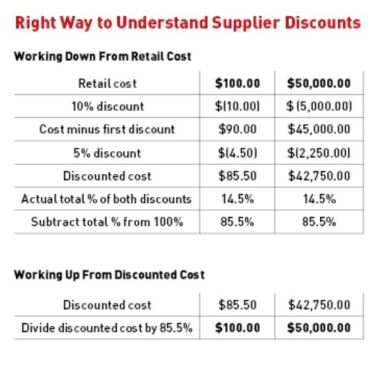
If you’re trying to increase your overall gross margin, then you want to make sure you’re not giving customers a better bargain than the lumberyard would give them. You can do that by following the steps in the second chart (below right). On the larger issue of determining gross margin and correctly setting markup, see “Markup and Margin” (Aug/15).