Knee Walls
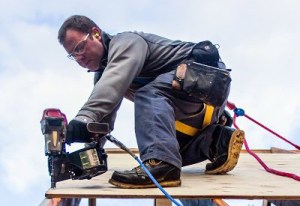
How to handle upper-story knee walls depends on whether they’re drywalled on the back — as in a knee-wall closet — or left open, in which case the area behind them is considered part of the attic.
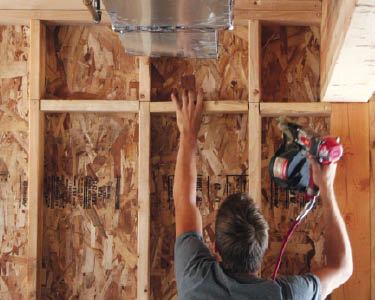
When the design calls for finished storage space behind knee walls, we frame them with top plates. If the area behind the wall will not be finished, we usually just nail the studs to the sides of the rafters. But there’s no need to fire block the bays, because the entire space behind the wall is considered unfinished attic.
Basement Walls
If the house has a basement, we typically frame a 2×4 stud wall inside the perimeter, holding it away from the concrete foundation about an inch or so. Even when there’s batt insulation in the bays, the back of the wall would be open at the top where the plate attaches to the joists — which means that by code fire blocking is needed.
The easiest way we’ve found to fire block this spot is to butt a continuous 2×8 to the mudsill, letting it overhang the foundation wall. We nail the 2×8 to the floor joists above, then nail the 2×4 top plate of the basement wall to the 2×8.
This technique serves another purpose too. Since the mudsills are straight and square, the overhanging 2x8s are also straight and square. We quickly plumb down from the 2×8 edge with a laser to lay out the bottom plates of the 2×4 walls, which gives us a perfectly straight, square layout without any fuss.
Separating stud bays. Because of the air space behind them, our basement walls trigger a second code requirement: R602.8 (item 1.2) states that fire blocking is needed “horizontally at intervals not exceeding 10 feet” within concealed spaces in stud walls. The rule is intended to prevent all the bays in a wall from being connected when the studs are not drywalled or sheathed on both sides. (This condition also occurs in double-framed walls, or where strapping is used to flatten a wall or ceiling.) We meet the requirement by sistering 2-by material to the sides of studs and running it back to the foundation. This blocking isn’t pressure treated, so we hold it off the concrete and get the insulator to caulk the gap when he seals and insulates the wall.
Stairways
Most carpenters are accustomed to putting sloped fire blocks in the stud bays alongside stair stringers. What not everyone realizes is that this blocking is necessary only if the stud bays are open to a concealed space below the stair. But if the area below the stair is accessible, the bottom of the stringers and the walls below the stair must be covered with 1/2-inch drywall (R311.2.2). In that case, there’s no longer a need to install the sloped blocks in the bays, though many framers do it anyway, out of habit.
The enclosed space between the stringers must also be separated from the joist bays at floors and landings. The subfloor takes care of the bottom, but the top will probably need to be blocked. This is another place where we often use a single strip of sheathing or lumber.
Flues
The houses we build contain manufactured fireplaces, so we don’t have to deal with masonry. We follow manufacturers’ installation instructions, but always hold framing back at least 2 inches from flues, per code. When we frame chimney chases, we install a 3/4-inch plywood or OSB lid at each ceiling the flue passes through. The fireplace installer cuts an oversize hole in the lid, runs the flue through it, and then closes the 2-inch gap with a metal fire-stopping ring.