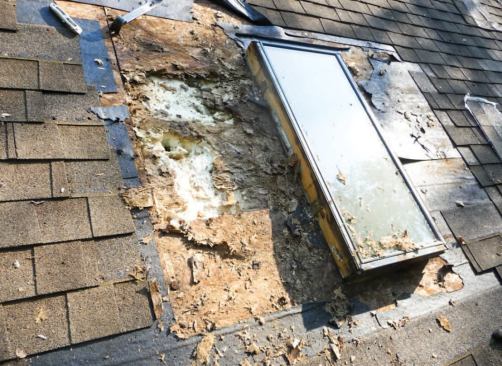
Water dripping from a skylight during an autumn rainstorm
looked like a minor leak. But when the roofer making repairs
discovered an unexpectedly large area of saturated OSB
sheathing and extremely corroded nails and plywood clips, he
called me to take a look. We agreed that this was more than a
flashing problem.
The roofer and I had worked on the house together 13 years
earlier, when it was built. I was the framing contractor; the
owners were the GCs. Vaulted ceilings were a key part of the
home’s design, and I’d framed much of the
6/12-pitch roof with raised-heel scissor trusses. The owners
then had the trusses insulated with open-cell Icynene spray
foam, creating an unventilated roof assembly. Icynene was also
used to insulate the walls of the single-story home, which was
built on a permanent wood foundation surrounded by berms on the
west, north, and east sides. Inside, the soil was covered with
compacted stone and a layer of poly taped at the seams; the
pressure-treated floor joists were installed on top. The home
is heated with a natural gas furnace and has central air
conditioning and a Venmar vanEE 1000 Duo energy-recovery
ventilator (ERV). Supply ductwork in the attic was also
insulated with Icynene, while uninsulated return ductwork runs
underneath the wood-frame floor.
Foam Inspection
I wondered if the home’s unusual construction and
unvented roof were contributing to the problem, so I called
Silas Hoeppner of Cenergy, a local HERS rater and energy
consultant, to inspect the foam installation. Hoeppner
didn’t discover any major defects, but he did find
several small voids, some of which corresponded with areas of
damaged sheathing that we found (see Figure
1). Those voids could have allowed some moisture to be
transported by air movement to the sheathing.
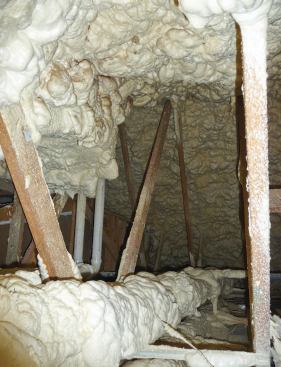
Figure 1. Framed with a combination of standard and
raised-heel scissors trusses, the conditioned attic was
insulated with low-density open-cell foam sprayed on the
underside of the roof sheathing (top left). The foam
installation had some voids (top right) that could have allowed
warm, moist air to reach the underside of the cold roof
sheathing and condense; the void shown here corresponded with
an area of rotted sheathing near the skylight
(bottom).
Vapor diffusion — the movement of moisture from areas
with high moisture concentrations to areas with lower moisture
concentrations — was also a concern. Icynene is a good
air barrier, but unlike closed-cell spray foam, it’s
vapor permeable. The IRC requires a vapor retarder coating to
slow diffusion when an unvented roof is insulated with
open-cell foam in climate zone 5, where this house is located.
While this installation had no vapor retarder — and
therefore did not meet code — Hoeppner noted that the
manufacturer’s specs don’t recommend one in Des
Moines’ 6,600 heating-degree-day climate, since it could
interfere with drying to the interior during warm months, when
the air conditioning is operating and the interior of the house
is cooler and drier than the exterior.
Most of the roof deck was sprayed with 9 inches of Icynene,
which has a stated R-value of 3.6 per inch. But the insulation
was sprayed unevenly, and Hoeppner measured depths as little as
6 inches (R-21.6). Even assuming an average R-value of around
30, the roof had less insulation than the IRC’s current
R-38 minimum for zone 5.
Measuring Humidity and Radon
To monitor the home’s temperature and humidity levels, I
installed a couple of simple UEi THL1 data loggers
(877/571-7901,
tequipment.net). I
mounted one high up on one of the vaulted ceilings in the
living space, and another in an attic area. Using software that
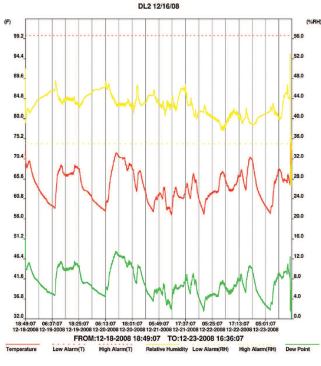
came with the data loggers, I charted the data over a period of
two winter weeks in December 2009 (Figure 2)
and found that the home had relative humidity (RH) levels that
ranged from 40 to 48 percent in the conditioned attic but rose
as high as 56 percent in the living space, even with the ERV
operating.
Figure 2. Temperature and humidity data showed
abnormally high wintertime relative-humidity levels —
almost 50 percent in the home’s conditioned attic and
even higher in the living space.
Given the home’s unusual earth-bermed construction and
the high radon levels in our area, radon testing also seemed
like a good idea. As it turned out, the home had levels
exceeding 38 picocuries per liter (pCi/L), much higher than the
EPA’s 4 pCi/L action level. So my clients installed a
radon-mitigation system — basically a continuous-duty fan
that depressurizes the subsoil under the ground-level vapor
barrier and exhausts radon-containing soil gas to the outside.
With the new radon system installed, radon levels dropped below
3 pCi/L later that winter. As an added benefit, the installer
reported that RH levels in the house had dropped beneath 30
percent, a more normal wintertime level.
Depressurizing the soil under a house also tends to dry the
soil out, so I wasn’t surprised by the drop in indoor
humidity. I was concerned that the roof damage had been caused
by excess water vapor from the soil migrating through the spray
foam — either through diffusion or, more likely, air
leakage — and condensing on the cold sheathing. But I
couldn’t rule out the possibility that the wet sheathing
was the result of ice dams caused by conductive heat loss,
especially considering the modest levels of insulation and the
roof’s relatively low pitch.
Roof Repair
With indoor humidity now in check, I was less concerned about
vapor migrating through the Icynene and condensing on the roof
sheathing. Still, there wasn’t enough insulation in the
roof, so I recommended stripping the entire roof and adding a
continuous layer of 2-inch-thick extruded polystyrene (XPS) on
top of the roof deck, then installing 2x4 sleepers, new
sheathing, and new shingles. The new foam and sheathing would
more than triple the cost of reroofing the house, but it was
the least expensive way to add needed insulation to the vaulted
ceilings. Owens Corning Foamular 250 has an R-value of 5 per
inch, so 2 inches of foam would bring the R-value of the roof
assembly up to about R-40. The continuous layer of foam would
also keep the OSB sheathing warmer, so that it would be less
likely to become a condensing surface.
Since we would have to install sleepers over the foam to attach
new sheathing, I planned to take advantage of this by also
using the sleepers to provide ventilation to the new roof deck.
This would help keep that sheathing cold and prevent the
formation of ice dams. Of course, adding extra thickness to the
roof meant that we would also have to address the existing
fascia and gutters and remount the skylights.

Installing the Foam
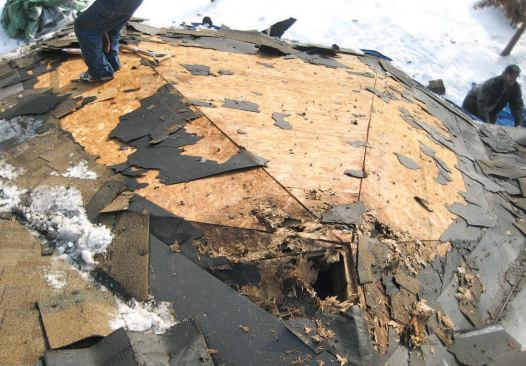
Once my crew starting stripping off the old roof, we found more
areas of damaged sheathing, with the worst damage on the
north-facing side of the roof where the skylights were located.
Interestingly, the sheathing over the heated garage —
which was conventionally insulated with cellulose blown into
the attic rather than spray foam on the sheathing —
looked as new as the day the shingles were installed
(Figure 3). It’s possible that humidity
levels were lower in the garage attic, since a sheathed and
spray-foam-insulated attic partition wall isolated it from the
rest of the house.


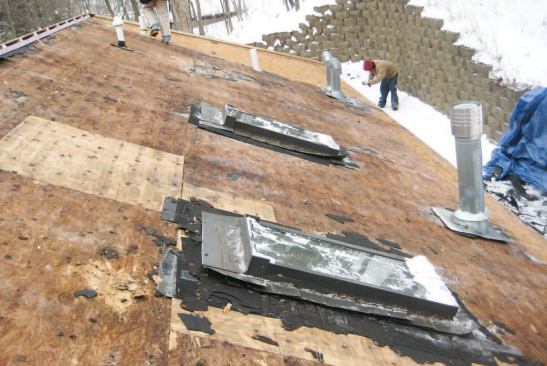
Figure 3. While the initial problem appeared to be a
leaking skylight, there were other areas on the roof that had
deteriorating OSB sheathing (top) and corroding plywood clips
and fasteners. The north-facing roof sheathing over the vaulted
living space suffered the most damage, while the sheathing over
the unconditioned garage attic (at the far end of the roof in
the photo on the bottom) showed virtually no damage at
all.
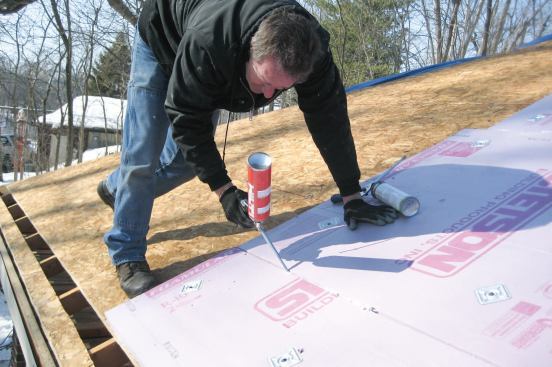
After patching the remaining areas of damaged sheathing, we
began installing foam, working from the ridge down. We quickly
fastened the rigid sheets to the sheathing with 2 1/2-inch-long
Duro-Last HD screws and washers (800/248-0280,
duro-last.com), using
four to six fasteners per sheet. Because the sleepers would
hold the foam sheets securely in place once they were
installed, we needed only enough fasteners to keep the foam
from slipping while we walked on it. To ensure that the blanket
of rigid foam was as continuous as possible, we carefully
sealed all of the joints between the sheets and around
penetrations with low-expansion canned spray foam.
The trickiest part of installing the foam board was fitting it
around a half-octagon roof framed over a bump-out entry on the
south-facing wall of the house. That roof had been framed
California-style on top of the existing roof deck, but the
lower-level roof sheathing wasn’t continuous (as it
typically would be with overlay framing). With the upper
framing partially open to the lower framing and perhaps not
enough sheathing to spray the foam against, it seemed possible
that there was an air pathway up into the upper cavity. This
would have allowed water vapor to collect and condense here,
and could explain why there was considerable rot on the
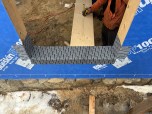
sheathing and framing at the octagon roof peak (Figure
4). To block off convective pathways into this cavity,
we removed the rotted sheathing, cut rigid foam to fit around
the repaired framing, then carefully sealed the foam joints
with a portable two-part spray foam kit (800/321-5585,
fomo.com) before resheathing
the roof.


Figure 4. Warm, humid air had collected and condensed
on the framing and sheathing of the bump-out entryway roof,
causing it to rot (top left). To block air leakage into this
cavity, the author cut rigid foam to fit around the framing and
over the partially sheathed roof (top right), then sealed
everything up with two-part foam (bottom).
Ventilating the Roof
The original roof trusses had been blocked off at the wall
plates with plywood baffles before the Icynene was sprayed, but
the eaves themselves were uninsulated and finished with vented
metal soffits. By cutting away a 4-inch-wide section of the old
roof sheathing along the eaves and outside the wall plate line,
we were able to use the original vented soffits to provide an
air path up into the 2x4 sleepers installed on top of the rigid
foam (Figure 5). The sleepers are fastened
through the foam to the trusses underneath with 5 1/2-inch-long
Duro-Last fasteners. We first tried 7-inch screws but found
that the shorter screws had plenty of bite and took much less
of a toll on the battery life of our cordless impact
drivers.


Figure 5. Taking advantage of existing vented soffits,
the author cut slots in the sheathing along the eaves (top
left) to provide air pathways through the eaves assembly.
Sleepers installed over the foam provided solid nailing for the
new OSB roof sheathing and ventilation channels underneath (top
right). New beveled 2x6 subfascia “extenders”
accommodated the 3 1/2 inches of added roof thickness
(bottom).
Since condensation didn’t appear to be an issue on the
hip roof over the garage, we saved a little money by not
installing continuous foam there. Instead, we cut the foam into
3 1/2-inch-wide strips and padded the sleepers out with these
rippings before installing our new sheathing, to avoid visual
problems at the eaves and ridge. When we installed the
sleepers, we cut them a little short wherever there was an
obstruction — at the hips and around skylights, for
example — to provide ventilation pathways.
New Roofing
To accommodate the thicker roof assembly at the eaves, we
extended the existing subfascia with 2x6s cut with a beveled
top edge to match the 6/12 roof pitch. Later, after felting the
roof and installing the new architectural shingles, we covered
the subfascia with new metal fascia material, and installed new
gutters to finish the eaves (Figure 6).
Figure 6. Rigid foam adds R-value to the roof
assembly, while a new radon-mitigation system helps dry out the
soil beneath the home, reducing indoor humidity levels. Air
entering the vented metal soffits (top) flows up through
channels between the sleepers and exits out the continuous
ridge vent, helping to keep the new roof deck cold.
There was no way around it: Installing exterior foam this way
also meant remounting the skylights. In this case, the wood
skylight frames were so distressed from interior condensation
they had to be replaced anyway. At the ridge, we installed a
LOR-30 Lo-OmniRoll ridge vent (800/643-5596,
lomanco.com), a continuous
roll-out design that has performed well for us.
In the end, the total cost for repairing this roof was about
$32,000, which included the two new Velux skylights.
That’s a lot to pay for repairing a roof leak, but with
this belt-and-suspenders approach the new roof assembly will be
better equipped to handle excess moisture than the original one
was.
Builder Mark Parlee specializes in exterior renovations and
building-envelope problems in Urbandale, Iowa.