I’m about to embark on an exciting build of a “dancing winder” staircase this summer, which I’ll document in a JLC article to come later this year. Before we get to that complex winding stair, however, I thought I’d begin easing into the topic of winding stairs with a discussion of the simplest design—a basic “quarter-turn,” or L-shaped, stairway with two half-flights of stairs, a lower one leading up to a landing, where it turns the corner and starts the upper half-flight.
Adobe Stock
At the corner of a square landing below the handrail on a quarte…
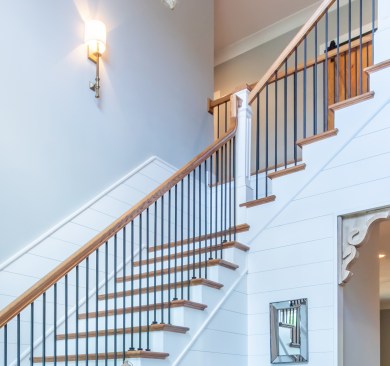
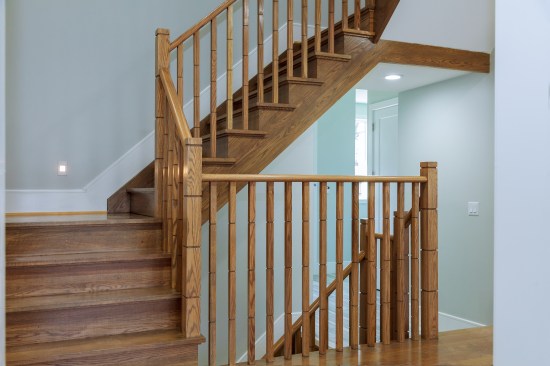
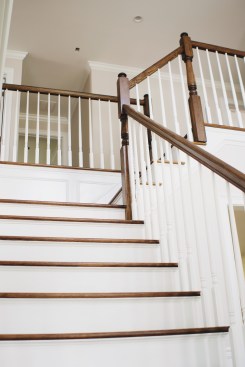
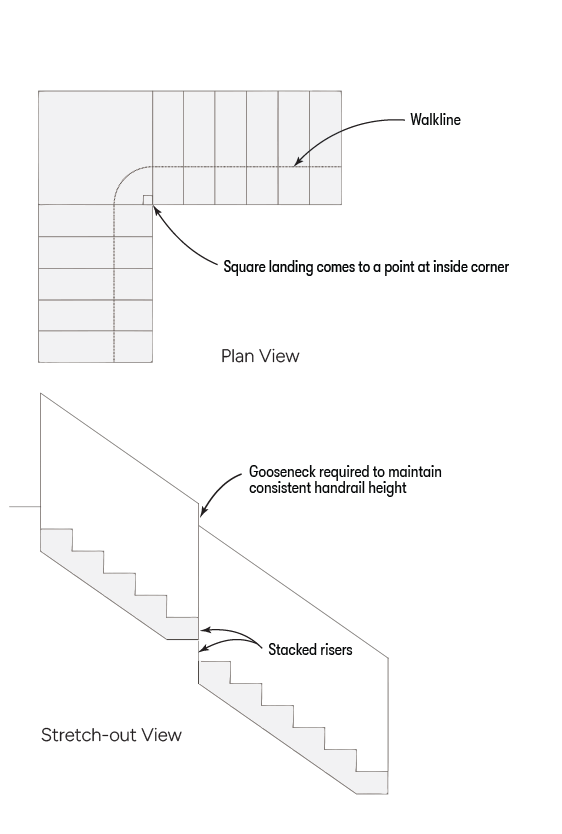
A typical quarter-turn stair, such as the one shown in the slideshow above, has a square landing. There’s nothing wrong with this landing shape but it complicates the handrail. To understand why, let’s first focus on the inside corner of the landing as shown in the illustration below: You have a riser from the top tread on the lower half-flight of stairs coming up to the landing, and from the landing you have another riser to the first tread in the upper half-flight of stairs. These two risers meet at the inside corner of the landing where they are essentially stacked on top of each other. This can be seen plainly in a Stretch-out View (see illustration below).
In This Series
Unstacking Risers for an Elegant Handrail
French Landings: An Evolution in Building Elegant Stairs
French Landing Layout
A Stretch-out drawing is the world’s simplest 3D model that old-time stair builders used to work out stair problems. The drawing consists of two elevations of each half-flight combined as one elevation. If you folded the drawing along the line of the landing newel to create a right angle, you would have a rough approximation of the quarter-turn stair. Flattening it out allows you to see not only the run of the stringers, but also the run of the handrail, and in the case of the square landing, the two stacked risers at the inside corner are immediately apparent.
Stacked Risers on Stairs
In essence, a square landing is a big tread that comes to a point on the inside below the handrail. If it were a winder tread, code would not allow it to come to a point. There would be too little surface for walking safely near the handrail where most people walk. (Most people tend to take the shortest path.) But because it’s a “landing,” it’s allowed by code. In fact, more falls happen on stairs with landings than on stairs without landings. However, because the fall is shorter down the half-flight, falls from landings tend to be less serious than falls down full flights of stairs.
Unstacking the Risers
The square landing also creates other problems. Notice the line of the handrail on the stretch-out drawing of the stair with a square landing. If you want to maintain a consistent handrail height, the lower portion has to ease up into a gooseneck that runs vertically at the newel, so it can hit the newel at the same height where the upper handrail jumps off of it. At least three separate handrail pieces are required for this detail.
Alternatively, the upper and lower handrails can die into the landing newel at different heights. This requires either a wide square landing newel or an elongated block high on a turned newel; both are common because it’s easier than assembling
a gooseneck.
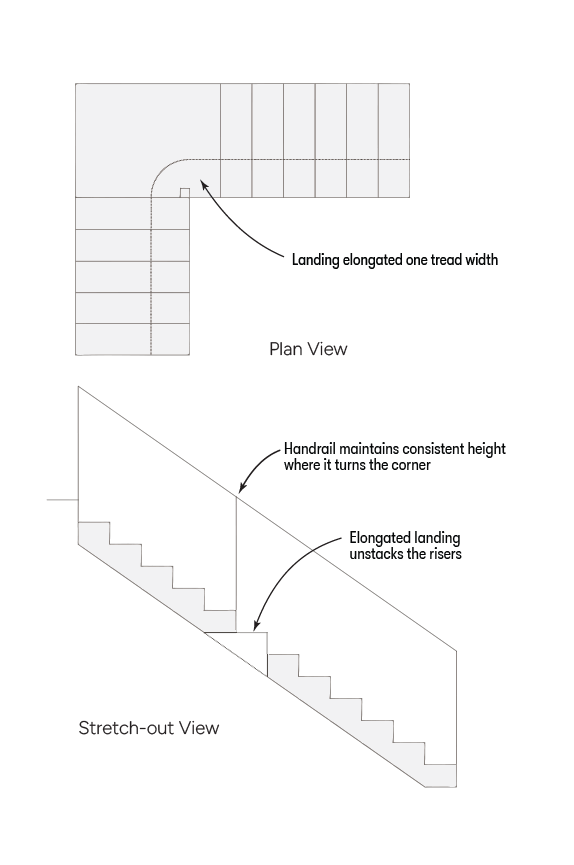
But there is an easier and much more elegant way to accomplish this: If you extend the landing by one tread depth (by eliminating that corner below the handrail), as shown on the second stretch-put drawing above, the line of the handrail becomes a single line. It turns the corner but you don’t need to change elevation; rather, it maintains a smooth, consistent line.
The drawback, of course, is that the elongated landing does take a little more space: The landing and lower half-flight must shift one tread depth over at the first floor, so it won’t work in all cases. But if addressed at the design phase it’s often easy to implement, and the result is a vastly simplified handrail that only has to make the turn but does not need to change elevation.
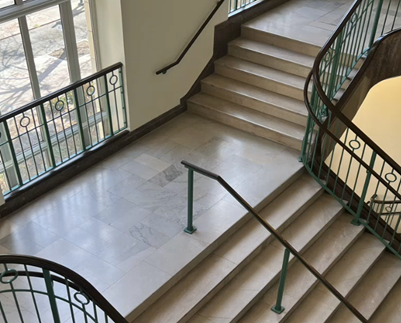
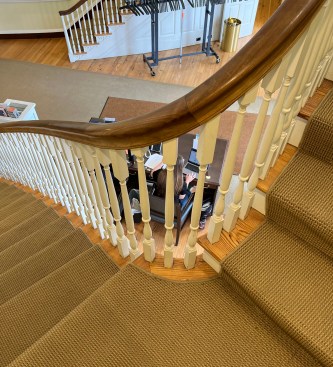
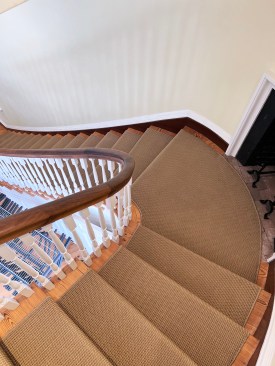
If space is limited, there are ways to build a smaller landing and maintain the simpler handrail. One of my favorite examples of this is the stairs designed by Thomas Jefferson at the Rotunda at the University of Virginia (see photos below).
Brian Campbell
This landing at the Orange County Regional History Center in Orl…
This stair uses a pie-shaped landing and a few skewed treads above and below the landing. Because of the curve it presents itself like a circular stair, but in essence it’s a quarter-turn stair. Instead of a square landing that comes to a point on the inside of the turn, Jefferson elongated the landing to match the tread depth below the handrail, so it successfully unstacked the risers and achieved that smooth, single-line handrail.
Code allows irregular-shaped landings (not a square or rectangle) as long as they are at least as big as the area of a circle with a 36-inch radius (about 4,072 square inches) and as long as the walkline (12 inches from the guardrail where most people walk up or down a stair) is at least as long as a quarter-circle with a 12-inch radius (about 19 inches).
With the skewed treads (slightly angled treads above and below the landing), these stairs begin to look like winder stairs, which use wedge-shaped, or triangular, steps called “winders” to change direction instead of a landing.
In the next column, I will dive into more detail on winder stairs and introduce the concept of a French landing, which uses curves in the treads and landings to keep the walkline the same and to achieve a smooth handrail line.
Keep the conversation going—sign up to our newsletter for exclusive content and updates. Sign up for free