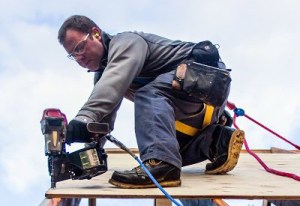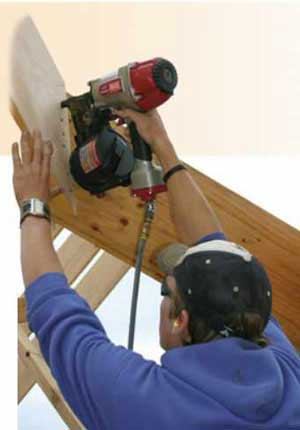
Until recently, my framing crew used stick nailers to fasten framing and small coil nailers to fasten sheathing. But about a year ago, we started using larger coil framing guns for both tasks. The reason is simple: Coil guns hold more fasteners than stick guns, so using coil nails boosts our production by reducing the number of times we have to stop and reload.
Consider the numbers. My old stick gun holds two full strips of framing nails. Since the nails I buy come 25 to the strip, a full load (we don’t break strips) is 50 10d nails. A coil framer, by contrast, holds one coil of fasteners — but the brand we buy contains 225 10d nails per coil. That amount increases if you use smaller nails.
I’ve heard that coil framers are common in Florida and in parts of the East Coast, but not in other areas of the country. This is partly a matter of tradition; people tend to use the kind of tools they learned on, and most of us learned on stick guns. The other reason more carpenters don’t use coil guns is that they’re heavier than stick guns when they’re filled with nails.
Testing the Tools
Over the summer, my crew had the opportunity to try out seven coil guns: the Bostitch N89C-1, Hitachi NV83A2, Makita AN901, Max CN890II, Paslode F325C, Porter-Cable Coil350, and Senco SCN65. We had the tools for a little more than three months and framed every day.
Criteria. In evaluating these guns, we concentrated mostly on balance and weight, power, and nail-driving speed. We also looked at the depth-of-drive mechanism and assessed the usefulness of added features like hooks and built-in air filters. The one quality we could not evaluate was long-term durability.
Balance and Weight
Empty, a coil gun weighs about the same as a stick gun. But load them both with 10d fasteners, and the coil gun is suddenly 2 1/2 pounds heavier. For some carpenters, this will be a problem. I understand, because in general I too prefer lighter tools. But when it comes to framing guns, I’m willing to carry more weight if it means being able to work longer without having to reload.
A coil gun is more comfortable to use if it’s balanced front to back. Some of the coil guns are very well-balanced, but others feel nose-heavy. This was not an issue when we nailed subfloor, but it was when we held the guns in other framing positions. If we had had only a single coil nailer, we might not have noticed, but with seven models to choose from, it became obvious which were the most comfortable to use.
The Hitachi is better-balanced than the other tools, and so it feels lighter than the specs say it is. The Makita, Max, and Senco are also well-balanced and comfortable to handle — especially the Makita. The Bostitch, Paslode, and Porter-Cable all feel nose-heavy; using a nose-heavy gun gives you a sore wrist.
Weight specs. Some of the tool weights shown in this article differ from the numbers cited by the manufacturers. The manufacturers’ weight specs are frequently wrong. I’m told that this happens because the companies change something on the tool and then forget to correct the specs. We got our weights by weighing each tool (including air fittings) on an electronic postal scale (see “Coil Gun Specs”).
Speed and Power
All of these tools have the power to put 10d nails into the hardest material we ever use — LVL beams. The catch is in how fast they can do it. When I say a gun is fast, I mean it can drive fasteners in rapid succession without leaving any heads standing proud. Manufacturers sometimes include a spec for how fast their guns can cycle. For example, Paslode says its gun will cycle 10 times per second — which is faster than any carpenter could or would want to drive fasteners.
I can’t vouch for the specs, but in use the Hitachi and Paslode cycle faster than other models. The Max feels a little slower than the rest. The only time we noticed this was when we nailed LVLs or fastened top plates, a task that involves driving a lot of framing nails in rapid succession. If we slowed down just a little, the problem went away.
As for power, the Makita and Bostitch feel more powerful than other models, but not to the extent that our purchase decision would be strongly affected. All of these guns have enough power to do the job.
Depth of Drive
An adjustable depth-of-drive mechanism is an important feature for us. Because we use the same guns for both framing and sheathing, we change nails and depth settings all the time. Our building inspectors are picky about shear nailing and will fail us if we overdrive fasteners. But if the nails stand proud, we have to go back and hammer them down.
We can adjust most of these guns by pushing a button or by turning a dial, but the Paslode and the Porter-Cable require the use of an Allen key. Since it’s inconvenient to use a key, I won’t buy a nailer that requires one.
Added Features
Some guns have added features: adjustable exhaust vents, swivel fittings, oversize triggers, built-in air filters. Like the cup holders in a car, they are convenient but not reason enough to buy a particular model. The one added feature that would affect my buying decision is a hook.
Whereas a number of stick nailers come with hooks, only one coil gun — the Makita — has one. A hook allows you to quickly free up one of your hands by hanging the tool on something. To me this is an incredibly convenient feature and one of the main reasons why I really like the Makita tool.
Bostitch N89C-1
This is a brand-new coil nailer — so new we had to test a preproduction model. It has excellent driving power and feels solidly made. It features a tool-free depth of drive that adjusts with a nose-mounted push button. I like the tip because it’s exceptionally aggressive.
The gun comes with a “smart” trigger, which works a lot like the trigger on the Max: If you squeeze the trigger first, the tool bounce-fires, but if you compress the tip first, the gun fires single shots. According to Bostitch, you can convert the tool to full-time bounce-firing by knocking out a pin.
Although the N89C-1 is in many ways a very nice tool, it felt nose-heavy and bulky to the carpenters on my crew.
Hitachi NV83A2
The NV83A2 is the coil version of a Hitachi stick nailer I’ve used and liked in the past. In use, the Hitachi drives nails faster than every model except the Paslode, which is equally fast. This tool weighs 8.2 pounds, about average for a coil framer, but it’s so well-balanced it feels lighter. As a result, it’s very comfortable to use.
The tip is less aggressive than that of the Bostitch, but it still grabs well enough to toenail engineered lumber. The depth-of-drive mechanism is controlled by a dial and works very well. This is an excellent nailer, and the only reason it’s not my favorite is that it doesn’t come with a hook.
Makita AN901
Three things stand out about the AN901. First, it’s extremely light, a pound lighter than the next-lightest gun. Second, it’s unusually tall. The height takes some getting used to, but does not make the tool any harder to use. Third, it comes with a hook for hanging the tool.
The Makita is very powerful, and although it’s not as fast as the Paslode and the Hitachi, it’s fast enough for our needs. It’s light and well-balanced, so it’s comfortable to use. The only problem we had with it was its tendency to overdrive fasteners when we ran it off the same compressor as the other guns. We normally run our compressor at 100 psi, but we had to turn it lower to nail shear with the Makita.
This gun has a number of added features, including a translucent magazine cover that allows you to see how many fasteners are left, and a built-in air filter to keep dirt and grit from getting inside. My favorite feature is the hook, which — despite the manufacturer’s admonitions not to do so — I use for hanging the tool on my belt. The AN901 would be a nice gun even without the hook; with it, the tool goes to the very top of my list.
Max CN890II Super Framer
The CN890II is powerful and seems to be very well-made. I like it because it’s one of the better-balanced guns. Its numerous added features include a swivel connector at the air inlet that prevents hose kinks, and a built-in air filter that cleans itself every time you unplug the hose.
The gun has two firing modes: the usual bounce-firing and a single-shot mode activated by compressing the contact element and squeezing the trigger in a particular order. If you compress the element before squeezing the trigger, the gun will not fire again on that squeeze. Bounce-firing is simply a matter of squeezing first and then hitting the contact element.
The downside to the Max is that it’s one of the heavier models and seems to cycle slower than other guns. Although we usually didn’t notice the slower speed, that changed when we drove a lot of large fasteners at once, as you might do when nailing off top plates. Fortunately, this task is only one small part of framing a house, and in my mind the tool’s other qualities make up for the shortcoming.
As with other models, I’d rate this one higher if it had a hook.
Paslode F325C
The F325C is as fast and powerful as any coil framer we tried. It has an aggressive tip and is comfortable to use despite the fact that it’s somewhat nose-heavy. The trigger is longer than most and extremely sensitive; its size makes it easy and comfortable to use, even with gloves on. (A sensitive trigger is good ergonomics but means you have to be careful not to fire the gun accidentally.) I like the speed and power of this tool and would consider buying one if it weren’t for one problem: The depth-of-drive mechanism requires the use of an Allen key.
Porter-Cable Coil350
The Coil350 is a powerful gun with an aggressive tip that’s good for toenailing. I also like the tool’s magazine, because it has openings in it so you can see how many nails are left inside.
Unfortunately, the things I don’t like about this gun outnumber the ones I do. It is noticeably nose-heavy and uncomfortable to use. According to the manufacturer, it weighs 7.4 pounds — but it actually tips the scales at 8.3 pounds. And the depth-of-drive mechanism requires the use of an Allen key, which in my book automatically disqualifies the tool.
Senco SCN65
The SCN65 is of average weight for a coil framer but is so well-balanced it feels lighter and smaller than it really is. In terms of speed and power, it’s about average for this group of guns. The depth of drive adjusts very easily, but the tip is not quite as aggressive as I would like. An opening in the magazine makes it easy to look inside and see how many nails are left. In addition to framing with this gun, we used it for siding; it performed both tasks very well.
Overall, I’d say this is an average coil gun. My major gripe is that it does not seem to be that well-made. After only a week of use, the foam grip on the handle tore. While I realize this doesn’t necessarily say anything about the gun’s insides, it certainly does not inspire confidence.
Favorites
Here’s how I’d rank the top three guns in this category.
Makita gets my vote for first place. Well-balanced, extremely light, and very powerful, my favorite nailer is the only one with a hook, a feature every gun should have. Its one negative — the tendency to overdrive nails when sharing an air compressor with other guns — can be fixed by lowering the compressor setting or by using an inline pressure regulator.
Hitachi snags second place. If this well-balanced and extremely fast tool came with a hook, I’d probably rate it No. 1.
And coming in third? The Max. Well-balanced and solidly made, with added features like a swivel fitting and an antidouble-fire mechanism, this tool might rank higher if it were faster and lighter and included a hook.
Tim Uhleris lead framer for Pioneer Builders Inc. in Port Orchard, Wash.
The Straight Shtick on Coil Nails |
|---|
| Coil framing nails have full round heads collated at 15 degrees by a pair of steel wires. I prefer wire collation because the leftover wire doesn’t fly up and hit you in the face the way bits of plastic can when you use full round-head plastic collated stick nails. In our area, coil nails cost a little bit more than stick nails, but I’m told that the two types of nails cost the same in areas where coil nails are more common. Most of the guns we tested are designed to accept fasteners from 11/2 to 31/2 inches long, and from .099 to .131 inch in diameter. Fasteners this size work just fine in most of the country, though there are some areas where thicker fasteners are required by code or by an engineer’s design. For example, in California, shear-wall sheathing is often fastened with .148-inch nails, and I have been on jobs where an engineer specified .148-inch fasteners for framing. It’s worth noting that a few guns are rated to accept .148-inch nails. At first this didn’t make sense to me, because I had never heard of a coil nail this size. But as it turns out, Bostitch makes a 21/4-inch-by-.148-inch coil sheathing nail. A delicate issue. Because coil framing nails are collated with a pair of steel wires, they are a lot more delicate than strips. If you drop a box of coil nails, the collation can bend and distort the shape of the coils. Best-case, the distorted coil won’t feed properly through the gun. Worst-case, you’ll have to throw out the nails because they won’t feed at all. To load a coil gun, you open the magazine and a cover on the nose, and then put in a coil, laying the end on the feed pawls. Close the magazine and cover, and you’re ready to go. If a nail jams, you simply pop open the cover on the nose to clear it. I’ve heard people say that coil guns are finicky and tend to jam. In my experience, unless you do something really bad to the coil, they jam less often than stick guns. If a nail does jam, clearing it is simply a matter of opening the same hinged feed cover you open to load fasteners (see photo, above). When I frame with a stick gun, I fill my nail pouch with extra strips of fasteners. The gun may be lighter, but I’m still carrying a heavy load. When I frame with a coil gun, I leave a couple of coils sitting somewhere nearby. |