After decades of cobbling together deck railings from various
pieces of pressure-treated lumber — often to ill effect
— carpenters now have new options. Following on the
development of composite and plastic decking, manufacturers are
offering kits that can speed installation and provide a clean,
professional-looking railing that doesn’t need painting
or staining. For this article, I looked at wood-plastic
composite and vinyl railings, as well as a few aluminum
systems.
The railing kits include top and bottom rails, balusters, and
installation hardware. Screws and hardware are usually made
from stainless steel and, if exposed, are powder-coated to
match the rails. Post sleeves, caps, and post trims are
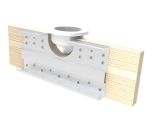
typically purchased separately. Special hardware —
usually hinged brackets that you pivot to the proper angle
— is available for angled layouts and stair rails.
Manufacturers offer a variety of styles and colors to match or
complement most types of decking. Products can be customized by
using different types of balusters or mixing colors.
Planning Ahead
While manufactured rails promise easy installation — the
post sleeves require no assembly, the balusters are precut, and
all the connections have been worked out in advance —
there are a couple of key points to keep in mind.
First, baluster spacing is fixed, because the top and bottom
rails come with predrilled holes for fastening balusters. This
is a great time-saver, but it means there’s no good way
to fudge the spacing when balusters crowd the posts. The
instructions typically say to lay out rail cuts from the middle
— usually the center of a space — in order to
create equal end spaces. Check before you cut; you might be
able to gain space by shifting the layout and using one less
baluster. You’ll get the best results if you can lay out
your posts to match the railing, but this isn’t always
possible.
Second, while many manufacturers offer rugged post mounts for
attaching to stone or concrete slabs, most railing kits
installed in residential settings rely on 4x4 posts for their
structural integrity. This means that the builder assumes
responsibility for giving the customer a safe, code-compliant
railing. Fortunately, researchers and manufacturers have
addressed this issue and there are now several hardware options
available that provide a straightforward solution (more on that
to come).
Wood-Plastic Composite
Railings
Composite railings are made from the same kinds of
formulations used in composite decking. First-generation
railing products were made from a single layer of composite.
More recently, manufacturers have begun using co-extruded
material.
Single-layer railing products have the look and feel of
composite decking; typically heavier and more flexible than
wood, they’re often waxy and mottled in appearance
(see Figure 1). Composites contain a mix of
wood flour (finely ground sawdust) and a polymer such as
polyethylene or polypropylene. The polymer binds the material
together; the wood fiber is an inexpensive filler that
increases strength and thermal stability.
Figure 1. The most basic type of
composite railing is made from a single layer (left) of the
same material used to make composite decking. Pieces are heavy
and waxy and look slightly grainy (right) — the plastic
equivalent of MDF or particle board.
Parts are produced by extrusion. Manufacturers take pains to
ensure that the fiber is fully encapsulated within the polymer
so that the composite is resistant to insects, rot, and mold.
Inevitably, though, some of the fiber remains at or near the
surface, where sun and rain can get to it. Past failures of
composite decking were often the result of fiber getting wet.
In extreme cases, the material cracked, swelled, or
deteriorated; more typically, the partially exposed fibers
became stained or supported the growth of mold. Most composites
now contain biocides to suppress the growth of rot and
mold.
Discoloration from the sun is also a problem. Manufacturers
add pigment and UV stabilizers to the mix, but fading is
usually excluded from warranty coverage.
Co-extruded composites. Some newer composite railings
are co-extruded, meaning that a thin cap layer of vinyl (or
acrylic) is bonded to the composite core. Co-extruded
composites are more resistant to mold and fading because
there’s no wood fiber in the cap. The cores are typically
a wood-vinyl mix, which bonds well to the vinyl cap and is also
lighter and stiffer than a conventional composite. The cap
layers are fairly tough: In researching this article, I scraped
co-extruded parts from several manufacturers with the tip of a
screwdriver. It was hard getting through to the core —
much harder than scraping through paint on wood. The resulting
scratches looked bad but posed no danger to the composite
below.
Co-extruded railings are available in standard colors like
white, tan, brown, and gray, as well as in black, which is
currently quite popular. The cap layer can be textured to look
like painted wood, though the finish is typically glossier
(Figure 2). Azek’s Premier Rail and
GAF’s RailWays are among the more convincing lookalikes,
resembling wood that’s been sprayed and then back-rolled.
Radiance Rail (TimberTech) and Horizon Plus (Fiberon) are also
fairly convincing, though their balusters are a bit too smooth.
At the other end of the spectrum are products such as
CertainTeed’s Panorama, which is far too smooth to be
mistaken for wood.


Figure 2. Co-extruded material has a wood-vinyl
composite capped by a thin layer of vinyl (left). The mottled
appearance of the single-layer composite at far left (in middle
photo) is due to the presence of partially exposed wood fiber;
the cap layer of the co-extruded material to its right contains
no fiber. The cap layer on the GAF RailWays product (right) has
the texture of wood that’s been painted and
back-rolled.
Installation of composites. Composite rails are easy
to install. The carpenter slides the post covers over the 4x4
support posts (Figure 3), cuts the rails to
length, then assembles the balustrade. In most cases, the
balusters attach with screws driven through predrilled holes in
the subrails. Once assembled, the balustrade is positioned
between the posts, fastened in place, and covered with a top
rail. While screwing in balusters is not the fastest method of
assembly, it’s certainly the most bullet-proof, providing
little opportunity for joints to open or balusters to rattle.
Some manufacturers have devised methods to speed the
installation of balusters by omitting the screws
(Figure 4).
Figure 3. Like many composite products, the Azek
Premier Rail system is installed by sliding a post sleeve over
a wood support post (top left), screwing balusters to a subrail
(top right), covering the subrail with a top rail (bottom
left), and then securing the rails to posts (bottom
right).
Figure 4. The hollow balusters in GAF’s
RailWays system fit over ribbed plastic fittings screwed to the
rail before assembly (left). Fiberon’s Horizon Plus
Railing (middle) relies on press-fit plastic inserts —
one end fits in the baluster and the other in a slot in the
rail. The balusters in Trex’s Artisan Series (right) drop
into routed openings in a vinyl spacer strip; it snaps into the
rail.
Rails are typically joined to posts with stainless-steel
fasteners and L-shaped metal brackets that butt to the post and
the bottom of the rail. While color-matched powder-coated
brackets are fairly inconspicuous, a cleaner look is achieved
with a two-piece rail that completely conceals the hardware, as
with CertainTeed’s Panorama, TimberTech’s Radiance,
and Trex’s Artisan series (Figure
5).
Figure 5. While the powder-coated
hardware on this Azek rail is fairly unobtrusive (top left),
the bracket on the TimberTech Radiance rail (top right) is
completely concealed by the top rail (bottom).
Vinyl Rails
Vinyl rails consist of hollow vinyl sleeves over structural
metal channels. The metal, usually an aluminum extrusion,
supports the sleeve, which by itself is not stiff enough for
long spans. Because balusters are subject to less stress than
rails, they can be made from vinyl alone. Dark vinyl tends to
fade, so only light colors are available — white, tan,
brown, and gray.
Though vinyl railings are intended to resemble painted wood,
the effect is not convincing. The smooth, shiny surface is a
giveaway, as are the plastic brackets that vinyl systems
typically rely on to conceal the connections between posts and
rails (Figure 6).
Vinyl rail extrusions are reinforced with
aluminum channel (left). In most vinyl kits, an obvious plastic
bracket covers the joint between post and rail
(right).
Most companies buy vinyl extrusions from large manufacturers
like Veka or Kroy, then combine the parts in various ways to
produce individualized products. It’s not unusual to see
the same parts across several brands.
Installing vinyl rails. Vinyl systems are very easy
to install because the balusters drop into holes in the rails.
(The drawback is that because they’re not screwed into
place, the balusters could rattle in the wind or squeak when
someone leans on the rail.) The railing cuts aren’t
critical because the connection is hidden by the plastic
bracket (Figure 7).
Figure 7. With the lower rail of the Veka VI Pro
system in place and the balusters in their holes (left), all
that’s left to do is fit the upper ends of the balusters
into the top rail. The VI Pro uses heavy aluminum hardware
(middle); plastic hardware — as on the CertainTeed
Panorama rail (right) — is more typical for vinyl
railings.
Noteworthy products. CertainTeed makes a couple of
vinyl products that — when viewed from a distance —
might almost pass for wood. The company’s Edgewood series
rails are colored and textured to resemble wood brushed with
paint or stain. If it weren’t for the plastic brackets,
they’d be fairly convincing. And its Colonial vinyl
baluster, which is supposed to look like a turned wood spindle,
is thicker-walled than most and crisp enough to be
believable.
Veka’s VI Pro Handrail System comes with the usual
square balusters or can be routed to accept round 3/4-inch
steel pickets in a variety of patterns and finishes. Curved
railings are available in stock and custom radii. The beefy
aluminum connectors for the VI Pro rail are more substantial
and contain more screws than the plastic connectors normally
used with vinyl rail.

Aluminum Rails
Aluminum rails are a good option for customers who want the
sleek unobtrusive look of metal without the corrosion
associated with steel. Most aluminum rails receive a
factory-applied powder-coat finish that is tougher than
conventional paint.
Frequently used on commercial and multifamily projects,
aluminum systems are usually tested to both the IRC and IBC
standards. Aluminum is considered a conventional building
material in the code, so aluminum rails do not require special
approval and are often available with tempered glass infill
(see “When a Guardrail Contains Glass”)
Installation. Some products, such as
CertainTeed’s Durham, are assembled entirely on site. The
Durham balusters fit into precut holes in the rails and are
held in place by spring-loaded pins. Once assembled, the rail
sections are installed between aluminum posts that are bolted
to the deck (Figure 8).
Figure 8. The Durarail system is made from heavy
powder-coated aluminum; here it’s shown with a
combination of pickets and tempered glass (left). The balusters
in CertainTeed’s Durham system (right) are held in the
rails by spring-loaded pins; the compressible rubber end piece
prevents rattling.
The Durarail system is ordered to size and arrives partially
assembled, with pickets welded between rails that have already
been cut to length. The posts and rail cap are exceptionally
stout. Durarail is also available with tempered glass
panels.
Do Manufactured Railings Meet
Code?
Under the IRC, vinyl and composite railings are considered to
be an “alternative” material, which means their use
is subject to approval by the local building department.
Inspectors may ask for proof that the product complies with
code, such as stamped drawings from an engineer. In most cases,
however, they will be satisfied if you can show them a code
compliance report from the ICC Evaluation Service (ICC-ES) or
an accredited lab such as Architectural Testing Inc. (ATI). The
report affirms that the product has been tested in accordance
with ICC-ES AC174 — the Acceptance Criteria for Deck
Board Span Ratings and Guardrail Systems. This protocol
requires specific tests for durability — resistance to
termites, decay, freeze/thaw, ultraviolet, and the like. More
significantly, it requires testing of the guardrail system to
prove that it complies with the structural requirements of the
building code.
Structural requirement. Table R301.5 of the IRC
states that the upper rail of the guard must be designed to
withstand a 200-pound point load from any direction and that
the infill — the balusters — must withstand a
50-pound horizontal force over one square foot of area. The
bottom rail is not considered except insofar as it supports the
infill. (Site-built wood rails must be designed for the same
loads, but because wood is considered a conventional material
by code, wood rails aren’t usually tested. It’s up
to the inspector to decide if a particular wood railing is
strong enough.)
Most vinyl and composite railings rely on 4x4 wood posts for
support — posts for which the railing manufacturer takes
absolutely no responsibility. When a manufacturer addresses
these posts at all, it’s to give a blanket statement that
they must comply with the local building code. Under the IRC,
the post must be designed to withstand the same 200-pound load
as the rail. The problem is, the code doesn’t explain how
to achieve this, which places liability for safe performance of
the manufactured railing squarely on the builder.
Lacking guidance, some carpenters use questionable methods to
install posts — for example, notching and bolting them to
a rim that is merely nailed into place. Notching severely
weakens the post, and the lever action of the post can pull the
rim free from the joists.
Prescriptive guide. Last year, the American Wood
Council took the guesswork out of code-compliant wooden decks
by publishing the “Prescriptive Residential Wood Deck
Construction Guide” (DCA6). Available for free at
awc.org, it contains specific construction details for all
aspects of deck construction, including post attachments.
According to DCA6, the posts supporting deck rails should be
4x4 or larger, unnotched, and through-bolted to the outside
joist using a metal connnector detail like the one developed by
Frank Woeste and Joe Loferski in tests at Virginia Tech and
published in JLC in 2005 (“Strong Rail-Post
Connections for Wooden Decks,” 2/05). Note that since
2005, at least three manufacturers have released hardware
specifically designed for attaching 4x4 pressure-treated wood
posts to deck framing: DeckLok’s bracket system
(866/617-3325,
deck-lok.com),
Simpson’s DTT2Z and HD2AHDG deck post connector
(800/999-5099,
strongtie.com), and
USP’s DTB-TZ deck tie bracket (800/328-5934,
uspconnectors.com).
The upshot is that builders can now easily provide strong,
tested connections for critical guardrail attachment
(Figure 9).

Figure 9. Though the IRC contains few specific details
for attaching rail posts to deck framing, there are several
sources now available to provide guidance to builders and
inspectors. This drawing is based on research done at Virginia
Tech and published in JLC (2/05) and the American Wood
Council’s new deck construction guide, DCA6. Approved
hardware is available from Simpson Strong-Tie, USP, and
DeckLok.
Of course, not all railings are installed on decks: For posts
installed on stone patios or concrete slabs, manufacturers
offer flanged metal post mounts that attach with masonry
anchors (Figure 10).
Figure 10. For instances when it’s not
possible to support rails with wooden posts, most manufacturers
sell metal post mounts similar to this one from Azek.
Figure 11. Most manufacturers can supply
secondary graspable rails for use on stairs. The model shown
here is from Fairway Vinyl Systems.
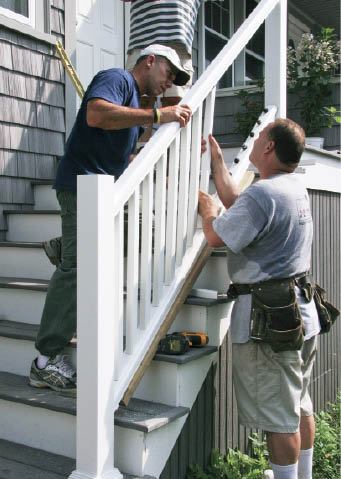
Graspable rail. Though the requirement for graspable
handrails on stairs is rarely enforced on residential decks,
the top rails of most manufactured railings are too wide to
comply. If the inspector is strict, however, many products are
available with ADA- and code-compliant secondary rails, usually
a cylindrical aluminum core with a vinyl cover (Figure
11).
David Frane is a senior editor at
JLC.