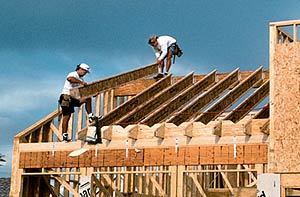
While many builders have incorporated I-joist floor systems into their standard construction, roof framing with wood I-joists remains somewhat of a mystery. Roofs tend to be more complicated than floors, so it’s natural that builders accustomed to stick framing might be cautious about using wood-I’s instead of solid-sawn rafters. But for certain kinds of roof configurations, wood I-joists may work better than dimension lumber — long-span cathedral ceilings are a good example. My purpose here is to clarify the differences between solid lumber and wood I-joists, and to provide some hints to make roof framing with wood I-joists easier. I-Joist Roof vs. Conventional Framing The first thing to understand is how a roof framed with wood I-joists differs structurally from a traditional stick-framed roof. In a typical roof framed with dimension lumber, the rafters rest on the exterior wall top plate at the lower end and bear against a ridge board at the top. Continuous ceiling joists or collar ties span from rafter to rafter. There is no need for bearing posts under the ridge board, which is nonstructural. The roof loads are carried to the top plates of the bearing walls, where the floor joists, acting in tension, keep the rafter ends from spreading out. What you have here is essentially a truss, built on site. The strength of the roof system depends a lot on the connections between the joists and the rafter ends: As long as those nails are adequate for the loads and don’t slip, the rafters are restrained from pushing out, the ridge board is compressed in place at the top, and the roof doesn’t sag (see Practical Engineering, 5/96, for more on this topic). With wood I-joists, there is no practical way to make a strong shear connection between the floor joists and the rafter ends. Instead, a wood I-joist roof system is framed with either a central bearing wall or a structural ridge — a beam that carries the roof load to posts. The load from the top half of the roof is carried by the bearing wall or structural ridge; the bottom half is carried by the exterior bearing walls. The loads are primarily gravity loads, which push down, not out, on the bearing walls. So there is no need to engineer a connection between the floor or ceiling joists — if there are any — and the rafter ends. In my work as a field rep for Trus Joist MacMillan, most of the wood I-joist roofs I see use a structural ridge beam rather than a center bearing wall. But whether you use a ridge beam or a bearing wall, there are two ways to support the joists at the upper end: with hangers or a beveled bearing plate (see “”). The important point to remember is that no birdsmouth cuts are allowed at the high end of the I-joist. This would mean cutting through the bottom flange at the bearing point, which would damage the I-joist. Using Hangers at the Ridge
The most common method is to use a face-mount hanger with a sloped seat (see Figure 1 and “,”) such as the Simpson LSSU series or the USP (Kant-Sag) TMU.
Figure 1. Sloped-seat hangers can be adjusted in the field to match the slope of the roof. These hangers require a plywood or lumber web stiffener on both sides of the I-joist to fill out the space between the hanger and the web. |
These hangers can be adjusted in the field to match the I-joist slope, and can be skewed side to side up to 45° for hip-and-valley jack rafters.
Web stiffeners.
The sloped-seat hanger requires a beveled web stiffener on both sides of the I-joist to fill out the space between the hanger and the web. You can rip stiffener material out of plywood (the thickness depends on the I-joist size), then production-cut it on a chop saw to the right length. For larger I-joists, use 2x4s for the stiffeners. Make sure you check the manufacturer’s literature for the proper stiffener size and thickness — it may vary from brand to brand. Plywood stiffeners should be attached with three 8d nails with points clinched. For 2×4 stiffeners on the larger I-joists, use three 16-penny nails. It’s a good idea to drive two nails from one side. It’s important to install stiffeners with a gap at the top (we recommend 1/4 inch). This prevents the top flange from prying off the joist web under load.
More from Journal of Light Construction
-

-
Emanuel Silva: The Case for Small Jobs
4 MIN READ
-
The Dangers of Poly Vapor Retarders
6 MIN READ